How to Choose the Right Android Tech Stack & Developers for Your Project

How to Choose the Right Android Tech Stack & Developers for Your Project
Everything You Need to Know Before Finalizing Your Tech Stack and Development Team
Why Choosing the Right Tech Stack Matters for Android Apps
Selecting a technology stack is not solely a technical issue — it establishes the limits of your app's performance now and how easily it can be changed later. The technology stack of your choice has an impact on performance, stability, compatibility with devices, maintenance costs, scalability, and speed of development, among other things.
An erroneous selection at the beginning may result in technical debt, poor performance, bug infestation, or expensive rewrites.
It is imperative to pause and assess your application's objectives, limitations, and long-term plan before writing a single line of code.
What to Think About — Key Considerations Before You Decide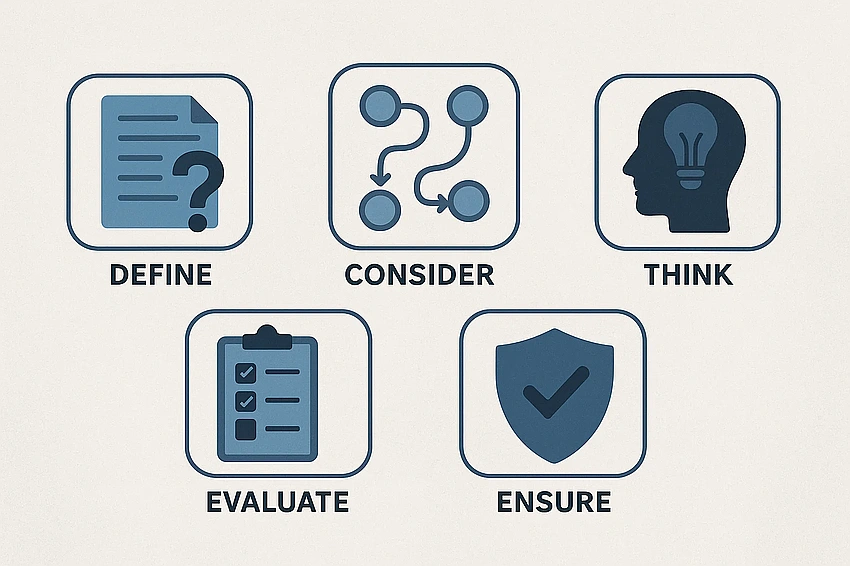
Define App Purpose, Features & Complexity
To start with, you need to recognize the main goal of your app. Is it just to do simple tasks or is it a sophisticated one for the whole company which needs online and offline scenarios, data steaming in real-time, top-notch UI, and deep device integration?
The degree of sophistication of your app should suggest the technology options to you.
Consider Target Audience, Platform & Device Capabilities
The Android system is compatible with a very wide variety of devices, ranging from inexpensive ones to the most sophisticated ones.
A thorough understanding of your target audience will enable you to select the best tools that will give the required level of performance on the devices they use.
Think About Scalability & Future Growth
If there will be an increase in the number of users or the functions of the application, then choose a stack that will be letting you build modular systems, as well as easy-to-maintain ones.
Doing this will make sure that there will not be any bottlenecks and that costs for architectural changes will not be incurred in the future.
Evaluate Time-to-Market, Budget & Resources
Some stacks will let you have the quickest development but at the cost of losing performance.
Other ones will be stable in the long run but will take more time, cost, and expertise.
Make sure that your stack selection corresponds with your timelines and the developer resources you have.
Ensure Security, Maintenance & Long-Term Support
From the first day, security has to be considered — especially for apps that are dealing with sensitive data or payments. Go for tech and libraries that are actively supported, have good community backing, and which are getting regular updates.
Match Stack to Team Expertise or Hiring Feasibility
Your project should not only reflect the skill sets of your current employees but also the skills you can easily train for.
This is also where many companies decide to 🔗Hire Android App Developers 🔗 to fill expertise gaps and ensure smooth execution.
Opting for specific or outdated technologies may add to the delays, risks, and costs.
| Also read: Transform Mobile App Development with the Best Android Application 🔗
Core Components of a Modern Android Tech Stack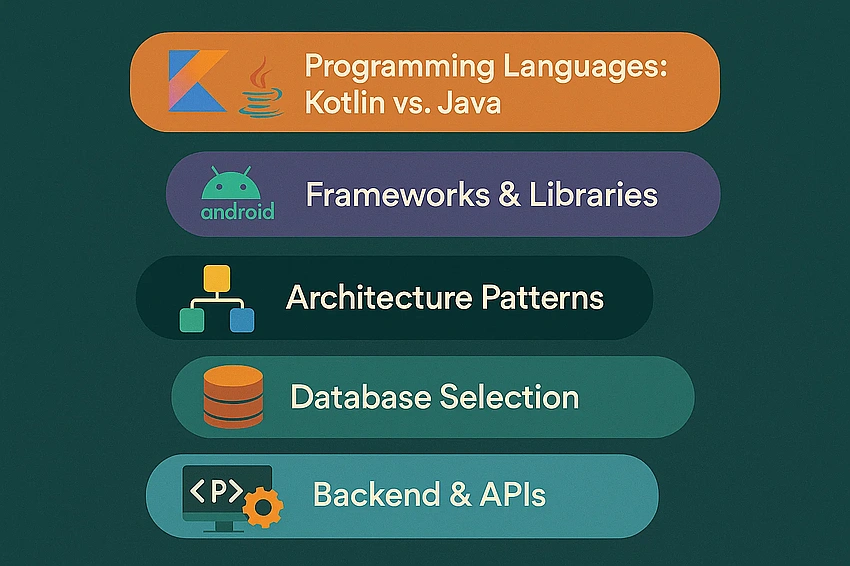
1. Programming Languages: Kotlin vs. Java
Kotlin has become the primary choice for Android development owing to its modernity. The language has the features of a concise syntax, null-safety, and complete interoperability with Java. It is Google’s favorite and the best choice for creating Android apps that are solid and capable of scaling.
Java is not out of the picture since it can help when dealing with legacy systems, enterprise applications, or slowly transitioning teams.
2. Frameworks & Libraries
Jetpack Components: ViewModel, LiveData, Room, Navigation
- Retrofit / OkHttp for networking
- Hilt / Dagger 2 for dependency injection
- Coroutines for asynchronous programming
- Glide / Coil for image loading
All these tools not only assist in making the software development process uniform but also enhance its overall quality.
3. Architecture Patterns
The selection of architecture is crucial for clean and scalable code. MVVM (most Android apps) is one of the common ones (recommended), MVI (great for predictable state management), Clean Architecture for enterprise-level apps, etc.
Good architecture also facilitates the collaboration with Dedicated Development Teams.
4. Database Selection
- Room (SQLite's representation in a simpler way)
- Realm (allows for instantaneous syncing at a remarkable speed)
- Firebase Realtime DB / Firestore (cloud-based and easily expanded)
Make your selection based on the need for real-time, offline capabilities, and the amount of storage available.
5. Backend & APIs
Your Android app can communicate with the following:
- Bespoke APIs
- Third Party Services
- Integration with Other Services
If your project involves a complex SaaS platform, a technology partnership with SaaS Consulting & Development Services will result in a safe and scalable backend architecture.
How to Pick the Perfect Android Developers
1. Technical Proficiency in Core Android Stack
It’s better to consider developers who have experience with:
- Kotlin & Java
- Jetpack libraries
- Design patterns
- CI/CD workflows
- Modular codebase structures
Developers who are professional in 🔗Android Development Services 🔗 can guide you through the process faster by implementing best practices and using reusable components.
2. Experience with Similar Projects
- See if their portfolio has:
- Real-time applications
- Scalable consumer apps
- Enterprise-grade solutions
- Apps that need APIs, cloud, or AI integration
This guarantees they are aware of the difficulties that come with app building and have the knowledge to solve them.
3. Understanding UI/UX for Android
The developer should comprehend Material Design, usability standards and user-friendly navigation design.
4. Cooperation & Communication Skills
Workmates should feel at ease with:
- Agile procedures
- Code assessing
- Version control practices
- Inter-team discussions
For lasting or extensive products, often firms Hire Android App Developers through a specialized hiring model to maintain uniform quality and collaboration through the Developer.
Building Your Android App: In-House vs. Outsourcing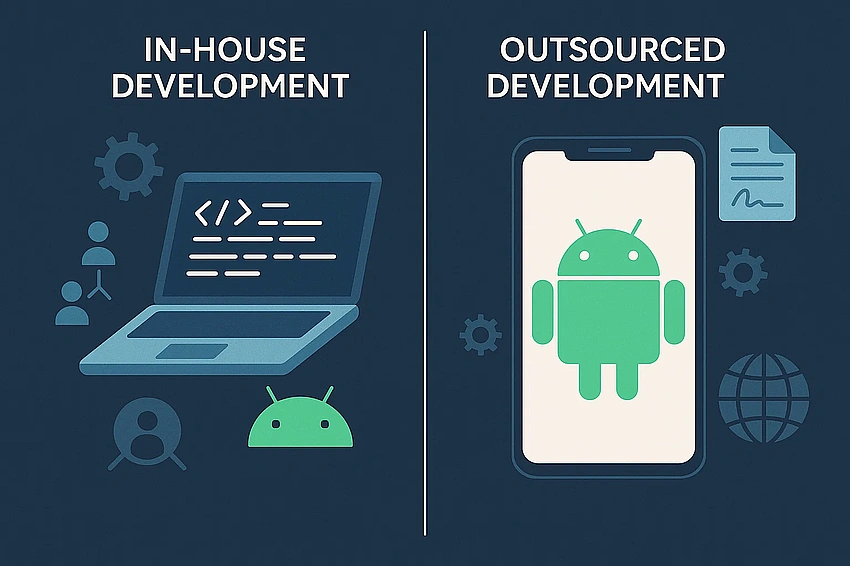
In-House Development
In-house development is best for companies that have tech teams and those that require controlling the entire process at every stage tight. Nonetheless, it takes a lot of time and moneys to hire full-time engineers.
Outsourced Development
It is absolutely perfect to work with an external team when:
- You want a quick time-to-market
- You need a specialized talent
- You are creating a high-skill or complex product
A great number of companies opt for 🔗Software Development Services 🔗 in order to obtain the right expertise without incurring the hiring costs.
| Also read: 🔗Top Companies to Hire Android Developers in 2025 🔗
Conclusion
Choosing the Android tech stack and the development experts that are the best and hottest is not only a technical question—this very decision will soon affect your application's performance, scalability, and, consequently, the whole market's success. If you properly evaluate your architecture, your tools, and the developers' skills, you will have no trouble making a trustworthy app that will get not only seen but also acknowledged among the rival Android apps.
If you are thinking about the expansion of your product or the addition of more complex features later on, then going for the right technology and the right team layout from the start will not only save you time but will also reduce the cost and effort.
