Infinite Scroll Killed Boredom (and Maybe Philosophy)

Infinite Scroll Killed Boredom (and Maybe Philosophy)
Infinite scroll isn't just a UI trick; it's a philosophical intervention. Explore how this design choice reshaped our experience of time, memory, and the very concept of boredom, impacting creativity and thought.
Digital interfaces are more than just tools; they're architects of our perception. Consider the infinite scroll, and its cousin, pull-to-refresh. These aren't just clever user experience hacks designed to boost engagement metrics.
They represent a fundamental reshaping of how we interact with information, time, and even our own minds.
The Vanishing Horizon of Information
Historically, content had boundaries. Books had pages, newspapers had folds, television shows had ends.
Even early websites had 'next page' buttons.
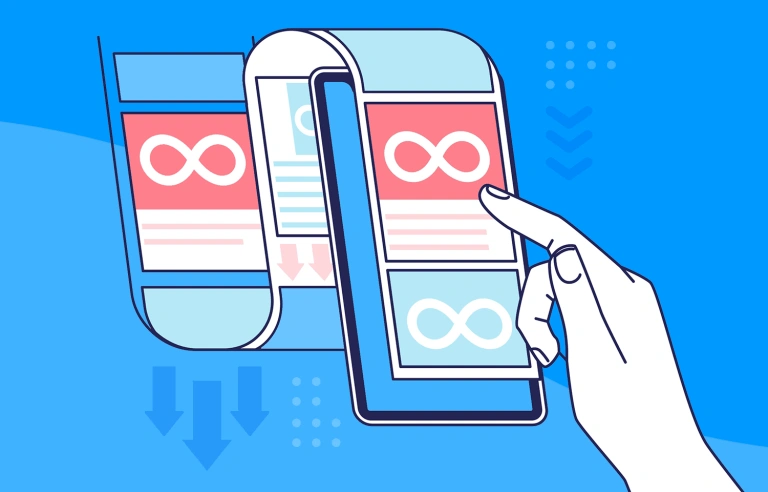
These were natural stopping points, giving us a sense of completion, a micro-moment to pause, reflect, or simply stop . Infinite scroll eliminated this horizon. The stream is endless, bottomless.
This design choice, initially aimed at maximizing 'time on site', subtly eroded our cognitive cues for closure.
 Rewiring Boredom: A Philosophical Cost
The most profound impact of this continuous feed is on boredom. For centuries, boredom wasn't merely an empty state; it was often a fertile ground. Thinkers from Pascal to Kierkegaard recognized it as a catalyst for contemplation, creativity, and the birth of high philosophy and art.
That restless mental space, that urge to fill the void, often led to profound insights.
Today, boredom is an enemy to be instantly vanquished. The moment a thought threatens to surface, the scroll offers a fresh dopamine hit. We've been conditioned to fear the void, not to embrace its potential.
This constant stimulus short-circuits the very mechanism that historically drove deep thought and innovative expression.
As philosopher Byung-Chul Han notes, “The world, as a project, comes to an end in boredom.” What happens when the world never ends, when the feed perpetually offers new distractions, ensuring no project (or thought) truly begins in the space of boredom?
 Memory, Time, and the Ephemeral Scroll
The endless stream also distorts our sense of time and memory.
Without distinct 'pages' or 'ends' to anchor content, information blurs into an undifferentiated mass. Did I see that post an hour ago, or yesterday?
Was it on this platform or another? The linearity of experience is fragmented, making recall difficult. Each refresh or scroll buries the past further, prioritizing the immediate and the new, contributing to a collective amnesia of the recent digital past.
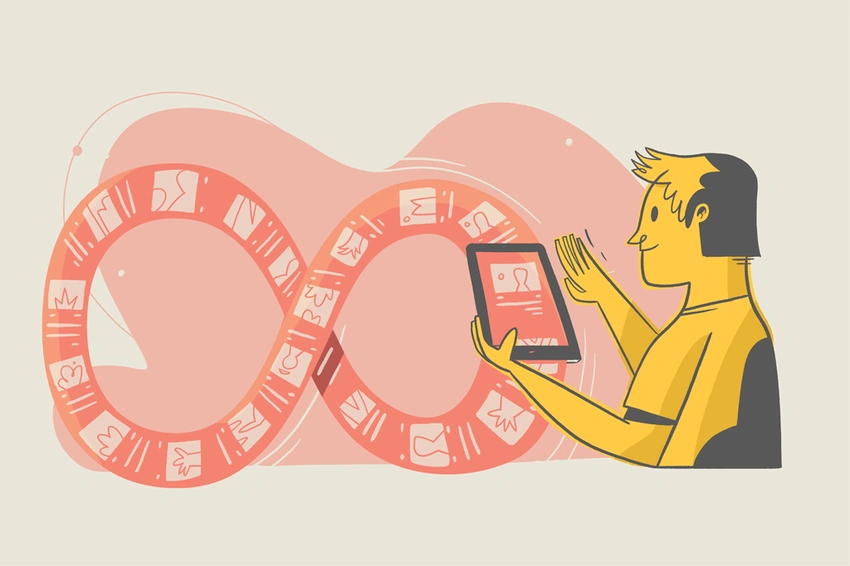
It's about a lack of anchoring . Our brains thrive on structure and categorization. Infinite feeds deny us this, creating a flat, ephemeral landscape where everything is equally present, and therefore, nothing truly stands out or sticks.
 Design's Unintended Philosophers
Designers, perhaps unknowingly, have become profound philosophical agents. The choices we make about interface elements aren't neutral; they carry implicit assumptions about human nature, attention, and value.
The infinite scroll, initially a metric-driven optimization, has inadvertently reshaped our cognitive landscapes, reducing moments of unstructured thought and potentially limiting the very conditions that foster deep human creativity and reflection.
As we craft the digital future, it's crucial to move beyond mere engagement metrics.
We must consider the epistemological and existential implications of our design choices. Are we building platforms that empower human thought, or merely addicting users to an endless present?
