Managed Live Production Services vs. In‑House Streaming Infrastructure

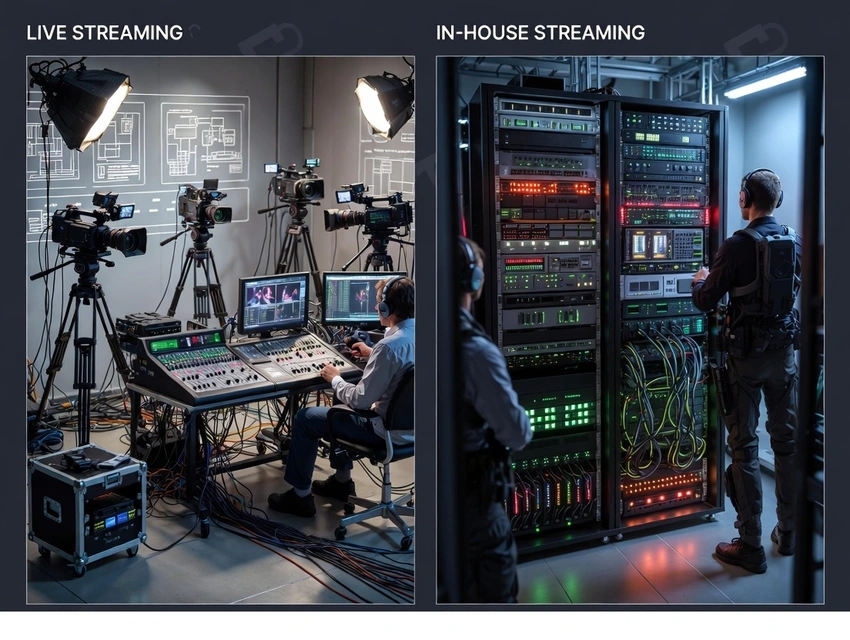
Managed Live Production Services vs. In‑House Streaming Infrastructure
In today’s digital era, audiences expect real‑time access to events, experiences, and content no matter where they are. Whether it’s a global corporate event, an esports tournament, a product launch, or a live concert, organizations face the continuous challenge of delivering high‑quality streams that engage, inform, and delight. Two primary approaches have emerged for executing live broadcasts: partnering with managed live production services 🔗 or building and maintaining an in‑house streaming infrastructure.
This article explores these two paradigms in depth, examining costs, capabilities, scalability, operational demands, technology requirements, security considerations, and overall strategic fit. Within the following comparison, we will look at real‑world applications, best‑practice guidelines, and the pros and cons of each approach. Ultimately, the goal is to help organizations make an informed decision about which model better supports their goals.
To begin, let’s clarify what live production services entail and why so many modern businesses are adopting them in place of traditional internal models.
What Are Managed Live Production Services?
Managed live production services refer to third‑party providers that handle the full technical and operational aspects of live streaming and video broadcasting on behalf of an organization. This includes everything from camera setup, switching, and encoding to distribution, content management, and viewer analytics.
These services are often delivered by specialized media and technology companies with deep experience in streaming workflows. They handle the infrastructure, operations, and staffing allowing enterprises to focus on their core mission and content rather than the complexities of live production.
What Is In‑House Streaming Infrastructure?
By contrast, an in‑house streaming infrastructure is built, maintained, and operated entirely by an organization’s internal team. This means the enterprise is responsible for:
- Hardware procurement and maintenance (cameras, mixers, encoders, servers, networking)
- Software solutions for encoding, transcoding, content management systems (CMS), and player integration
- Staffing for technical operations, broadcast control, and troubleshooting
- Network reliability and security
- Backup and disaster recovery
Each live event requires active participation from the internal team from setup to teardown and technical expertise is essential to avoid failures.
Historical Context: Why Live Video Matters More Than Ever
Live video has grown exponentially in recent years. Platforms like YouTube Live, Facebook Live, Twitch, and LinkedIn Live have made streaming accessible to businesses, creators, and individuals. According to a 2022 Cisco study, video traffic will account for 82% of all internet traffic by 2026, a number that continues to climb as streaming technologies improve.
Live streaming isn’t just entertainment it has become a communication staple for organizations worldwide. It supports:
- Remote conferences and training
- Town halls and leadership messages
- Hybrid events
- Product launches
- Sports and esports broadcasting
- Worship services and community events
As such demand continues to grow, so does the need for reliable, high‑quality streaming delivery. But how should organizations achieve that?
Capability Comparison: What Each Model Offers
Production Quality and Technical Expertise
Managed Live Production Services
Managed services have deep experience in delivering professional broadcast quality. Providers typically:
- Employ trained technicians familiar with multi‑camera switching, audio mixing, graphic overlays, and encoding best practices
- Use proven workflows that reduce the risk of stream dropouts and errors
- Integrate advanced features such as instant replay, highlight generation, multi‑angle production, and augmented graphics
This level of expertise is difficult and costly for most organizations to replicate internally.
In‑House Streaming Infrastructure
In‑house teams can achieve high quality if the organization has the right talent. However:
- Recruiting and retaining qualified broadcast engineers is expensive
- The organization must invest in ongoing training to keep up with industry standards
- Less frequent events mean skills may atrophy
Smaller teams often struggle to match the consistency and polish of experienced managed service providers.
Technology and Tools
Managed service providers often have access to cutting‑edge tools because they serve many clients and can amortize technology costs across projects. This includes professional‑grade encoders, multi‑CDN delivery networks, graphics engines, and production automation tools.
Organizations with in‑house infrastructure must purchase and maintain these technologies outright. Investing in high‑end broadcast hardware and software represents significant capital expenditure (CapEx) and ongoing operations expenditure (OpEx).
Cost Comparison: Controlled Budget vs. Capital Investment
One of the biggest decision points between managed services and in‑house infrastructure is cost structure.
Managed Live Production Services
Pros
- Predictable operational costs (typically subscription or service fees)
- No upfront capital investment for hardware and infrastructure
- Costs scale with usage pay more when you stream more
- Lower risk of unexpected hardware failure or maintenance costs
Cons
- Over time, service fees can add up, especially for high‑volume users
- Some services may charge extra for premium features (e.g., advanced graphics, CDNs)
In‑House Streaming Infrastructure
Pros
- Ownership of hardware and technology
- Potentially lower long‑term operating costs if volume is high
- Full control over every aspect of the stack
Cons
- High upfront capital cost for servers, encoders, networking, cameras, and storage
- Ongoing maintenance, upgrades, and support costs
- Need for dedicated engineering staff
To decide on cost effectiveness, organizations should perform a total cost of ownership (TCO) analysis that includes equipment depreciation, staff salaries, software licensing, and data transport costs over a 3–5 year period.
Scalability and Flexibility
Large events or sudden spikes in viewership require infrastructure that can scale.
Managed Services
Managed live production vendors typically leverage cloud infrastructure and Content Delivery Networks (CDNs) that can scale globally with minimal effort. They also often work with multi‑CDN strategies improving reliability and global performance by distributing traffic across multiple providers.
This makes managed services particularly suitable for organizations with unpredictable or rapidly growing viewership.
In‑House Streaming Infrastructure
Scaling an in‑house system means buying more hardware, allocating more bandwidth, and potentially investing in more data center capacity. Without cloud‑native design, internal infrastructures can quickly become bottlenecks.
While hybrid models (local production + cloud streaming) exist, full scalability often requires significant resources.
Time to Market and Operational Burden
Organizations seek fast, reliable solutions. The time it takes to go live is a competitive advantage.
Managed Services
With experienced providers, organizations can often launch live streams quickly sometimes within hours. Managed services handle setup, testing, content routing, and monitoring. This allows internal teams to focus on messaging and event content.
In‑House Infrastructure
Building and maintaining your own streaming environment is time‑intensive. Installation, testing, and configuration cycles can take weeks or months, especially if the team is learning new tools. Ongoing operational support consumes staff time that could be better spent on strategic initiatives.
Security, Privacy, and Compliance
Security is a rising concern in today’s digital ecosystem.
Managed Live Production Services
Reputable providers invest in security controls such as encryption, access management, secure CDN delivery, and compliance certifications (e.g., ISO standards). This offloads an important responsibility from the organization.
However, this also means trusting external systems with sensitive content and possibly user data a concern for regulated industries.
In‑House Streaming Infrastructure
In‑house infrastructures give organizations granular control over security, user access, rights, and data residency. This is especially attractive to organizations with strict compliance requirements (government agencies, healthcare, finance).
However, achieving this level of control internally requires strong security expertise and continuous monitoring.
Use Cases and Ideal Scenarios
Let’s examine when each approach makes sense:
Best Fit: Managed Live Production Services
- Organizations with infrequent or sporadic live events
- Without consistent usage, investing in infrastructure isn’t cost‑effective.
- Teams with limited technical broadcast expertise
- Managed providers bring experience and reduce risk.
- Global live events with large audiences
- Scalability and reliability are best handled by services that specialize in global delivery.
- Enterprises focusing on content, not technology
- Frees creative teams from technical burden.
- Companies needing comprehensive support and monitoring
- 24/7 operational support is often included.
An example area where managed services excel is 🔗enterprise live streaming 🔗 enabling internal communications, product launches, and large‑scale corporate events without requiring heavy investments.
Best Fit: In‑House Streaming Infrastructure
- Organizations with daily or constant streaming needs
- Example: newsrooms, sports networks, broadcast houses.
- Companies requiring strict control over data and security
- Government agencies and financial institutions often prefer internal systems.
- Teams with in‑house broadcast expertise
- When staff and resources already exist, internal systems may make sense.
- Organizations planning long‑term investments
- If use is predictable and continuous, ownership may be worthwhile.
Hybrid Models: A Balanced Middle Ground
It’s worth noting that many organizations adopt hybrid approaches, combining both managed services and in‑house components.
For example, a company might:
- Use internal infrastructure for routine internal meetings and training
- Tap into managed live production services for major events or global broadcasts
- Use in‑house tools for encoding while outsourcing CDN delivery
Hybrid models offer flexibility, allowing organizations to adapt based on event size, audience, and budget.
Performance, Reliability, and Uptime
When live events go wrong buffering, dropout, sync issues viewers disengage, and reputational harm can occur.
Managed Live Production Services
Managed service-level agreements (SLAs) often guarantee uptime and performance metrics. Vendors invest heavily in:
- Redundant paths for data delivery
- Multiple CDNs
- Monitoring and failover systems
This makes managed services attractive for mission‑critical events.
In‑House Streaming Infrastructure
Achieving the same reliability internally requires:
- Redundant servers
- Multiple ISPs and backup networks
- Dedicated monitoring teams
Most organizations cannot match the performance resilience offered by specialized vendors without significant investment.
Support, Maintenance, and Expertise
A key advantage of managed services is the expert support that comes bundled with the service. Live broadcast operations are inherently risky; technology can fail, networks can lag, and unanticipated challenges arise.
Managed providers typically offer:
- Proactive monitoring
- Real‑time troubleshooting
- Technical account managers
- Post‑event reporting and analytics
Internal teams must handle all of this themselves which can strain internal resources and distract from core business priorities.
Innovation and Future Trends
Live streaming technologies continue to evolve rapidly. Innovations include:
- AI‑based camera tracking
- Real‑time graphics and augmented reality overlays
- Low‑latency streaming (e.g., CMAF, WebRTC‑based workflows)
- Personalized streaming experiences
Managed services frequently adopt and deploy these innovations faster than in‑house teams because of economies of scale and focus on technology advancement. By contrast, internal teams may struggle to keep pace without substantial investment.
A recent example of emerging standards is the adoption of Common Media Application Format 🔗 (CMAF) for low‑latency delivery, enabling real‑time interaction at scale.
Choosing the Right Approach
Both managed live production services and in‑house streaming infrastructure have valid applications. However, the ideal choice depends on an organization’s goals, budget, technical expertise, and long‑term strategy.
Choose managed services if you need:
- Scalability beyond internal capability
- Professional broadcast quality with minimal internal effort
- Lower operational burden and predictable costs
- Rapid deployment and flexible support
Choose in‑house if you need:
- Total control over technology and data
- Continuous, high‑frequency live operations
- Strong internal broadcast expertise
- Long‑term cost effectiveness at high usage volumes
In many cases, a hybrid strategy delivers the best balance leveraging third‑party providers for large events while maintaining internal infrastructure for routine needs.
As live streaming continues to become a cornerstone of digital communication, organizations that strike the right balance between capability, cost, and control will be best positioned for success.
