The Architecture of Absolution: D.D. Kosambi and the Marxist Deconstruction of the Bhagavad Gita


The Architecture of Absolution: D.D. Kosambi and the Marxist Deconstruction of the Bhagavad Gita
D.D. Kosambi’s radical Marxist deconstruction of the Bhagavad Gita as a product of class struggle and material history.
For generations, the Bhagavad Gita has been approached as a text suspended outside of human time. To the faithful, it is the eternal, unalterable word of the divine, spoken on the precipice of a cosmic war. To the early Western Orientalists, it was an exotic, mystical puzzle of the East, a text to be analyzed purely for its linguistic roots or its otherworldly idealisms. Even during the Indian national movement, leaders like Bal Gangadhar Tilak and Mahatma Gandhi treated the Gita as a timeless ethical reservoir, drawing from it templates for active resistance or radical non-violence. But in 1962, a polymath named Damodar Dharmanand Kosambi shattered this tradition of scriptural idealism.
Writing his landmark essay, "The Historical Development of the Bhagavad Gita" (published in Myth and Reality), Kosambi brought the text down from the heavens and firmly planted it into the soil of ancient Indian material reality. As a Marxist historian, statistician, and mathematician, Kosambi rejected the idea that any text could be understood independent of the economic conditions of its authors and its audience. He did not ask what the Gita meant in the abstract; he asked what the Gita did for the shifting class structures of ancient and medieval India.
The result was a brilliant, deeply controversial, and enduringly sharp critique. Kosambi unmasked the Gita not as a flawless piece of divine philosophy, but as a highly sophisticated ideological tool—an elastic, contradiction-ridden text that successfully greased the wheels of Indian feudalism and stabilized a changing socio-economic order.
The Method: Historical Materialism vs. Scriptural Idealism
To understand Kosambi’s critique, one must first understand his tool: historical materialism. In the traditional study of Indian history, texts were taken at face value. If a text claimed a golden age existed under a certain king, historians recorded it as fact. Kosambi flipped this methodology on its head. He argued that the true history of a society is found in its base, how people produce food, clear land, exchange goods, and organize labor. The culture, religion, laws, and scriptures are the superstructure, which grows out of and serves to protect that material base.
When applied to the Gita, this methodology yielded a radical insight. Kosambi realized that trying to find a single, coherent, timeless philosophy in the Gita was an exercise in futility because the text itself was a composite document, altered over centuries to reflect changing material realities.
Kosambi noted that the Gita we read today is full of deep, unresolved philosophical contradictions. It shifts rapidly between the dualism of Samkhya philosophy, the non-dualism of the Upanishads, the ritualism of the old Vedic religion, and the emotional surrender of Bhakti. While traditional theologians spent centuries trying to intellectually harmonize these contradictions, Kosambi arrived at a far more pragmatic conclusion: the contradictions were the entire point.
The Dialectics of Samanvaya (The Utility of Contradiction)
Kosambi coined a vital concept to explain the text's internal friction: Samanvaya, which translates to reconciliation, synthesis, or compromise.
In the eyes of a Marxist historian, the period during which the Gita was compiled and expanded (roughly between the late Mauryan empire and the dawn of the Gupta dynasty) was a time of immense social fragmentation. The old Vedic tribal structures were dead. New empires were rising and falling. Competing religious sects—Buddhism, Jainism, various local cults, and orthodox Brahminism—were locked in a fierce battle for cultural and political dominance.
Had the Gita taken a rigid, singular philosophical stance, it would have become the text of just one faction. Instead, its authors executed a brilliant stroke of ideological synthesis.
"The core of the Gita is this dialectical reconciliation of opposites. It allows the reader to focus on whatever doctrine suits their immediate material or spiritual need, while quietly ignoring the verse that contradicts it." - D. D. Kosambi, Myth and Reality
Think of how this functioned among the ruling elites. A king looking to wage an aggressive war of conquest could turn to Chapter 2, where Krishna explains that the soul is immortal, meaning that killing enemies on the battlefield is an illusion because nothing truly dies. At the very same time, a wealthy merchant or a conservative priest looking to maintain social order could turn to Chapter 4, where the text reinforces the divine absolute nature of the caste hierarchy.
By integrating disparate ideas into a single, beautifully composed poem, the Gita acted as a peace treaty for the upper classes. It provided a shared ideological vocabulary that united different factions of the ruling elite, allowing them to form a cohesive block capable of managing the lower strata of society.
The Feudal Nexus: Bhakti as the Ideology of Fealty
The most powerful and original component of Kosambi’s critique is his analysis of Bhakti (devotion/surrender). In spiritual discourses, Bhakti is celebrated as the ultimate democratization of religion—a path to God that requires no complex rituals, no expensive sacrifices, and no advanced literacy. It requires only love and total surrender to the divine.
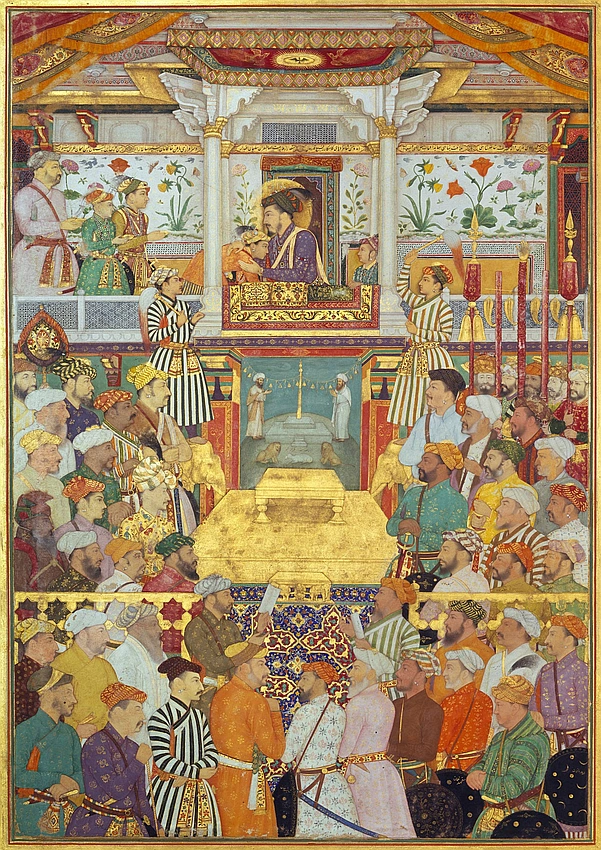
Kosambi, however, looked past the spiritual beauty of Bhakti to analyze its economic utility. He observed that the rise of Bhakti in Indian religious life precisely mirrored the rise of feudalism as the dominant economic system of the Indian subcontinent.
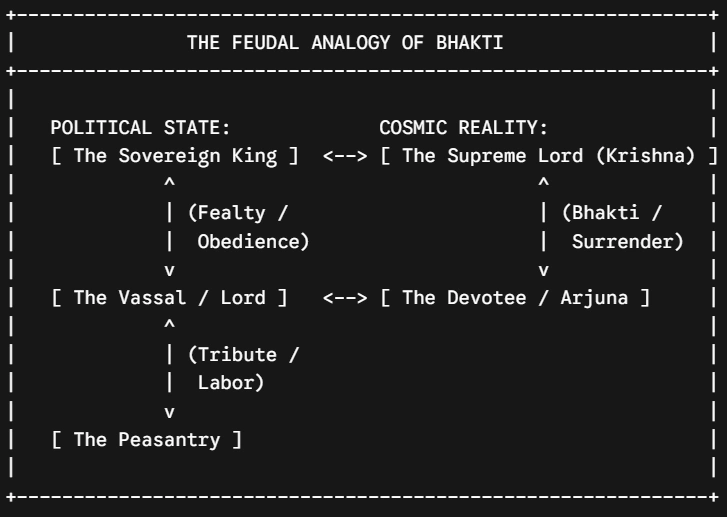
As large, centralized empires like the Mauryan state collapsed, power became radically decentralized. The land was carved up into a complex network of local lords, regional barons, and vassal kings. In such a fragmented world, how do you maintain political cohesion? You cannot rely on a massive, centralized standing army because the infrastructure is too fractured. Instead, the entire economic and military survival of the state depends on an invisible chain of personal, absolute loyalty.
The vassal lord had to swear absolute fealty to his king, promising to send troops and taxes whenever called upon. In return, the local peasant had to show absolute obedience to the landlord.
Kosambi argued that Bhakti was the perfect ideological reflection of this material reality. When Krishna demands that Arjuna abandon all other duties and simply surrender to him ("Sarva-dharman parityajya mamekam sharanam vraja"), he is providing the cosmic blueprint for the feudal contract.
By framing absolute, unquestioning psychological surrender to a higher master as the highest spiritual virtue, the superstructure of the Gita trained the population to accept the material relations of fealty. To disobey your worldly lord was to show a lack of the very same discipline required to serve the heavenly Lord. Bhakti made political submission feel like a path to spiritual enlightenment.
The Material Transition: From Pastoral Tribes to Agrarian Fields
To fully appreciate why the Gita became so vital when it did, Kosambi traced the profound economic transition ancient India was undergoing.
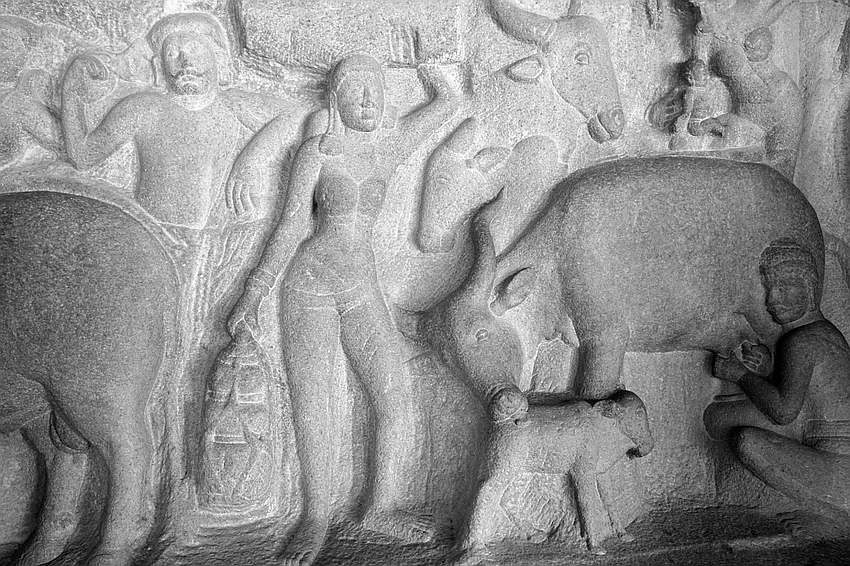
During the early Vedic period, Indian society was largely pastoral and tribal. Wealth was measured in cattle, and production was organized around small, tightly knit clans. Religious life matched this base: it revolved around massive, expensive animal sacrifices (Yajnas) managed by the Brahmin priests. These sacrifices were functional for a pastoral elite who had cattle to burn and raw wealth to display, but they became a massive economic drag as society began to change.
With the discovery of iron and the clearing of the dense forests of the Gangetic plain, India transitioned into a settled, agrarian economy. Agriculture requires a completely different material logic than pastoralism:
- You cannot routinely slaughter thousands of cattle for religious rituals; you need those oxen to plow the fields.
- You cannot rely on tribal clan loyalty when managing vast tracts of agricultural land worked by a diverse, multi-ethnic population of conquered tribes and laborers.
The old Vedic religion was structurally incompatible with this new agrarian mode of production. Buddhism recognized this early on, gaining massive support from the merchant classes (Vaishyas) and regional kings by explicitly banning animal sacrifice and critiquing the rigid tribal structures.
The Gita represents the Brahminical response to this crisis. It gracefully moved the locus of religion away from the expensive, bloody public Yajnas of old and relocated it to the internal, private sphere of personal duty and devotion. Krishna redefines sacrifice itself in the text, arguing that offering a single leaf, fruit, or drop of water with pure devotion is superior to the old rituals.
By making religion portable, affordable, and deeply internalized, the Gita allowed the agrarian ruling classes to maintain religious hegemony without draining the economic resources needed to sustain the agricultural base.
The Elasticity of Ethics and the Pacification of Labor
A major target of Kosambi's critique was the celebrated ethical core of the Gita: Nishkama Karma (acting without attachment to the results).
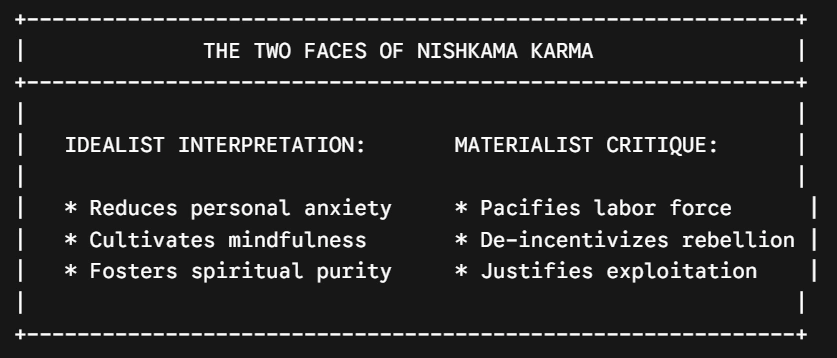
In standard philosophical readings, this doctrine is viewed as a sublime tool for mental liberation. It teaches the individual to focus entirely on the quality of their effort, shedding the paralyzing anxiety of success or failure. It is an ethics of pure intention.
Kosambi’s materialist lens, however, exposed the deep political utility of this doctrine for class pacification. If you are a member of a dominated class—a low-caste laborer tilling fields that belong to a feudal lord—the doctrine of Nishkama Karma carries a chilling systemic implication:
- It tells you that you have an absolute obligation to perform your labor (Karma).
- It simultaneously warns you that demanding the rewards, profits, or fruits of that labor (Phala) is a spiritual failing.
If a worker sincerely believes that desiring a better wage, a share of the harvest, or an improvement in material conditions is an act of selfish attachment that delays soul liberation, the ruling class no longer needs to rely purely on physical violence to prevent strikes or rebellions. The ideology does the policing for them. The worker pacifies themselves in the pursuit of spiritual purity.
Furthermore, Kosambi emphasized the extreme "elasticity" this doctrine afforded the rulers. Because the morality of an action was no longer judged by its visible material consequences, but rather by the inner detachment of the person doing it, the ruling elite could easily absolve themselves of systemic violence. A king could order the execution of rebels or wage an aggressive war of expansion, yet remain entirely "sinless" under this framework, provided he convinced himself he was doing it purely as a matter of detached caste duty.
Historical Convergences: Kosambi and Ambedkar
Though D.D. Kosambi approached the Gita through the lens of Marxist economic history and Dr. B.R. Ambedkar analyzed it through the lens of caste oppression and legal philosophy, their structural conclusions share a remarkable synergy. Both intellectuals saw the text as a profoundly political document wrapped in the language of the divine.
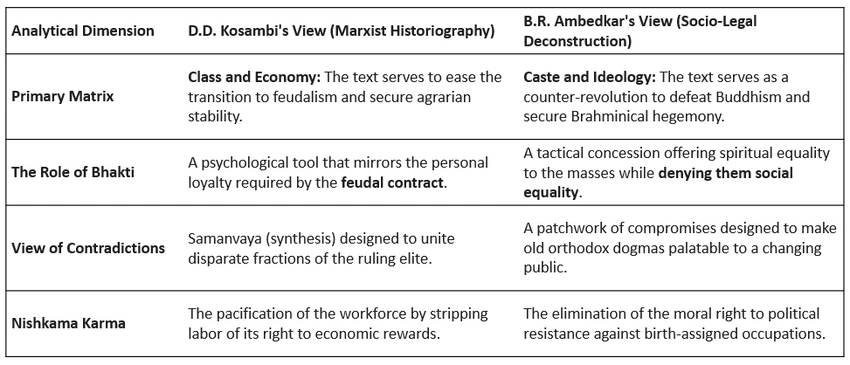
Where Kosambi saw the text gracing the wheels of an evolving feudal mode of production, Ambedkar saw it building an ideological fortress around the unequal social division of labor. Together, their critiques form a comprehensive pincer movement against scriptural idealism, forcing readers to reckon with the real-world, human casualties of systemic philosophies.
The Enduring Superstructure
D.D. Kosambi did not write his critique to diminish the artistic, literary, or poetic brilliance of the Bhagavad Gita. As a scholar of Sanskrit literature, he deeply appreciated its aesthetic genius. Rather, his work served as a vital warning against reading ancient texts through a lens of uncritical romance.
The ultimate testament to Kosambi’s thesis of the Gita's "structural elasticity" is visible in how the text continues to function today. Because it was constructed as a beautiful synthesis of contradictions, it remains infinitely malleable. It can be utilized by an industrial capitalist to encourage loyalty among corporate employees, by a revolutionary to justify a fight against injustice, or by a politician to whip up nationalist fervor.
By exposing the material foundations of the Gita, Kosambi did something far more profound than providing a mere textual commentary. He gave us a masterclass in how ideas become weapons, how philosophy serves power, and how a text written in the dim light of antiquity can continue to shape the political boundaries of the modern world.
