What Happens When an Artist Decides That Caring Is Political
What Happens When an Artist Decides That Caring Is Political
What Happens When an Artist Decides That Caring Is Political
A portrait of artist Srishti Gupta’s journey from community art to political activism, and the unsettling question of what happens when caring for the people around you becomes a political act.
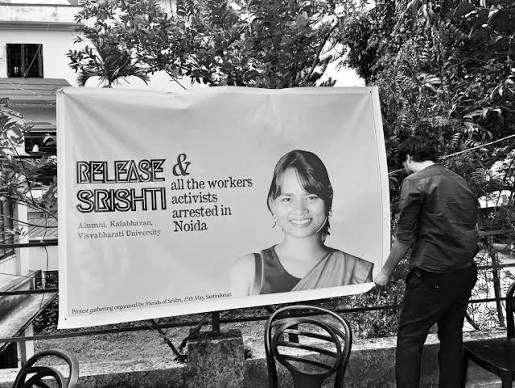
Displayed now in an exhibition in Shahbad Dairy, Srishti Gupta’s photograph feels almost surreal in its new setting, surrounded by the people and neighbourhood that have become part of her story. She is standing in front of a group of women, speaking while they listen. Nearby, children have left messages for her on blue paper. “Miss you Srishti didi,” they wrote.
Gupta is 28. She has spent more than five months in prison after being arrested in connection with protests by industrial workers in Noida. She faces 11 cases and has yet to secure bail in two of them. The police describe her as a “key conspirator”. Her friends describe an artist who cared about the people around her so intensely that eventually that care became political.
The Artist Who Refused to Stay in the Studio
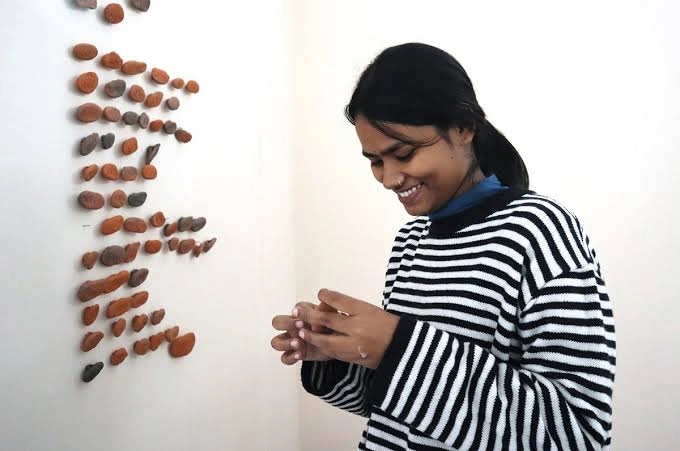
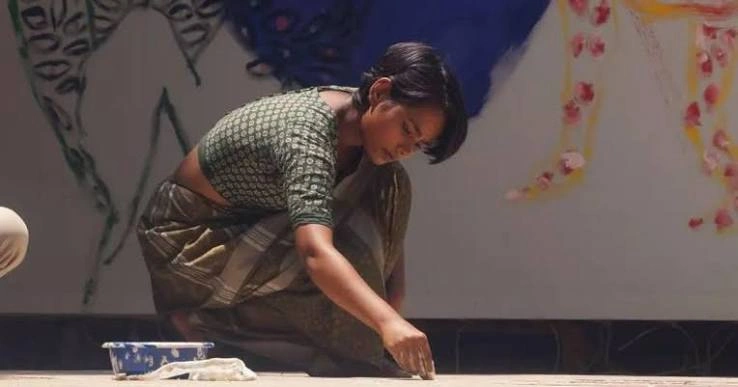
Gupta studied fine art at Delhi University before moving to Visva-Bharati in Santiniketan for her master’s degree. Something changed there. Her friend Vinod Karki recalled conversations about Palestine, capitalism and politics. She wrote poetry, learnt local handicrafts and spent time in a Santhal village near the university.
What stayed with people was the way she entered these communities. Maksud Ali Mondal, an artist she knew from Santiniketan, told Scroll that she did not romanticise the Santhal landscape. She kept returning. She learnt how to sow paddy. She made handmade paper. Her relationship with the villagers continued even after she left, with people still calling to ask when she would be released. This is important because Gupta’s story complicates the comfortable idea of the artist as an observer. There is a familiar distance between making art and participating in the world that art supposedly represents. Gupta seems to have spent years dismantling that distance.
By the time she returned to Delhi in 2023, she was volunteering with community libraries for women and children. She eventually moved into Shahbad Dairy. She taught children art and helped women with literacy. One resident remembered her taking her injured son to hospital and finding a blood donor for him.
Then she went to a workers’ protest.
Empathy Has a Charge Sheet
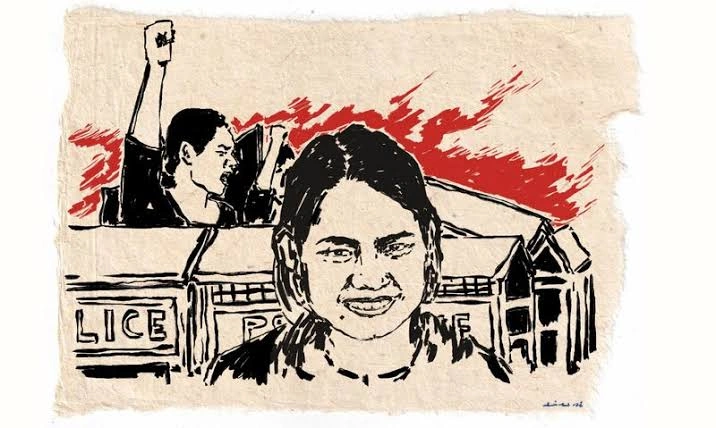
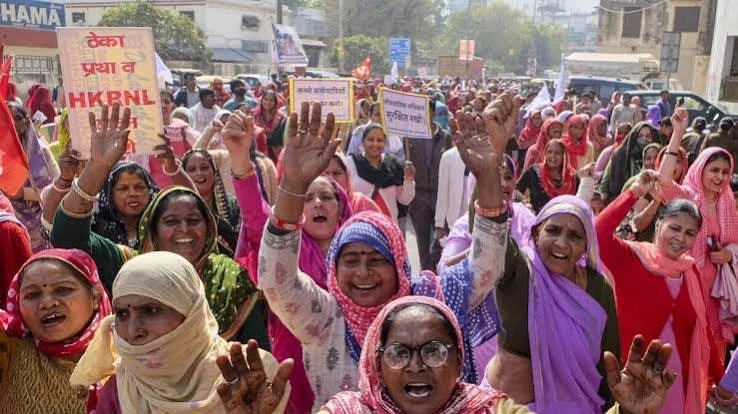
Thousands of industrial workers had taken to the streets in Noida demanding higher wages, with many wages reportedly unchanged since 2014. Gupta joined the protest alongside activists associated with the Left-leaning Progressive Artists’ League. She was among those arrested on April 11. The police account is considerably more serious. One chargesheet says Gupta’s “main responsibility was to make posters and paintings for protests and incite workers” and calls her a “key conspirator”. Police have also linked her to Left organisations and characterised her ideology as Maoism, citing books found in her possession. Her fellow activists have alleged that police tried to plant evidence in her home. Police denied this and said their search was conducted under a court order.
These claims remain contested. The Allahabad High Court has also criticised the authorities investigating cases related to the protests, including over what it described as “concocting” stories about another young artist arrested alongside Gupta. That does not settle the allegations against Gupta, but it makes the circumstances around the arrests impossible to treat as a simple story of police allegations on one side and an artist on the other.
And from here, the story begins to extend beyond the life and work of a single artist.
What Are We Asking Artists to Be?
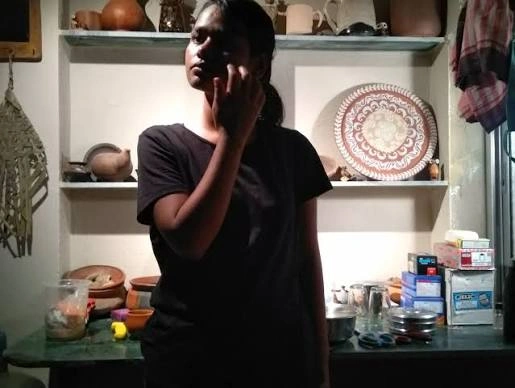
I keep thinking about the phrase “crime of empathy”, because it sounds almost too neat until you look at what Gupta actually did with her life. She did not simply make paintings about marginalised people. She lived among them. She taught their children. She became involved in their daily problems. Her friend Naureen Sabba told Scroll that Gupta changed her understanding of what an artist could be by talking about artists who stayed with marginalised communities and voiced their concerns through their work.
Then Gupta followed that principle into a political protest, and suddenly the same proximity that made her an artist worth talking about could be read as evidence against her. We are very comfortable with political art when it arrives safely on a gallery wall. We can admire the poster, discuss its symbolism and then walk home. Gupta’s life suggests a more difficult version of artistic practice, one where the artist has to decide what happens after the artwork is made.
Her own questions, as recalled by Mondal, were already about the contradictions of the art world: how artists survive without conventional jobs, where funding comes from and what it means to accept money from capitalists whose businesses may damage the environments they claim to support.
The Blue Paper Is the Part I Cannot Forget
Perhaps the strangest thing about this entire story is that the exhibition organised for Gupta is not filled only with political material. There are children’s drawings and messages waiting for her. There is evidence of a person who became part of a neighbourhood before she became a name in a criminal case.
That is what I keep returning to. The state may describe Srishti Gupta through charges, organisations and ideology. Her friends describe her through questions about capitalism. The people of Shahbad Dairy seem to remember her through something much simpler. A teacher. A neighbour. “Srishti didi.” And perhaps that is the most revealing thing about her story. The political question is not only what an artist is allowed to say. It is what happens when an artist decides that other people’s lives are not material for the artwork but lives worth standing beside.
Gupta once learnt how to make paper in a Santhal village. Later, she taught children in Shahbad Dairy. Now, while she remains in prison, those children are using paper to write that they miss her. The work has travelled further than she has.
What Justice Owes Srishti Gupta
Srishti Gupta, an artist whose work has become part of our cultural community, should not be spending her life behind bars. Their release should come soon. If the courts cannot recognise the seriousness of their continued detention, or cannot see that the circumstances of their imprisonment deserve as much scrutiny as the accusations brought against them, then the language of justice begins to lose its meaning in practice. A legal system cannot claim to protect freedom while treating incarceration as an acceptable response to dissent.
There are, however, reasons not to abandon hope entirely. The Allahabad High Court has recently taken the Uttar Pradesh Police to task over their disregard for established procedures surrounding arrest and detention, particularly where those procedures appear to be treated as secondary to political instruction. At least one bench has demonstrated an awareness of how easily institutional power can be used to silence disagreement rather than uphold constitutional rights. There is also the example of neighbouring Haryana, where protesting workers detained in circumstances bearing similarities to this case have been granted bail through detailed and carefully reasoned judicial orders. Such decisions offer a basis for expecting the courts in Uttar Pradesh to approach these cases with the same attention to law and due process. There is, then, some reason to hope.
I hope the courts remember what is at stake when they decide Srishti’s future: not simply a question of detention, but the demands of art, freedom and a life that should be allowed to continue outside a prison cell. I hope that soon Srishti and her colleagues will be back where they belong, making art together and living their lives beyond the walls of the prison.
