How Yayoi Kusama Made a World Out of the Things We Were Taught to Hide
How Yayoi Kusama Made a World Out of the Things We Were Taught to Hide
How Yayoi Kusama Made a World Out of the Things We Were Taught to Hide
The world's favourite artist is dead but her work still has a lot to say about mental health, creativity, and humanity.
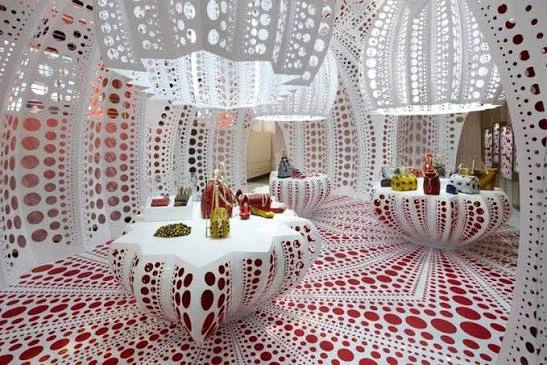
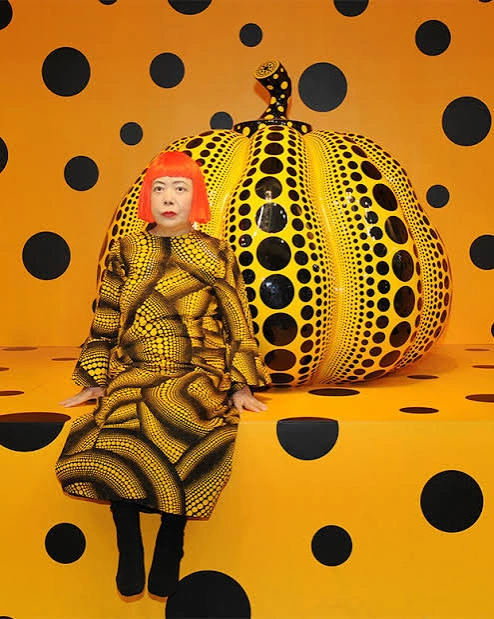
Yayoi Kusama was 10 when she began experiencing vivid hallucinations, visual and aural disturbances she described as “flashes of light, auras, or dense fields of dots”. A 1939 drawing of a woman in a kimono, assumed to be her mother, shows her obliterated by those dots, which became Kusama’s artistic obsession. She hallucinated flowers, too. Looking at red flowers on a tablecloth, she saw the same pattern covering the ceiling, windows, walls, her body and finally the universe. She described feeling that she had begun to self-obliterate, revolving in endless time and space until she was reduced to nothingness.
As someone who has been diagnosed with ADHD at a fairly early age, I find myself drawn to this idea of perception becoming inseparable from emotion. I know that feeling of experiencing something intensely, of a thought refusing to remain where you put it; sometimes there is no place to put it even. Sometimes the way we emote and think can feel difficult to translate into language that other people recognise. Kusama has always felt special because she discovered another language. She took what she experienced internally and gave it a form that other people could finally feel.
The things we learn to hide
Kusama's work makes me think about how often difference is first encountered as something embarrassing. We learn to regulate ourselves before we learn to understand ourselves. We are taught to sit still, to concentrate, to stop fidgeting, to explain what we mean in a way that makes sense to everyone else. For somebody with ADHD, even ordinary attention can become a negotiation with the room around you.
Kusama's experiences were profoundly different from mine, and I do not want to collapse mental illness and neurodivergence into the same category. Yet I recognise something in her insistence on making perception visible. Her art begins with experiences that could easily have remained private and turns them into something that other people have to encounter.
That feels particularly significant because Kusama never presented art as a cure. She described creating art as the method through which she could relieve the pain, anxiety and fear she experienced every day. Art became the thread she followed towards a way of living.
The dotty extravaganza
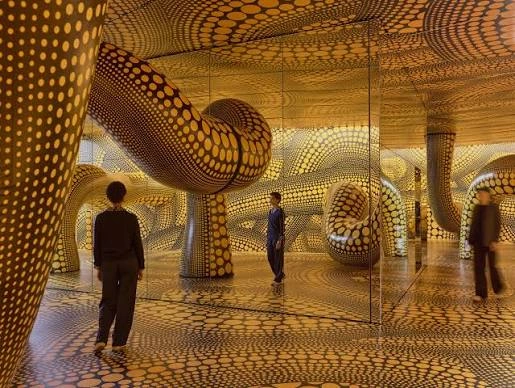
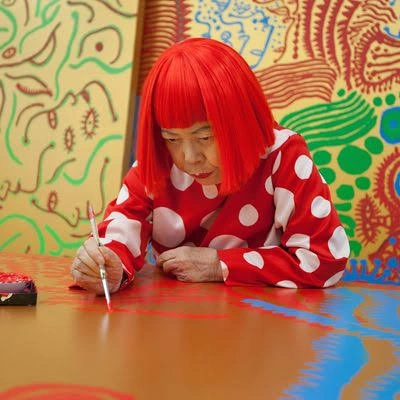
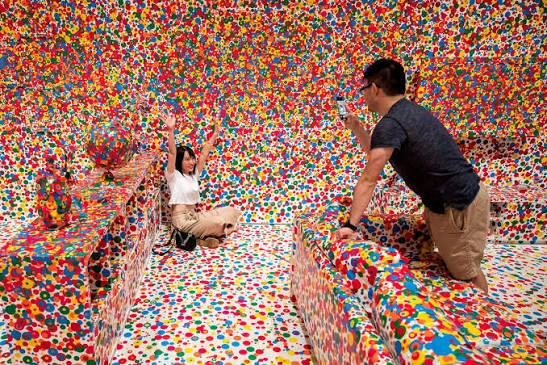
The dots became the most recognisable part of Kusama's visual language, but their familiarity can obscure how strange the original idea was. She took a pattern associated with ordinary decoration and allowed it to spread until surfaces, objects and bodies began to disappear inside it. The same impulse runs through the Infinity Mirror Rooms. Mirrors multiply the viewer. Lights repeat themselves. The room seems to continue beyond its physical boundaries. What begins as a visual pattern becomes an experience of losing your bearings.
For Kusama, this was connected to the idea of self-obliteration. The individual dissolves into repetition and space. The viewer is given a version of the sensation that she had described experiencing herself. I think this is why the rooms did manage to become such a phenomenon. It is something you expect to go and see, but there is a fascinating quality to the repetition that simply sucks you in. Even a picture on the internet is capable of doing that, if you sustain your gaze long enough and let your imagination take you there.
A different way of being seen
There is a tendency to describe neurodivergent artists through the conditions they live with, as though a diagnosis provides the missing key to their work. Kusama's life resists that kind of neat explanation, in my opinion. She voluntarily entered a psychiatric hospital in Tokyo in the 1970s and continued working from a studio nearby, and managed to remain extraordinarily productive. Her career eventually brought her international recognition on a scale that few contemporary artists achieve, a career that i snot reduible to her diagnosis. But it is part of the tapestry that is Kusama, an important node in her polka-inundated world.
The art world has certainly become more interested in neurodivergence. Artists who might once have been excluded from major institutions are increasingly being recognised. One such notable example is Nnena Kalu, who is autistic and has a learning disability, and won the Turner Prize in 2025. This fundamentally changes the discourse from whether disabled or neurodivergent people can participate in the art world to what artistic and material culture can look like when their ways of seeing are allowed to shape it. This is a path Kusama helped form, arriving at that conversation herself decades before the language around it had become widespread.
Children and Kusama
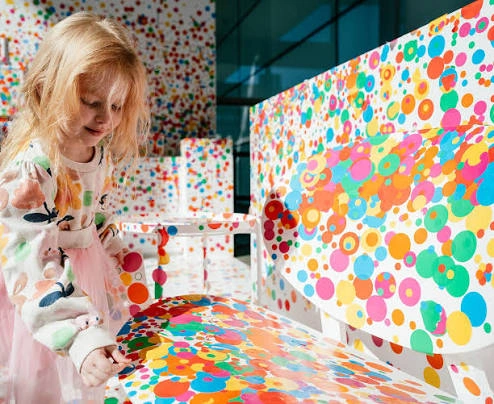
I read a small account of a preschool visit to the Obliteration Room in The Guardian recently, and it only made sense for me to include that account in this retrospective. Children who visited Kusama's work at Tate Modern went back to their nursery and made their own pictures of dots.
What interests me most is what happened after the children went home. At one preschool, a child who had previously shown little interest in art began noticing dots everywhere after seeing Kusama’s work. He started making his own dot assemblages for the wall and even made “Yayoi cakes” in the sandpit. The other children made Yayoi muffins with chocolate chips and sprinkles. One child called Kusama “baby Yayoi Kusama”; another imagined that her own baby could say the artist’s name. These details are much more revealing to me than another photograph of someone standing inside an Infinity Mirror Room. The children were able to come away with a borrowing of one of Kusama's obsessions serious enough to notice it in their own surroundings. A dot had become something worth stopping for.
I recognise that kind of fixation easily. With ADHD, my attention can attach itself to an oddly specific detail and suddenly make it feel disproportionately important. But there is something comforting in seeing an artist who did not necessarily try to discipline that instinct out of existence, but permitted it to engulf her world (and ours, too!).
The world after Kusama
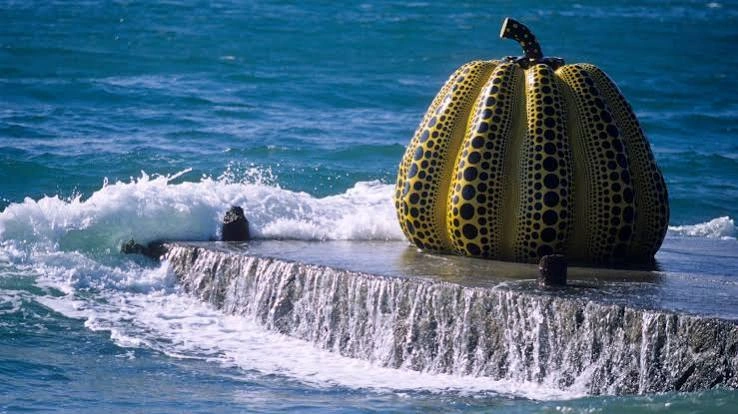
Kusama often referenced how art had saved her, saying: “If it were not for art, I would have killed myself a long time ago.” Although disabled and neurodivergent artists still face major barriers, and still experience moments of sadness and despair that are shared by those of us that love them, Kusama’s work and enduring influence stand as a lasting tribute to the complex magnificence of human perception and experience.
Perhaps this is where her legacy feels most urgent to me. Her work gives us a way of thinking about difference without immediately turning it into something that needs to be explained away. The dots, the repetition, the overwhelming rooms all began with a particular way of experiencing the world, yet they have given other people permission to recognise something of themselves in it. For those of us whose minds do not always move in straight lines, there is something deeply affecting about an artist who made her own way of seeing impossible to ignore.
Kusama leaves behind more than an instantly recognisable visual language. She leaves behind the possibility that the things we have spent years learning to conceal might also be the things through which we learn to see. Her legacy is vast and varied, but for someone like me, it sure is the easiest to feel!

Login to comment.
No thots yet. Be the first to share your thoughts!