Madras HC Dismisses Vijay's Challenge to ₹1.5 Cr Tax Penalty

Madras HC Dismisses Vijay's Challenge to ₹1.5 Cr Tax Penalty
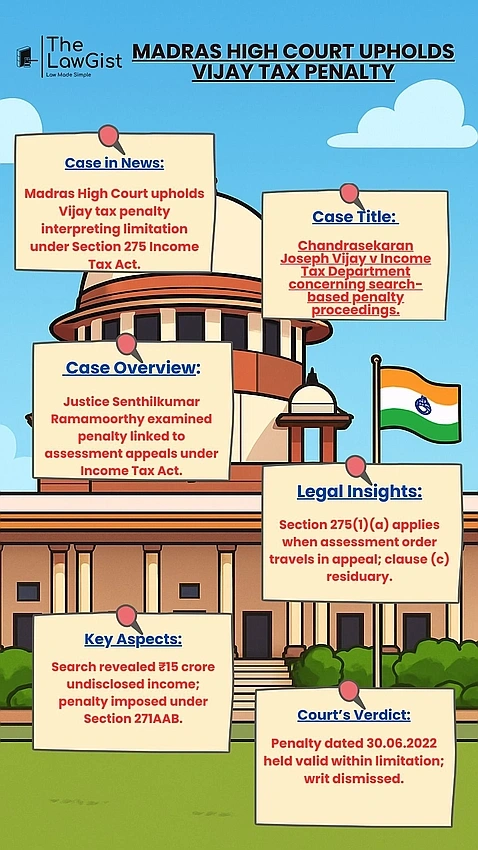
Madras High Court dismisses actor-turned-politician Vijay's plea against a ₹1.5 crore penalty for undisclosed income, while allowing ITAT review on other grounds.
The Madras High Court on Friday dismissed the writ petition filed by actor-turned-politician C Joseph Vijay, who is also the president of TVK, challenging a ₹1.5 crore penalty imposed by the Income Tax Department for not voluntarily disclosing an additional ₹15 crore of income in the 2015-16 financial year. The court, however, granted Vijay liberty to challenge the notice and the resulting penalty order before the Income Tax Appellate Tribunal on grounds other than limitation. The judge held that the show-cause notice was issued within the two-year limitation period prescribed under Section 263 of the Income Tax Act and did not find any legal infirmity in the issuance of the notice or in the initiation of the penalty proceedings. He further noted that the court would not adjudicate the merits of the penalty at this stage and that Vijay could pursue a challenge before the ITAT on permissible grounds.
Background details indicate that in September 2015, search and seizure operations were conducted at Vijay’s residence, after which the department claimed undisclosed income. Vijay subsequently disclosed an additional ₹15 crore for the assessment year 2016–17 and paid tax on it. In December 2017, the department passed an assessment order determining Vijay’s taxable income at ₹38.25 crore, after disallowing certain claims, including depreciation and expenses linked to Rasigar Mandram. In December 2018, penalty proceedings under Section 271AAB(1) were initiated. Vijay challenged the assessment before the Commissioner of Income Tax (Appeals), who partly accepted his case. The department then approached the ITAT, which partly ruled in its favour. The court’s recent order, therefore, leaves room for Vijay to pursue further arguments at the ITAT, while keeping the penalty intact for now.
The ruling underscores the court’s stance on procedural aspects—particularly the timing of show-cause notices—while signaling that the dispute over the penalty’s merits will continue at the appellate tribunal. For Vijay, the door remains open to contest the penalty on grounds beyond mere limitation, potentially shaping how similar cases are navigated in the ITAT.
