Rubio in Greece: 'America First' Echoes Through Ancient History

Rubio in Greece: 'America First' Echoes Through Ancient History
US Secretary of State Marco Rubio delivered a powerful 'America First' speech in Athens, using ancient history to urge Europe to reject globalism and embrace national power. Discover his message and its implications for
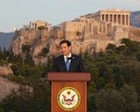
In a significant address from Athens, US Secretary of State Marco Rubio delivered a powerful defense of Donald Trump's "America First" foreign policy, using the iconic Parthenon as a dramatic backdrop. Speaking to assembled officials and reporters, Rubio's speech appeared to be a strategic move, potentially setting the stage for a 2028 presidential bid, as he urged European nations to "awaken from its long slumber" and reject a future he described as "atrophy, servitude, and decline." Rubio invoked historical parallels, drawing inspiration from ancient Greek founders, philosophers, and conquerors, and even referencing his family's own journey to the United States.
His central message was a forceful rejection of globalist politics, which he, echoing Trump, blamed for many of the West's challenges, including rising illegal immigration and the outsourcing of manufacturing jobs. The top US diplomat warned that the Western world stood at a critical "inflection point," passionately defending America's "unapologetic pursuit of national power." He criticized the trend of portraying nationalism as a "dirty word," arguing that it led to the tearing down of monuments and teaching children to be ashamed of their heritage.
Rubio asserted that the West must choose to "maintain its place at the head of the world" or face decline. Under President Trump, Rubio stated, the United States had made its choice: to aggressively pursue national power, reclaim control of critical supply chains, reindustrialize its economy, rebuild its defense capabilities, and strive for dominance in future technologies and industries.
This stance underscores a clear shift from traditional globalist approaches.
The speech comes at a time when relations between the US and Europe are experiencing various strains. These include the US involvement in Iran, Washington's perceived inconsistent support for Ukraine's defense against Russia, and internal disputes within NATO.
Ideological divides, fueled by influential figures like US Vice-President JD Vance, further complicate transatlantic cooperation. While acknowledging these tensions, Rubio sought to reassure allies, invoking Abraham Lincoln's first inaugural address.
He stressed that while
passions may, at times, have strained the bonds of affection between the United States and Europe, it must not be allowed to break them.
He called for strengthening alliances, citing a recent agreement between the US, Denmark, and Greenland regarding the Arctic as an example of bolstering NATO's security and reshaping regional dynamics.
#RubioInGreece #AmericaFirst #USForeignPolicy #TransatlanticRelations
