5G and RF over Fiber: The Essential Partnership for Next-Generation Speeds

5G and RF over Fiber: The Essential Partnership for Next-Generation Speeds
The arrival of 5G is not just an upgrade; it's a paradigm shift. It promises blazing-fast speeds, ultra-low latency, and the capacity to connect billions of devices in the Internet of Things (IoT). But this revolution comes with a massive engineering challenge. 5G's high-frequency signals (especially in the millimeter-wave spectrum) are powerful but fragile: they carry huge amounts of data but cannot travel far and are easily blocked by walls, windows, and even rain.
To make 5G a reality, antennas must be placed everywhere- on streetlights, buildings, and in large venues. This article explores how RF over Fiber (RFOF) technology is the only viable solution to this complex puzzle.
- We will cover the core physical challenges of 5G antenna deployment.
- We will explain why traditional coaxial cables are obsolete for 5G.
- We will detail how RFOF subsystems solve the problems of distance and signal integrity.
- We will touch on the advanced applications RFOF enables, from telecom to defense.
The 5G Challenge: Why Old Cables Fail
Traditional 4G networks often used heavy copper coaxial cables to connect antennas to their baseband units (BBUs). This worked because 4G operated at lower frequencies where signal loss (attenuation) was manageable.
5G, and especially millimeter-wave (mmWave) 5G, is a different beast. At these high frequencies, signal loss in a coaxial cable is catastrophic. A signal can lose over 90% of its power in just a few dozen meters. This makes it physically impossible to use copper cables to connect the vast network of 5G antennas (called Radio Units or RUs) that need to be deployed far from the central processing equipment.
The Solution: RF over Fiber (RFOF)
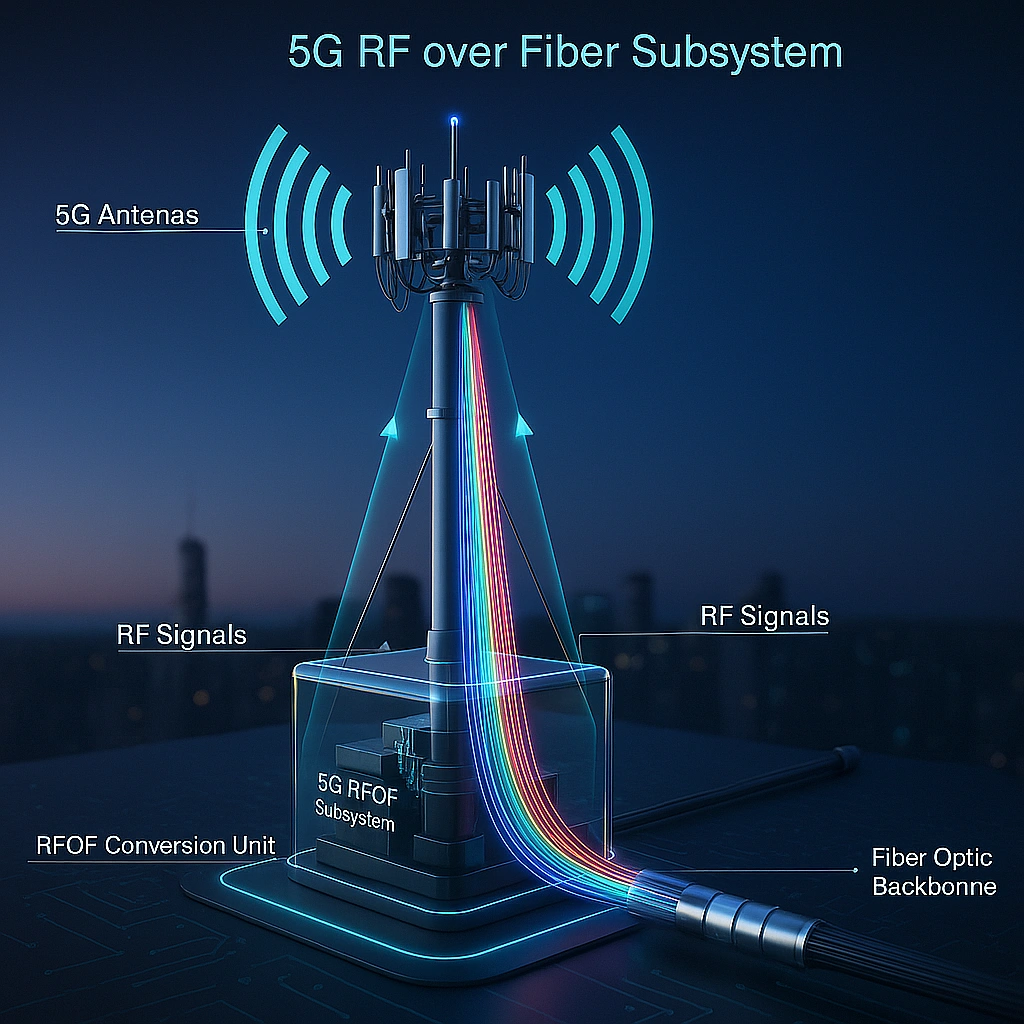
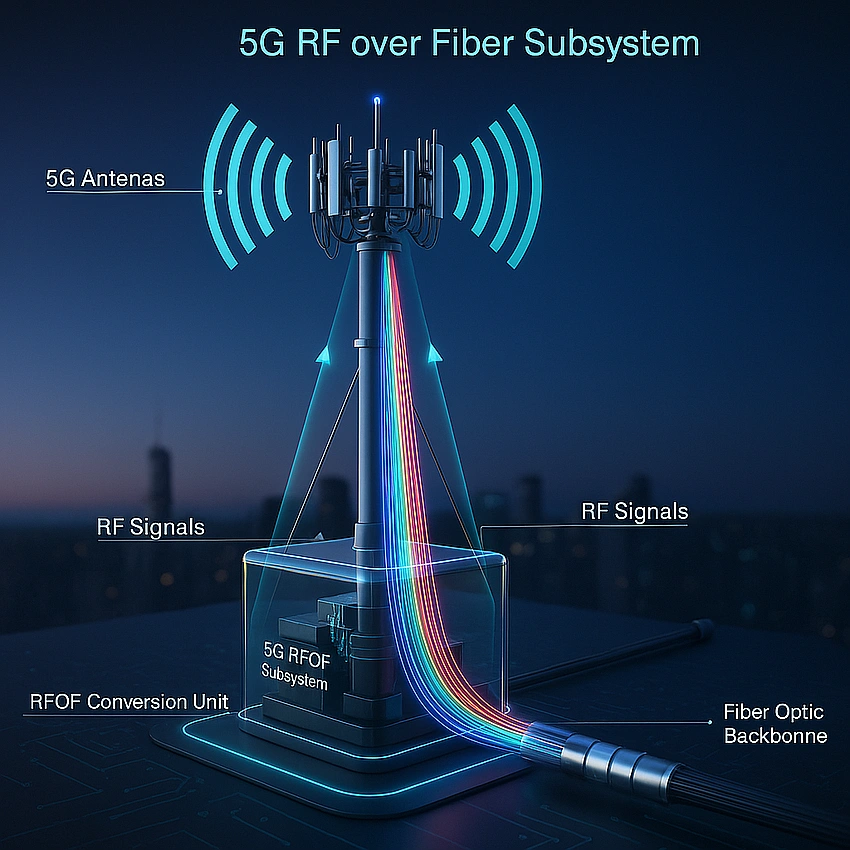
The solution is to stop trying to force a high-frequency electrical signal down a copper pipe. Instead, RF over Fiber (RFOF) converts the 5G signal into a light pulse at the antenna site. This light pulse is then transported over a lightweight, low-loss fiber optic cable.
This light-based signal can travel for many kilometers with virtually zero degradation. At the destination (the BBU or central hub), the light is converted back into a perfect replica of the original RF signal. This process provides a clean, lossless "transport pipe" for 5G signals.
What are 5G RFOF Subsystems?
This process requires a specialized set of hardware. A "subsystem" is more than just a single component; it's a complete, integrated solution designed for a specific task.
In this case, 🔗5G RFOF Subsystems 🔗 are purpose-built units that contain everything needed to perform this conversion and transport. They typically consist of:
- A Transmitter Unit: This unit is placed near the 5G antenna. It takes the RF signal and converts it to an optical signal.
- A Receiver Unit: This unit is located at the central baseband unit. It takes the optical signal from the fiber and converts it back into an electrical RF signal.
- The Fiber Optic Cable: The passive, high-bandwidth link that connects the two units.
These subsystems are the critical link that allows 5G antennas to be placed at their ideal locations for coverage, while the expensive and sensitive processing equipment can remain centralized and protected miles away.
Beyond Speed: The Benefits for 5G
Using RFOF is not just about overcoming distance; it brings a host of other benefits that are critical for 5G networks.
- Signal Integrity: Fiber is immune to electromagnetic interference (EMI). A 5G antenna on a crowded city street is surrounded by "noise" from power lines, radios, and other electronics. RFOF ensures this noise does not corrupt the signal.
- Reduced Weight and Size: A single fiber optic cable, thinner than a human hair, can carry more data than a copper cable as thick as your arm. This is vital when installing hundreds of antennas on poles and buildings.
- Scalability: The bandwidth of fiber is almost limitless. The same fiber installed today for 5G will be able to handle the even greater demands of 6G and beyond, making it a future-proof investment.
The Broader Impact: From Telecom to Defense
The high-performance, high-bandwidth, and noise-immune characteristics of RFOF are not just for telecommunications. The same core technology is essential for some of the world's most demanding applications.
Many defense platforms face even greater challenges than 5G. They must operate in extremely "noisy" electronic environments and transport complex signals from antennas to processing centers on ships, aircraft, or ground vehicles. These advanced systems require robust 🔗RF Solutions for Military applications 🔗, including radar signal transport and electronic warfare (EW) systems.
The R&D from the defense sector often pushes the technology forward, leading to more robust and reliable components for commercial 5G use. Companies like 🔗RFoptic 🔗 leverage this deep expertise in both defense and telecommunications to build RFOF subsystems that are robust, reliable, and optimized for high performance, whether on a battlefield or a 5G cell tower.
The Future: AI-Driven 5G Networks
The massive complexity of 5G, with its millions of shifting connections and signal paths, is too much for humans to manage manually. The future of 5G optimization lies in Artificial Intelligence (AI).
Leading tech companies are already exploring 🔗how dynamic 5G services are possible with AI 🔗. AI algorithms will be used to manage "network slicing" (creating virtual networks for specific tasks), predict traffic loads, and dynamically route signals over the most efficient fiber paths in real-time. This AI-managed "smart" network is only possible because of the clean, reliable data streams provided by an RFOF backbone.
5G is not just 4G with a "plus" sign. It is a completely new architecture that requires a new way of thinking about signal transport. The physical limitations of copper have made it obsolete for this new era.
RF over Fiber is the enabling technology that breaks through these limitations. By converting RF to light, 5G RFOF subsystems provide the clean, long-distance, high-bandwidth connections that allow 5G networks to deliver on their promise of a faster, more connected world.
Frequently Asked Questions (FAQs)
1. Why can't 5G just use the same coaxial cables as 4G? 5G uses much higher frequencies (like mmWave) to achieve its high speeds. At these high frequencies, electrical signals in a coaxial cable lose their power very quickly (an effect called attenuation). RFOF solves this by converting the signal to light, which can travel for kilometers over fiber with almost no loss.
2. What does "RFOF subsystem" mean? A subsystem is a complete, pre-packaged solution. A 5G RFOF subsystem isn't just a single part; it includes the transmitter (to convert RF to light), the receiver (to convert light back to RF), and all the associated electronics, all optimized to work together seamlessly for 5G applications.
3. Is RFOF technology secure? Yes, it is highly secure. Unlike copper cables, which can leak signals that can be intercepted, a fiber optic cable is extremely difficult to "tap" without being detected. The light signal is contained entirely within the glass core, making it a very secure medium for sensitive data.
4. What is the main benefit of RFOF for 5G? The main benefit is decoupling the antenna from the base station. It allows companies to place the small 5G antennas exactly where they are needed for best coverage (like on a lamppost), while the large, expensive baseband equipment can be centralized in a safe, convenient location (like a building basement) kilometers away.

Login to comment.
No thots yet. Be the first to share your thoughts!