Trump & Xi Toast Friendship Amid Tensions at White House Dinner

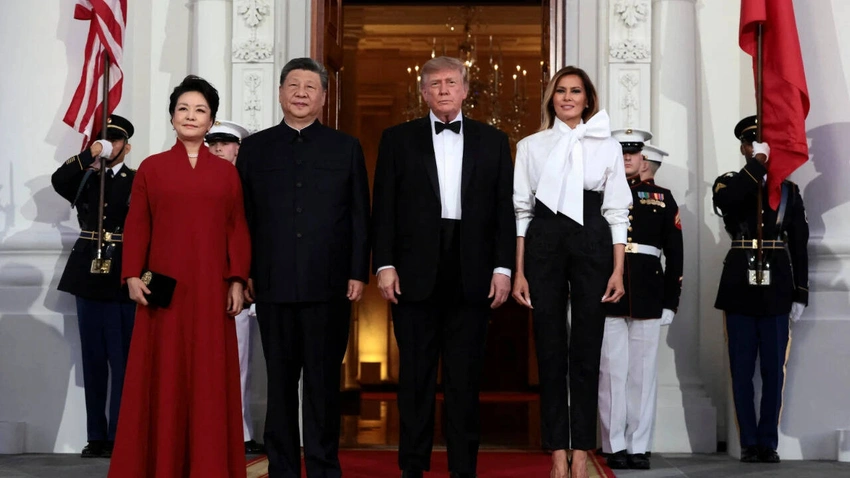
Trump & Xi Toast Friendship Amid Tensions at White House Dinner
US President Trump and China's Xi Jinping met for a lavish state dinner, exchanging warm words but sidestepping major issues like Taiwan and trade. What does this mean for US-China relations?
US President Donald Trump and China's President Xi Jinping engaged in a display of diplomatic warmth at a lavish White House state dinner, yet concrete progress on pressing global issues remained elusive. Both leaders spoke of a desire for future harmony, peace, and success between their nations, but underlying tensions, particularly concerning Taiwan, artificial intelligence (AI), and trade, continued to simmer beneath the surface.
President Xi emphasized the need for the US and China to act as "responsible major countries" and stressed that AI must remain "under human control." President Trump, meanwhile, toasted to a future of prosperity for both countries. Their arrival at the extravagant dinner was met by protesters outside the White House gates, leading to some arrests, highlighting the public's varied opinions on the complex relationship.
During his first US visit in over a decade, President Trump lauded Xi, telling attendees that despite their "different systems," the two countries had "never gotten along better." Xi echoed this sentiment, calling it a "historic juncture" for US-China relations and suggesting their ambitions could be "mutually reinforcing."
Despite the cordial exchanges, crucial matters dividing the world's two most powerful nations received little public mention.
China views US efforts as an attempt to contain its rise, particularly in trade, technology, and Taiwan.
The US, conversely, has been pushing for deals on trade and tariffs, aiming for reduced Chinese tariffs on American goods, increased imports of Chinese rare earth minerals, and boosted exports of US agricultural products.
Earlier in the day, Xi had urged Trump to adopt a "correct position" on Taiwan, a self-governing island claimed by Beijing. This comes after Trump delayed approval of a $14 billion arms package for Taiwan, a move he described as a "very good negotiating chip." Chinese state media also reported that Xi advised Washington behind closed doors to handle its approach to Taiwan "with prudence."
Looking ahead, President Xi confirmed that he and Trump would meet twice more by year's end: at the Asia-Pacific Economic Cooperation (APEC) leaders' meeting in Shenzhen, China, in November, and again at the G20 summit in Florida, also in November. While the dinner showcased significant pomp and diplomatic courtesies, the path towards resolving deeply entrenched disagreements between the two global giants appears to be a long one, marked by cautious optimism and persistent challenges.
