Yayoi Kusama After Infinity: The Afterlife of an Unforgettable Artist

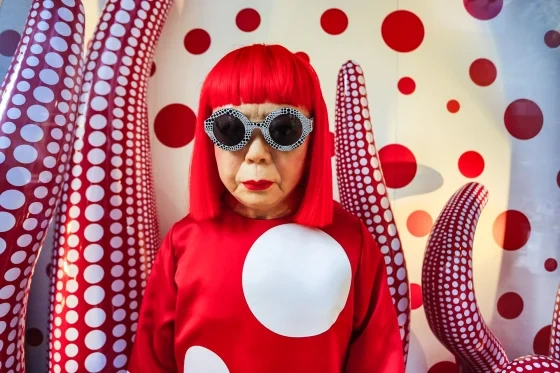
Yayoi Kusama After Infinity: The Afterlife of an Unforgettable Artist
Yayoi Kusama After Infinity: The Afterlife of an Unforgettable Artist
Yayoi Kusama died on 14 August 2026, aged 97, at a hospital in Tokyo. Her death was announced publicly on 27 August, bringing an end to one of the most singular artistic lives of the twentieth and twenty-first centuries.
But Kusama's work has always been strangely resistant to endings. Her art is built upon repetition, proliferation and infinity, ideas that make the notion of an artistic afterlife particularly fitting. What happens to an artist whose entire vocabulary was concerned with dissolving the boundaries between the self and everything around it?
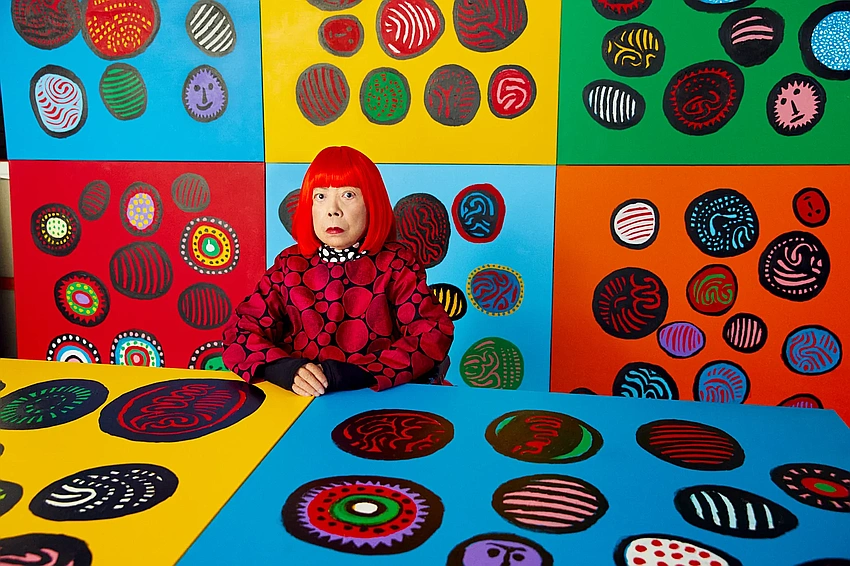
The Self as a Vanishing Point
Kusama's career can be understood as a prolonged attempt to make the individual disappear into something larger. Her nets, dots, mirrored rooms and repeated forms turn the self into a fragment within an apparently endless field.
This idea emerged from a deeply personal visual language. Kusama began experiencing hallucinations as a child and later transformed these experiences into paintings and installations. Yet reducing her art to biography would be too simple. Her importance lies in how she turned private perception into a public visual grammar. The dots are not merely a signature. They are a way of imagining existence as repetition without a definitive centre.
There is something almost literary about this. Kusama repeatedly wrote the same fundamental sentence in different artistic forms: the self is temporary, but the pattern continues.
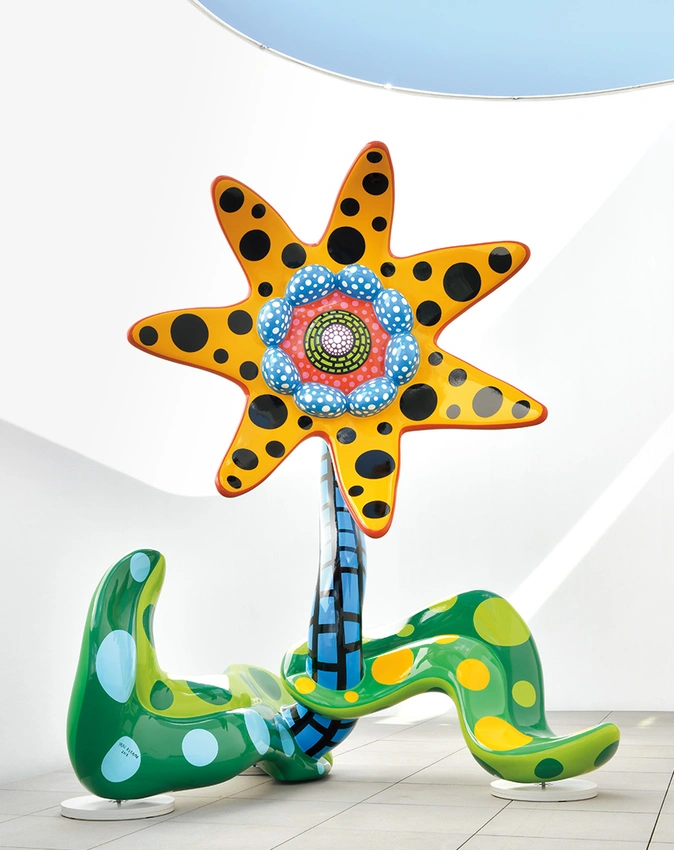
From Avant-Garde to Pop Culture
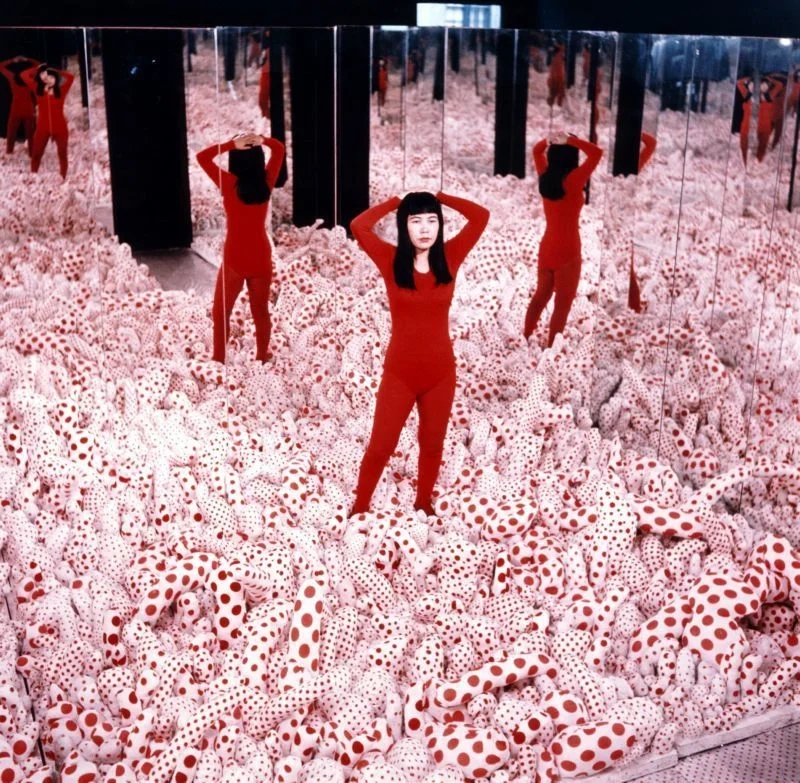
It is easy, in retrospect, to forget how radical Kusama once appeared. After moving to New York in 1957, she became an important figure in the city's avant-garde scene, producing large-scale Infinity Net paintings, soft sculptures, performances and happenings. Her work intersected with Minimalism, Pop Art, Feminist art and institutional critique without fitting comfortably into any of them.
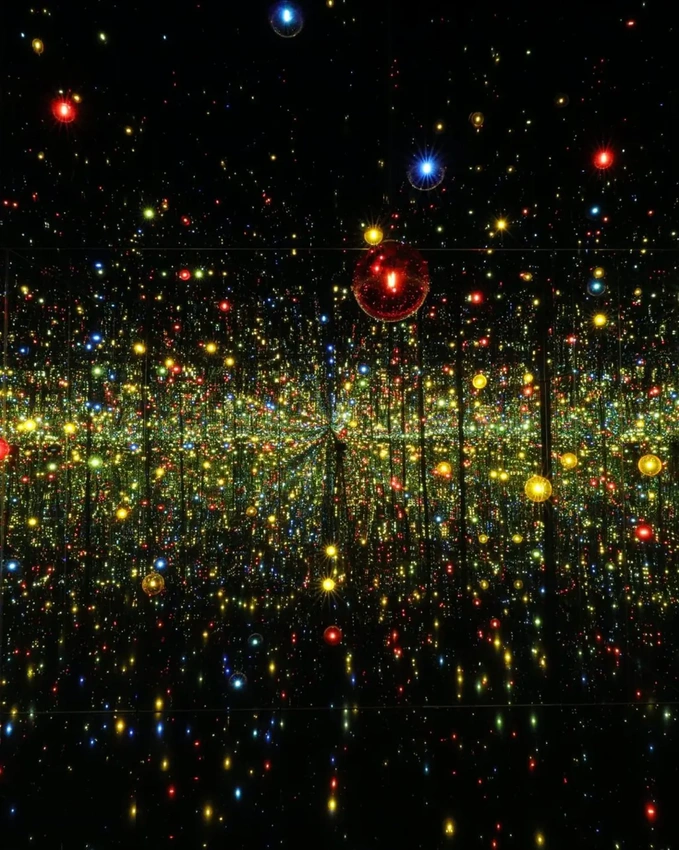
Her later transformation into a global cultural icon is equally important to her legacy. The pumpkins, polka dots and Infinity Mirror Rooms became recognisable far beyond the conventional art world. Her installations could be encountered simultaneously as serious contemporary art, tourist destination, social-media image and fashion object.
That contradiction is central to understanding Kusama's afterlife. Her work entered popular culture without entirely surrendering its strangeness. Millions of photographs of people standing inside her mirrored rooms might seem to flatten the art into an Instagram experience, but they also demonstrate something extraordinary: Kusama created images capable of travelling between museums, screens and everyday cultural memory. SFMOMA describes her practice as extending across painting, sculpture, installation, performance, film, fashion, design and literature.
The Museum Becomes the Afterlife
Perhaps the clearest evidence of Kusama's continuing life is the institutional infrastructure already surrounding her work.
The Yayoi Kusama Museum in Tokyo continues its programme following her death, with The Light Spreads Out, and Glittering Things Start Appearing All Around Me scheduled from October 2026 to January 2027. Meanwhile, a 2026 exhibition devoted to her prints is running at the Fukushima Prefectural Museum of Art until 23 September.
These exhibitions matter because Kusama's legacy does not depend upon a final retrospective being assembled after her death. The machinery of remembrance was already in motion. Her work had become institutionalised, archived, collected and repeatedly reinterpreted while she was alive.
The Museum Ludwig's major 2026 exhibition in Cologne, for instance, brought together more than 300 works across painting, drawing, sculpture, installation, fashion, performance and literature. Its scale demonstrated just how difficult it has become to contain Kusama within the category of visual artist alone.
What Remains After Infinity?
The most interesting question is not whether Kusama will remain famous. She almost certainly will. The more difficult question is what happens when the artist disappears but the image becomes increasingly ubiquitous.
Kusama understood the relationship between repetition and immortality better than most artists. Her dots proliferate. Her mirrored rooms multiply. Her pumpkins recur across generations and continents. Even her most recognisable motifs seem designed to outlive their maker.
There is, however, a danger in treating Kusama's work simply as an infinitely reproducible brand. Her commercial success, particularly her collaborations with fashion and luxury industries, has sometimes made the radicalism of her earlier work easier to overlook. The challenge for museums, critics and audiences now is to resist remembering only the Kusama who became a cultural phenomenon.
Her legacy is more complicated than the polka dot.
Kusama's real afterlife may therefore exist in the tension between intimacy and spectacle, illness and creation, avant-garde rebellion and mass popularity. She spent decades constructing an artistic universe in which everything could multiply until the boundaries of the individual disappeared.
Now the individual is gone. The universe remains.
And perhaps that is the most Kusama-like ending possible: not a full stop, but another dot in an apparently endless pattern.

Login to comment.
No thots yet. Be the first to share your thoughts!