Reflections on Kochi-Muziris Biennale 2025–26,“For the Time Being”

Reflections on Kochi-Muziris Biennale 2025–26,“For the Time Being”
Reflections on Kochi-Muziris Biennale 2025–26,“For the Time Being”
A field report from Fort Kochi and nearby islands as the 2026 Kochi-Muziris Biennale unfolds, where time is treated as a condition of experience and the city becomes the exhibition.
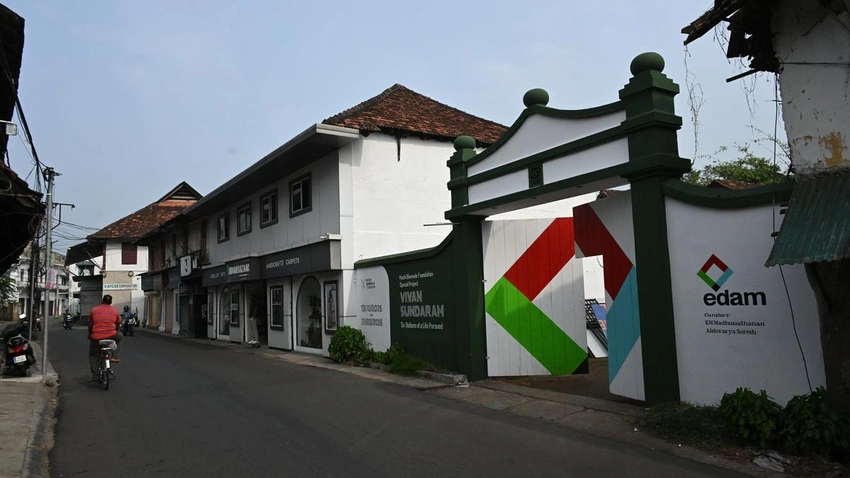
I arrived in Kochi in mid-March 2026, towards the closing stretch of the sixth edition of the Kochi-Muziris Biennale, a moment when the exhibition feels both exhausted and alive. Spread across Fort Kochi and nearby islands, the Biennale unfolds not in a single curated enclosure but across warehouses, colonial buildings, and open spaces that still carry the weight of trade, empire, and sea air.
What strikes you immediately is that the city is not merely hosting the Biennale, it is inseparable from it. The walk between venues becomes part of the exhibition’s rhythm: humid, slow, and insistently embodied.
“For the Time Being”: Time as Method, Not Theme
Curated by Nikhil Chopra with HH Art Spaces, this edition, titled For the Time Being, resists the temptation to over-explain itself.
Instead, time is treated less as a subject and more as a condition of experience. Many works demand duration: sitting, listening, waiting. This is not incidental. The curatorial impulse leans heavily into performance, process, and participation, an extension of Chopra’s own practice.
Across four days, I found myself repeatedly unsettled by how little could be consumed quickly. Unlike the spectacle-driven logic of global biennales, this one insists on slowness, even discomfort. You cannot “cover” it; you endure it, inhabit it.
Bodies, Memory, and the Politics of Material
One of the most persistent threads across the Biennale is the body; not always visible, but constantly implied. Works move through soil, fabric, sound, and architecture to evoke presence without representation.
Dineo Seshee Bopape’s installation, composed of mounds of earth and ambient sound, becomes less an artwork and more a site of quiet ritual. Sitting within it, one becomes aware of the body’s weight, its relation to land, and the uneasy histories embedded within both.
Similarly, Shiraz Bayjoo’s Sa Sime Lamer uses spices, coir, and colonial iconography to reconstruct the violent routes of extraction that once defined Kerala’s coastline. The installation is not didactic, but its materiality of pepper, muslin, wood does the work of historical recall.
What emerges is a curatorial emphasis on matter as memory. The artworks do not merely represent history; they stage its residue.
Participation and the Refusal of Passive Viewing
A noticeable shift in this edition is the insistence that the viewer is not external to the work. Many installations invite sitting, touching, or lingering, dissolving the boundary between spectator and participant.
This is not always comfortable. At times, the demand to “engage” feels almost coercive especially when exhaustion sets in after multiple venues. Yet, it is precisely this fatigue that reveals the Biennale’s underlying proposition: that art is not an object to be consumed, but a condition to be lived through, however briefly.
Scale and Intimacy: Sixty-Six Artists, Countless Worlds
With around 66 artists and collectives from over 20 countries, the Biennale is undeniably expansive.
The list ranges from globally recognised figures like Marina Abramović to emerging practitioners, alongside a strong presence of Indian artists. Yet, what is remarkable is how rarely the scale feels overwhelming. This is partly due to the spatial fragmentation of the exhibition nearly 30 venues dispersed across the city.
Each site develops its own micro-atmosphere. An abandoned warehouse might house a monumental installation, while a smaller room might hold a quiet, almost invisible work. The Biennale refuses uniformity, and in doing so, resists the flattening effect of large-scale exhibitions.
The “People’s Biennale”: Beyond the Art World
One cannot ignore the recurring description of the Kochi Biennale as a “people’s biennale.” It is a phrase that risks cliché, but here, it retains some truth.
Students, local families, tourists, and art professionals move through the same spaces, often with different levels of comprehension but shared curiosity. Programmes like the Students’ Biennale and Art By Children expand the exhibition’s reach beyond institutional art circuits.
At the same time, this inclusivity is not uncomplicated. Questions of accessibility; both intellectual and physical remain. Not all works are legible, and not all audiences are equally addressed. Yet, the attempt to sustain this openness feels genuine, even when imperfect.
Fatigue, Friction, and the Limits of the Biennale Form
By the third day, a certain fatigue sets in not just physical, but perceptual. The repetition of certain aesthetic strategies (earth, archives, soundscapes) begins to blur distinctions between works.
This is perhaps inevitable in any biennale of this scale. But it also raises a more pressing question: has the biennale form itself reached a point of saturation?
The Kochi edition attempts to counter this through decentralisation and performativity, yet it cannot entirely escape the logic of accumulation.
Leaving Kochi: What Remains
On my final evening, walking past the sea near Aspinwall House, I found it difficult to recall specific works in isolation. What remained instead was a texture of experience: humidity, sound, slowness, fragments of conversation, the feeling of sitting on mud or concrete or wood for longer than expected.
Perhaps this is the most honest achievement of For the Time Being. It does not offer clarity or resolution. It leaves behind a residue of time spent, rather than time understood.
And maybe that is enough.
#KochiBiennale2026 #KMB2026 #ForTheTimeBeing #TimeAsExperience #ArtInPublicSpaces
