India Faces Alarming Income Crisis, Warns Financial Planner


India Faces Alarming Income Crisis, Warns Financial Planner
Chennai-based financial planner D. Muthukrishnan highlights a stark split: top earners pull prosperity while the rest struggle. A closer look at India’s widening income gap.
According to financial planner D. Muthukrishnan, based in Chennai, the economic gap in India is much more pronounced than it appears, with the poorest 90% of the population accounting for only 43% of the country's income and subsisting on less than half of its per capita GDP.

Muthukrishnan brought attention to a significant structural inequality in India's economic structure in a post on X. Even though the national per capita GDP is $2,700, when the top 10% of earners are taken out of the equation, the number drops to just $1,300 for the bottom 90%.
“That’s worse than even Sub-Saharan Africa and Pakistan,” he wrote. “If you are not among the top 150 million but part of the balance 1.3 billion, every day is a literal hell.”
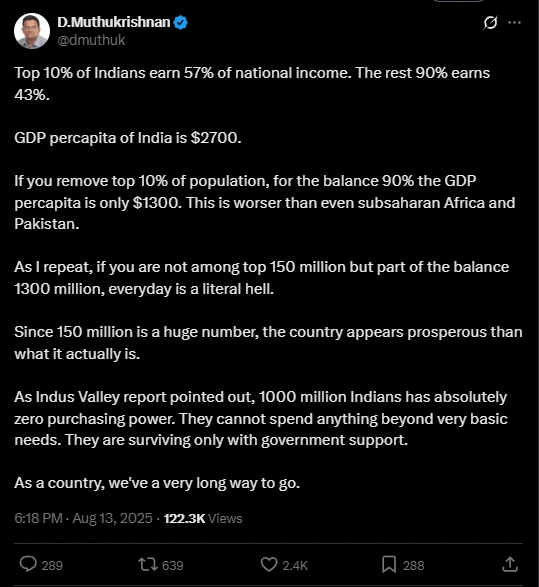
Muthukrishnan emphasized how India's comparatively large, wealthy class creates the appearance of prosperity. He pointed out that "the country appears prosperous than what it actually is," with 150 million high earners. However, life is harsh for the remaining 1 billion. He emphasized that approximately 1 billion Indians have "absolutely zero purchasing power," spending only on necessities and surviving primarily on government assistance, citing the Indus Valley Report. He wrote,
"As a country, we've a very long way to go."
The post has raised fresh questions about whether India's growth narrative can be sustained, particularly as policymakers brag about growing GDP numbers while poverty and disparities in purchasing power continue to exist in both rural and urban areas.
India’s income crisis reveals the deep divide between rapid GDP growth and the harsh realities faced by the majority of its people. While the top 10% controls most of the nation’s wealth, over a billion citizens struggle daily with little to no purchasing power. This growing inequality not only threatens economic stability but also risks long-term social harmony. To bridge this divide, India must adopt inclusive policies in employment, education, and healthcare. Without urgent reforms, prosperity will remain limited to a few, leaving the promise of growth an illusion for most.
