Last-Minute Reprieve! Kerala Nurse’s Execution Delayed—Life or Death Still Hangs in the Balance!

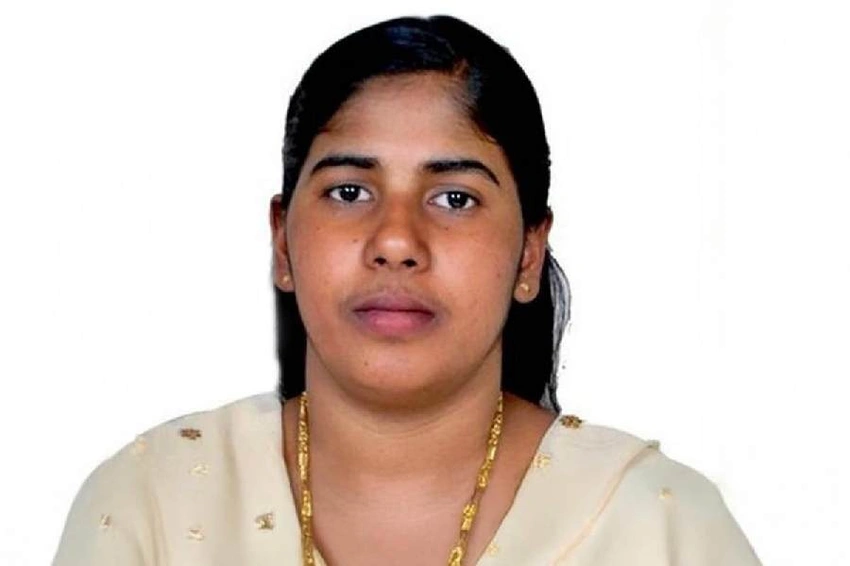
Last-Minute Reprieve! Kerala Nurse’s Execution Delayed—Life or Death Still Hangs in the Balance!
Nimisha Priya's execution has been postponed, offering her family some relief. Explore the ongoing challenges facing her case and the family's struggle for justice.
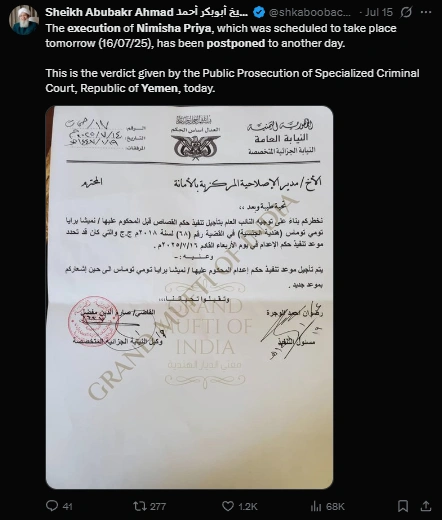
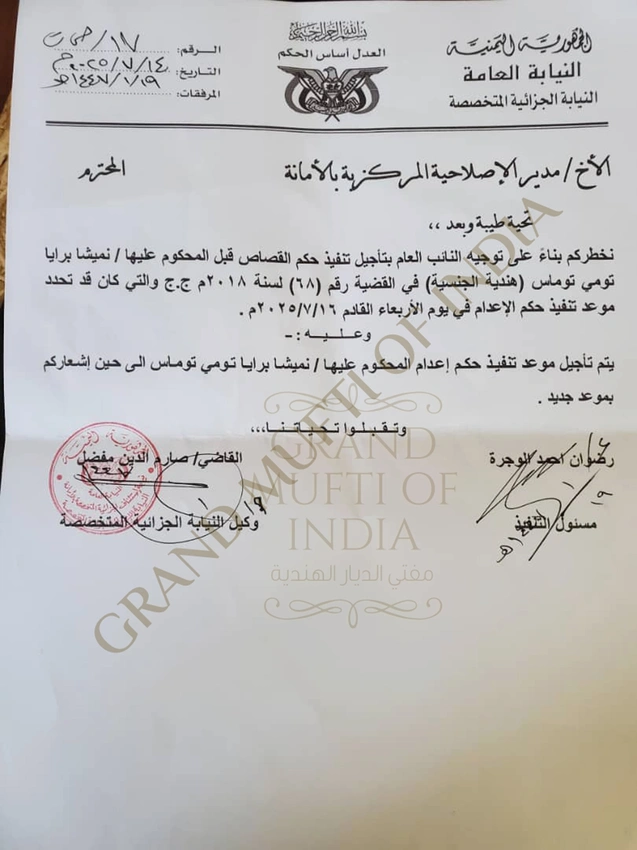
Nimisha Priya's family has experienced some relief since her execution was postponed, but there are still many obstacles in the way of her death sentence being commuted. The execution, which was scheduled for July 16, was indefinitely postponed as a result of mediation efforts conducted at different levels. Talal Abdo Mahdi, a Yemeni national, was the victim, but his family has not yet consented to the negotiations.
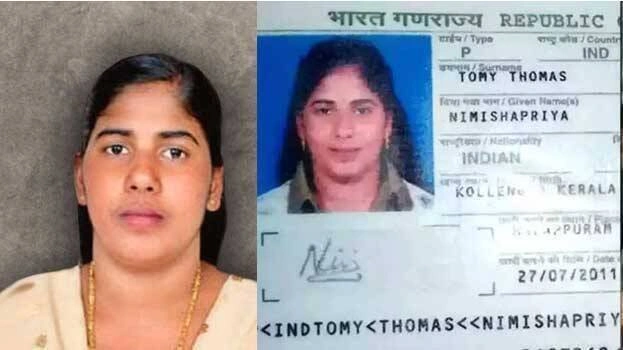
Born in Kerala's Palakkad, Nimisha has been imprisoned in Yemen since 2018 after being convicted of killing her former business partner, Mahdi. She is charged with giving Mahdi a sedative injection, which caused him to collapse and pass away after he allegedly mistreated and coerced her.
Talal Abdul Fattah Mahdi, Mahdi's brother, stated on social media that the decision to postpone the execution was surprising. Abdul Fattah Mahdi wrote that they would wait for justice, no matter how long it took. He rejected the idea of taking blood money, which is a type of compensation given to the victim's family by a convicted criminal.
Abdul Fattah Mahdi stated in his Arabic-language post that he was not shocked by the attempts at reconciliation, as there had been covert initiatives in the past. He emphasized that their position remained unchanged and restated the family's insistence that qisas, or retribution, be the only permissible course of action.
“The pressures we’ve faced haven’t changed us. Our demand is clear: retribution (Qisas), and nothing else, no matter what,” he wrote.
He was disappointed by the execution's postponement, calling it surprising, particularly since the authorities, he claimed, were fully aware of the family's total rejection of any attempts at reconciliation.
“In any case, what comes after setting an execution date is harder than what came before. We will pursue it until it is carried out. A delay will not deter us, and pressure will not shake us — for blood cannot be bought… truth is never forgotten… and justice is coming, no matter how long the road. It’s just a matter of time — and from God, we seek help," he added.
The attempts to commute the death sentence by paying blood money have also drawn criticism from several Yemeni social media accounts.
The Negotiation Is Still Ongoing
The execution was eventually postponed as a result of senior Sunni leader Kanthapuram AP Aboobacker Musliyar, also known as Sheikh Abubakr Ahmad, reportedly reaching out to Yemeni leaders. For the past few years, Samuel Jerome, an activist and expat, has been in Yemen to facilitate negotiations with Nimisha Priya's mother, Premakumari. The Supreme Court attorney and Save Nimisha Priya International Action Council member Subhash Chandran informed that the negotiation would take a lot of time.
"We haven't started discussion over blood money as every member of the victim's family has to be convinced first."
Since joining the negotiations on July 11, Kanthapuram has been able to start conversations with powerful Yemeni leaders, according to Subash.
Family Members Are Concerned
Nimisha's family, including her mother Premakumari, husband Tomy Thomas, and teenage daughter, is relieved that the case has been postponed, but they are still concerned about the case's continued media coverage. Tomy told that he was worried about Nimisha's safety as well as that of Premakumari and Samuel, who are remaining in Yemen.
“There are so many discussions happening in our media. We are worried where this would lead to. I don’t want to engage in talks with any media,” he said.
The victim's family feels that social media comments and media reports that demonize the victim and disparage Yemeni law could incite them. Premakumari begged the media to cease covering the incident in an interview with a television channel.
Conclusion
This case has become a delicate tug-of-war between diplomatic influence, international law, and cultural justice as a result of the recent pause. The results will have an impact that goes well beyond a single person, posing concerns about international citizen protection and the applicability of restorative justice.
