NASA's New Roman Telescope Lifts Off! 🚀 Unlocking Universe's Secrets

NASA's New Roman Telescope Lifts Off! 🚀 Unlocking Universe's Secrets
Witness history! NASA's $4 billion Nancy Grace Roman Space Telescope launched on a SpaceX rocket. It's set to explore dark energy, dark matter, and exoplanets. Get ready for cosmic revelations!
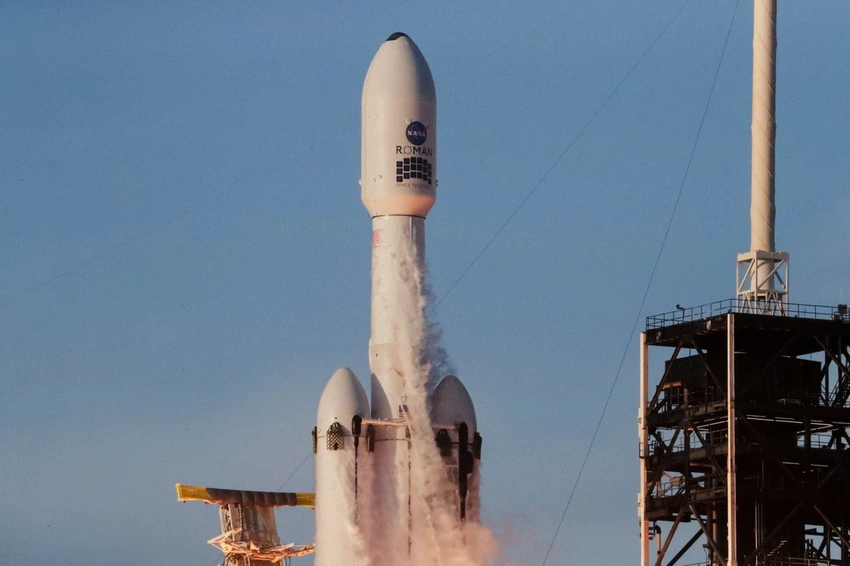
A new era of cosmic exploration has dawned! NASA successfully launched its latest flagship observatory, the Nancy Grace Roman Space Telescope, into space on Sunday. This ambitious mission, which saw the roughly $4 billion telescope lifted by a SpaceX Falcon Heavy rocket from NASA's Kennedy Space Center in Cape Canaveral, Florida, aims to unravel some of the universe's most profound mysteries.
Originally designed as a spy satellite for the National Reconnaissance Office, this remarkable instrument has been repurposed by NASA for scientific discovery. Its primary mission is set for five years, with the potential for another five, promising a decade of groundbreaking observations. Once positioned in its orbital location at Lagrange Point 2, approximately a million miles from Earth, the Roman Telescope will begin its vital work.
Scientists anticipate using its panoramic views to investigate cosmic enigmas such as dark energy and dark matter, test gravity across vast scales, and diligently search for exoplanets, planets orbiting stars beyond our solar system. Julie McEnery, the Roman telescope's senior project scientist, expressed the team's excitement, stating at a post-launch news conference,
It feels like I'm on the edge of a precipice, and we're just about to set a foot off into the unknown.
This sentiment perfectly captures the anticipation surrounding the telescope's 90-day commissioning period, after which it will commence its science operations, beaming back unprecedented data to Earth.
The launch marks not only a significant technological achievement but also a renewed commitment to understanding our universe.
With its advanced capabilities, the Nancy Grace Roman Space Telescope is poised to make discoveries that could redefine our knowledge of the cosmos, opening new windows into the vast expanse of space and the fundamental forces that govern it.
