AI Interior Design: A Creative Boost or a Homogenizing Force?
AI Interior Design: A Creative Boost or a Homogenizing Force?
Pinterest's new Restyle feature lets AI redesign your room. Is this the future of personalized decor, or will it make all our homes look the same?
The AI Design Revolution is Here
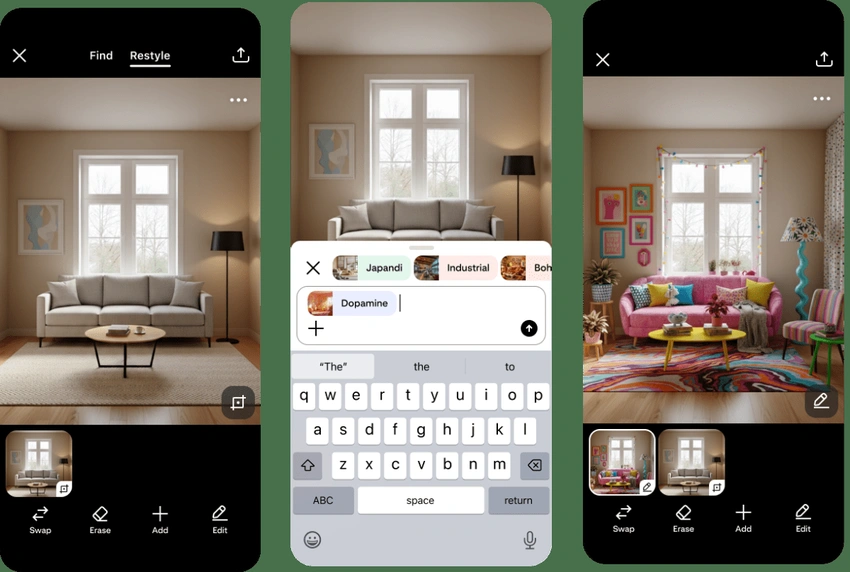
The future of home decor is here, and it's powered by artificial intelligence. Pinterest, a long-time hub for visual inspiration, is rolling out 'Restyle', a groundbreaking new feature designed to transform how we envision our living spaces. Imagine snapping a photo of your own room and then, with a simple prompt, instantly seeing it reimagined with new furniture, lighting, accessories, or even a completely different paint color.
It's about making those dreams tangible within your unique environment, pushing inspiration closer to actual purchase.
Democratizing Design for Everyone
Restyle is a powerful step towards democratizing interior design.
Suddenly, the ability to experiment with high-end aesthetics or trendy styles like “bohemian,” “industrial,” “whimsical,” or “dopamine” is at everyone's fingertips, without the need for expensive designers or countless hours moving furniture.
It's a sophisticated AI, built on Pinterest Intelligence, powered by robust technology like Nvidia Blackwell GPUs and Nvidia Dynamo, combined with open-source models.
The real game-changer? The ability to visualize items in your own space . Think about that friction point: you see a beautiful sofa online, but how will it look in your living room?
Restyle aims to solve this.
By seeing items in their own spaces, people may be more likely to buy the items they've saved to their boards, completing the funnel from pinning to purchase.
This feature is currently in beta in the U.S. and Canada and promises to roll out more broadly next month, giving millions the power of a digital interior decorator.
The Double-Edged Sword of AI Creativity
While the democratizing aspect of Restyle is undeniable, it also prompts a critical question: will AI foster or stifle creativity? On one hand, it can be a fantastic tool for ideation, offering endless possibilities and quick iterations that would be impossible manually. It allows users to play, to explore, and to push boundaries they might not have considered on their own.
However, there's a flip side. If everyone is prompting AI with similar requests or leaning on its predefined styles, could we see a homogenization of interior design? Will the unique, quirky, or unexpected design choices that make a home truly personal start to fade?
The beauty of human creativity often lies in its imperfections, its surprising juxtapositions, and the stories behind carefully curated items.
Navigating the Future of Home Decor
The key lies in how we use these powerful tools. Restyle isn't a replacement for human taste; it's an enhancement.
Users aren't just passive recipients of AI suggestions; they can actively engage.
They can also click on individual items in the room to swap them out, erase them from the image, or make further edits.
This level of control means that while AI can lay the groundwork, the final touch, the true personalization, still rests with the individual.
Ultimately, AI as an interior designer presents an exciting opportunity. It can empower countless individuals to feel confident in their design choices, making beautiful, personalized spaces more accessible than ever before. The challenge will be to leverage its power for exploration and inspiration, rather than allowing it to dictate a uniform aesthetic.
The future of design might just be a collaborative dance between human intuition and artificial intelligence.
