Radio Frequency Over Fiber (RFoF): The Complete Technology Guide

Radio Frequency Over Fiber (RFoF): The Complete Technology Guide
Introduction
Radio frequency over fiber commonly abbreviated as RFoF is a signal transport technology that converts RF electrical signals into optical signals for transmission over fiber optic cable, then reconverts them back to RF at the receiving end. Once considered a niche solution, RFoF has become a critical enabling technology for 5G infrastructure, defense systems, satellite communications, and electronic warfare platforms.
This guide breaks down what radio frequency over fiber is, how it works, where it is deployed, and what performance parameters matter most when selecting an RFoF solution. It also explores how leading RFoF providers are addressing growing frequency demands well above 6 GHz all the way to 67 GHz and beyond.
What Is Radio Frequency Over Fiber?
At its core, radio frequency over fiber is an analog photonic link. An RF transmitter (Tx) module accepts an RF electrical signal at its input, drives a laser (typically a directly modulated laser diode or an externally modulated laser using an electro-optic modulator), and launches the modulated light into a single-mode or multimode fiber. At the far end, a receiver (Rx) module uses a photodetector to convert the optical signal back into an RF electrical signal.
The key distinction from digital fiber transport such as CPRI or fronthaul links is that RFoF preserves the analog RF waveform with all its frequency and phase characteristics intact. This makes it ideal for applications where signal fidelity, wideband performance, and minimal latency are non-negotiable.
Why Use Fiber Instead of Coaxial Cable?
Coaxial cable suffers from significant RF signal loss that increases with both cable length and signal frequency. At higher microwave and millimeter-wave frequencies, this loss becomes prohibitive within just tens of meters. Fiber optic cable, by contrast, offers extremely low loss (typically 0.2 dB/km for single-mode fiber) that is essentially frequency-independent.
Key advantages of radio frequency over fiber compared to coaxial cable include:
- Very low and flat signal attenuation over long distances (kilometers vs. meters for coax)
- Immunity to electromagnetic interference (EMI), making it ideal for noisy RF environments
- Galvanic isolation between transmitter and receiver no ground loop problems
- Compact, lightweight fiber cables versus heavy and bulky coaxial cables
- Inherent security: fiber does not radiate RF signals and is difficult to tap without detection
- Support for wideband signals from MHz to tens of GHz on a single link
How Does an RFoF Link Work?
A complete radio frequency over fiber link consists of two main modules:
- Transmitter (Tx): Converts the RF input signal to an optical signal using a laser diode or electro-optic modulator.
- Receiver (Rx): Converts the optical signal back to RF using a photodetector (photodiode).
The system is bidirectional: a single fiber can support both uplink and downlink signals, typically using wavelength division multiplexing (WDM) to separate them. Many systems support multiple RF channels over a single fiber using CWDM or DWDM techniques.
Performance is characterized by several key parameters:
- Frequency range: The RF bandwidth the link supports, from as low as 1 MHz up to 67 GHz in high-performance systems
- SFDR (Spurious-Free Dynamic Range): A measure of linear dynamic range, critical for multi-carrier and high-fidelity applications
- Noise Figure (NF): Determines the sensitivity of the receiver lower is better
- Gain flatness: How consistent the link gain is across the full frequency range
- Optical power budget: The maximum allowable optical loss between Tx and Rx modules
Market Overview: Frequency Coverage Comparison
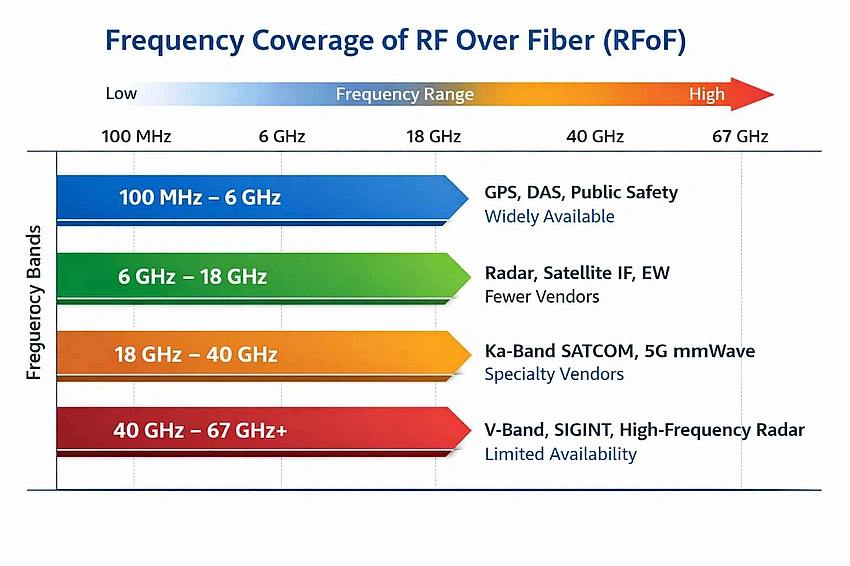
A key differentiator among RFoF vendors is frequency coverage. Most commercial off-the-shelf (COTS) RFoF products cover up to 3–6 GHz, which is sufficient for GPS distribution, cellular DAS, and public safety applications. However, applications in mmWave 5G (FR2, 24–40 GHz), Ka/V-band SATCOM, and electronic warfare require support up to 18, 40, or even 80 GHz.
The table below illustrates typical frequency coverage across the market:
<table><tbody><tr><td data-row="1">Frequency Range</td><td data-row="1">Typical Applications</td><td data-row="1">Market Availability</td></tr><tr><td data-row="2">100 MHz – 6 GHz</td><td data-row="2">GPS, DAS, public safety, C-band 5G</td><td data-row="2">Widely available</td></tr><tr><td data-row="3">6 GHz – 18 GHz</td><td data-row="3">X-band radar, satellite IF, wideband EW</td><td data-row="3">Fewer vendors</td></tr><tr><td data-row="4">18 GHz – 40 GHz</td><td data-row="4">Ka-band SATCOM, 5G FR2, mmWave radar</td><td data-row="4">Specialty vendors</td></tr><tr><td data-row="5">40 GHz – 67 GHz+</td><td data-row="5">V-band, EW/SIGINT, high-frequency radar</td><td data-row="5">Limited — specialty only</td></tr></tbody></table>
RFOptic offers RF over fiber solutions covering from 100 MHz up to 67 GHz using its High SFDR (HSFDR) product family, with external modulation technology enabling the high-frequency performance required for 5G FR2 testing, Ka-band SATCOM, and electronic warfare applications. Explore the full product range at rfoptic.com 🔗.
Key Applications of Radio Frequency Over Fiber
5G and Cellular Infrastructure
Radio frequency over fiber is widely used in 5G deployment for remote antenna units (RAUs), distributed antenna systems (DAS), and C-RAN (Cloud Radio Access Network) architectures. RFoF links transport the RF signal from the baseband unit to remote antenna locations, enabling coverage in tunnels, buildings, stadiums, and underground facilities where coaxial cable runs would be impractical.
For 5G New Radio (NR) in the FR2 (millimeter wave) band operating at 24 GHz, 28 GHz, and 39 GHz high-frequency RFoF solutions are required that support these frequencies natively, without downconversion.
Electronic Warfare and Radar
EW and radar systems require wideband RFoF links with very high dynamic range. Frequency coverage from L-band through Ka-band is often needed in a single platform. RFOptic's EW & Radar solutions 🔗 cover this market with HSFDR links designed for signal intelligence (SIGINT), radar calibration, and phased array antenna remoting.
Satellite Communications (SATCOM)
Ground station inter-facility links (IFL) have traditionally used coaxial cables or waveguide between the antenna and the indoor modem equipment. RFoF replaces this with low-loss fiber, supporting L, S, C, X, Ku, K, Ka, and V bands enabling greater separation distances between antenna and control room without signal degradation.
Defense and Military
Military platforms require EMI-immune, secure signal transport links. RFoF's inherent immunity to electromagnetic interference makes it ideal for shipboard, airborne, and ground vehicle installations. The absence of RF radiation from the fiber cable adds a layer of communications security (COMSEC).
Optical Delay Lines
A specialized application of RFoF technology is the Optical Delay Line (ODL), which uses the propagation delay of light through a known fiber length to simulate a precise time delay for radar and altimeter testing. RFOptic's Optical Delay Line product family 🔗 covers frequencies from 1 MHz to 67 GHz, serving both low-frequency and high-frequency radar calibration needs.
How to Select an RFoF Solution
When evaluating radio frequency over fiber products, engineers should consider:
- Frequency range: Does the link cover your full operating band, including harmonics and spurious signal considerations?
- Dynamic range (SFDR): How many carriers or modulation schemes need to coexist without intermodulation distortion?
- Noise figure: What is the minimum detectable signal level your system requires?
- Form factor: Is OEM module, benchtop, or rack-mount the appropriate packaging?
- Distance: How far does the signal need to travel? What is the available fiber budget?
- Management: Do you require remote monitor and control via SNMP, REST API, or a local GUI?
- Customization: Does the vendor support custom designs for specific frequency bands or mechanical constraints?
Frequently Asked Questions (FAQ)
What is the difference between RFoF and digital fiber transport (e.g., CPRI/eCPRI)?
RFoF is an analog link it transports the RF waveform directly in the optical domain without analog-to-digital conversion. Digital fiber links (CPRI, eCPRI, OBSAI) digitize the baseband signal and transport it as data. RFoF preserves the full analog RF signal, which is essential for wideband and high-fidelity applications such as EW, radar, and test & measurement.
What frequency does radio frequency over fiber support?
Off-the-shelf RFoF products typically cover 1 MHz to 6 GHz. High-performance systems from specialty vendors such as RFOptic extend this to 67 GHz and beyond using external electro-optic modulation, covering L through V bands in a single product family.
How long can an RFoF link operate over fiber?
Single-mode fiber links can operate over many kilometers with negligible RF signal degradation. The limiting factor is the optical power budget of the modules, not the fiber length. Multi-kilometer links are common in SATCOM ground stations and cellular C-RAN deployments.
Is radio frequency over fiber secure?
Yes. Fiber optic cables do not radiate RF signals and are extremely difficult to tap without causing detectable loss in the link. This makes RFoF inherently more secure than coaxial cable for sensitive government, defense, and intelligence applications.
What is SFDR and why does it matter for RFoF?
Spurious-Free Dynamic Range (SFDR) is the range between the smallest detectable signal and the point at which intermodulation products appear. Higher SFDR means the link can handle a wider range of signal levels and more simultaneous RF channels without distortion critical for multi-carrier cellular, radar, and EW applications.

Login to comment.
No thots yet. Be the first to share your thoughts!