How Bed Presence Monitoring Helps Nursing Homes Reduce Nighttime Fall Risks

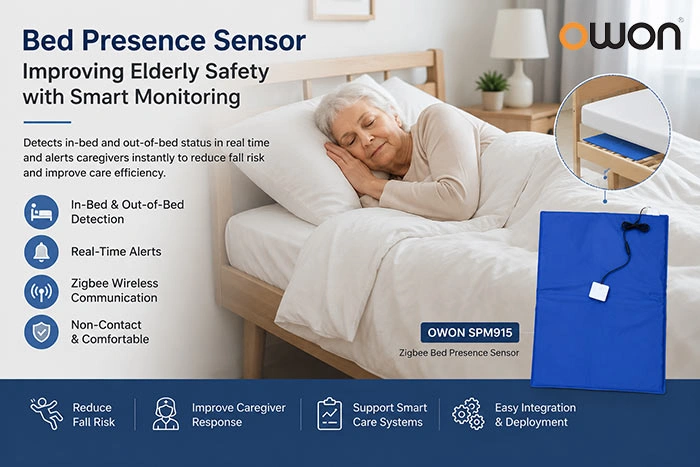
How Bed Presence Monitoring Helps Nursing Homes Reduce Nighttime Fall Risks
Learn how bed presence sensors improve elderly safety with real-time occupancy detection, fall prevention, and smart healthcare monitoring systems.
As populations age around the world, preventing falls and ensuring resident safety have become top priorities for nursing homes, assisted living facilities, hospitals, and home healthcare providers. One of the most effective technologies supporting this goal is the bed presence sensor 🔗.
Unlike wearable emergency buttons or camera-based monitoring systems, a bed presence sensor works automatically and continuously, detecting whether a person is in bed or has left the bed. This enables caregivers to respond more quickly when assistance is needed while allowing elderly residents to rest comfortably without wearing additional devices.
What Is a Bed Presence Sensor?
A bed presence sensor is a non-contact occupancy monitoring device designed to detect whether a person is lying in bed or has left the bed. The sensing element is typically installed beneath the mattress, allowing the system to monitor occupancy without disturbing the user.
Rather than measuring physiological parameters such as heart rate or respiration, the primary purpose of a bed presence sensor is to determine bed occupancy status and generate notifications when occupancy changes.
Typical monitoring functions include:
- In-bed detection
- Out-of-bed detection
- Real-time occupancy status
- Caregiver notification
- Long-term occupancy event recording
Because no wearable device is required, the technology is especially suitable for elderly people, rehabilitation patients, and individuals with limited mobility.
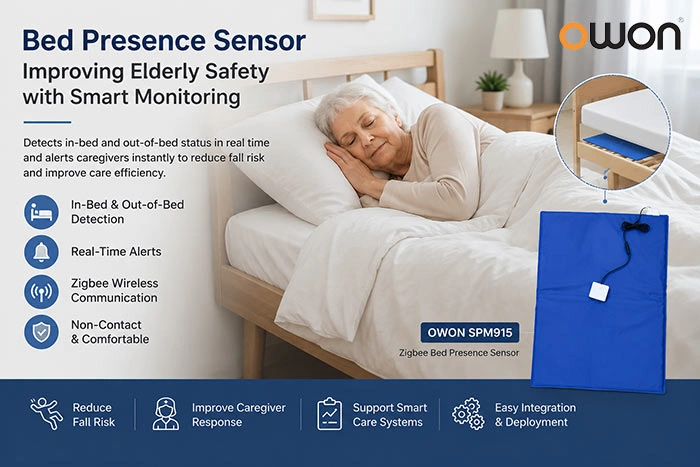
How Does a Bed Presence Sensor Work?
A bed presence sensor detects pressure or body presence through a sensing pad installed underneath the mattress.
When the occupancy status changes, the sensor immediately sends information to a connected gateway or healthcare monitoring platform. Depending on the system architecture, notifications can be delivered to:
- Caregiver mobile applications
- Nurse stations
- Smart healthcare platforms
- Nurse call systems
- Building management systems
Since monitoring is completely passive, residents do not need to learn how to operate the device, making it highly suitable for long-term elderly care.
Why Is Bed Presence Monitoring Important?
Falls remain one of the leading causes of injury among older adults. Many accidents occur when residents leave their beds at night without assistance.
A bed presence sensor helps caregivers become aware of these events immediately, allowing them to respond before a minor incident becomes a serious injury.
The technology offers several important benefits:
- Faster caregiver response
- Reduced fall risk
- Continuous nighttime monitoring
- Fewer unnecessary room checks
- Improved operational efficiency
- Better resident safety
Instead of performing routine manual inspections, caregivers receive notifications only when occupancy changes occur, improving both efficiency and quality of care.
Typical Applications
Bed presence monitoring is widely used in:
- Nursing homes
- Assisted living facilities
- Rehabilitation centers
- Hospitals
- Home-based elderly care
- Dementia care environments
As healthcare becomes increasingly digital, bed presence monitoring is also being integrated into IoT-based elderly care systems for centralized monitoring and reporting.
Example Solution: OWON SPM915 Zigbee Bed Presence Sensor
OWON offers the SPM915 Zigbee Bed Presence Sensor 🔗, designed specifically for elderly care and healthcare monitoring projects.
Key features include:
- Zigbee 3.0 wireless communication
- Real-time in-bed and out-of-bed detection
- Low power consumption
- Easy installation beneath the mattress
- Integration with Zigbee gateways and healthcare platforms
Unlike vital signs monitoring devices, the SPM915 focuses on occupancy detection, making it an ideal solution for projects where fall prevention and caregiver notifications are the primary objectives.
Why Bed Occupancy Sensors Are Becoming Standard in Smart Elderly Care
Today, healthcare providers often use the terms bed presence sensor and bed occupancy sensor interchangeably because both technologies help determine whether a resident is safely in bed or has left the bed.
A bed occupancy sensor 🔗 is increasingly deployed in nursing homes, assisted living facilities, rehabilitation centers, and smart healthcare projects to improve nighttime supervision while reducing unnecessary room checks.
For facilities implementing IoT healthcare solutions, integrating a bed occupancy sensor into a centralized monitoring platform allows caregivers to receive real-time occupancy notifications and respond more efficiently to potential fall risks.
The OWON SPM915 supports these applications through reliable Zigbee wireless communication and seamless integration with smart healthcare systems.
Choosing the Right Bed Presence Monitoring Solution
When selecting a monitoring solution, healthcare providers should evaluate:
- Detection reliability
- Wireless communication stability
- Easy installation
- Low maintenance requirements
- Compatibility with existing healthcare platforms
- Long-term product availability
- OEM and ODM support
Choosing the right technology partner is just as important as selecting the sensor itself, particularly for long-term healthcare deployments.
Bed Presence Monitoring Solutions for Healthcare and OEM Partners
As elderly populations continue to grow worldwide, healthcare providers, distributors, and system integrators are increasingly investing in intelligent occupancy monitoring technologies.
OWON provides the SPM915 Zigbee Bed Presence Sensor, supporting real-time occupancy monitoring for nursing homes, rehabilitation centers, hospitals, and assisted living projects.
With Zigbee connectivity, low power consumption, and flexible integration capabilities, the SPM915 is suitable for OEM and ODM partners developing smart elderly care platforms and healthcare monitoring systems.
If your project requires a reliable bed occupancy sensor for elderly care or healthcare applications, OWON can provide product customization, private branding, long-term manufacturing support, and technical integration assistance.
FAQ
What does a bed presence sensor detect?
It detects whether a person is currently lying in bed or has left the bed, allowing caregivers to receive real-time occupancy notifications.
Is a bed presence sensor the same as a bed occupancy sensor?
In most elderly care and healthcare applications, the two terms describe the same type of occupancy monitoring technology. Both are designed to detect bed occupancy status and improve resident safety.
Does the SPM915 monitor heart rate or respiration?
No. The SPM915 is designed for occupancy monitoring only. If your project requires heart rate and respiration monitoring, products such as the OWON SPM912 or OWON SPM913 are more suitable.
Can the SPM915 integrate with Zigbee healthcare systems?
Yes. The SPM915 supports Zigbee 3.0 communication and can be integrated with Zigbee gateways and IoT healthcare platforms for centralized monitoring and automated notifications.
Conclusion
A bed presence sensor is an effective solution for improving elderly safety through continuous occupancy monitoring. By detecting in-bed and out-of-bed events in real time, caregivers can respond more quickly, reduce fall risks, and improve operational efficiency.
As smart healthcare and elderly care systems continue to evolve, technologies such as the OWON SPM915 Zigbee Bed Presence Sensor provide healthcare providers and OEM partners with reliable, scalable solutions for modern occupancy monitoring.
