Global Markets Reel as US Strike Fuels Oil Surge, Fed Rate Hike Looms

Global Markets Reel as US Strike Fuels Oil Surge, Fed Rate Hike Looms
Asian shares and US futures tumble, while oil prices soar after a US strike on Iranian rocket launchers and renewed Federal Reserve rate hike concerns. Investors brace for volatility.
Global financial markets experienced a turbulent start to the week, with Asian shares and U.S. futures retreating significantly. This downturn was largely driven by two key factors: renewed expectations that the U.S. Federal Reserve will soon raise interest rates and a sudden escalation of tensions in the Middle East following a U.S. military strike on Iranian rocket launchers.
Investors reacted swiftly to comments from Fed Chairman Kevin Warsh, whose recent speech reinforced the likelihood of the U.S. central bank taking aggressive measures, including interest rate hikes, to curb inflation. This hawkish stance has dampened market sentiment, as higher rates can slow economic growth and reduce corporate profitability, leading to a pull-back from riskier assets.
The geopolitical landscape added further pressure, particularly to energy markets. Oil prices surged by approximately 3% after U.S. forces struck Iranian rocket launchers on the Strait of Hormuz. This marked the first military action by the U.S. in the region in a month, signaling a potential shift from economic pressure back to open conflict, which poses significant risks for the volatile Middle East.
Brent crude, the international standard, jumped 2.9% to $90.61 per barrel, while U.S. benchmark crude oil soared 2.7% to $85.66 per barrel. Stephen Innes of SPI Asset Management commented,
The Middle East had finally gone quiet enough for oil traders to start sanding some of the war premium out of crude. Then Sunday arrived, with a reminder that quiet in the Strait of Hormuz is not the same as peace.
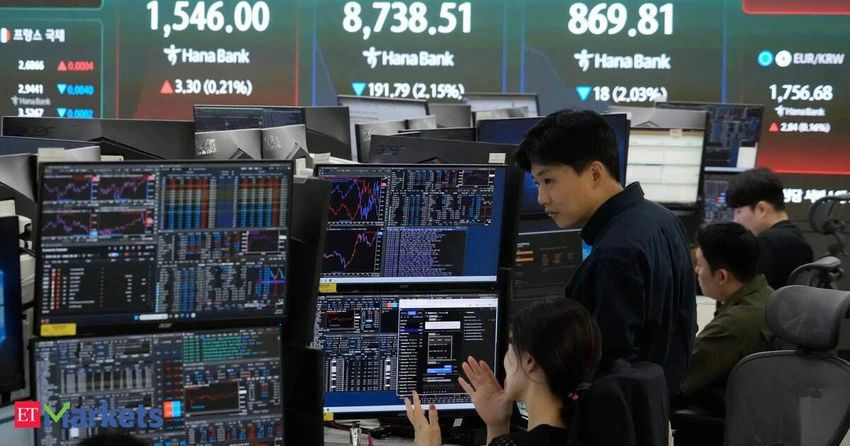
Specific market indices across Asia reflected this apprehension. In Tokyo, the Nikkei 225 lost 0.4%, while South Korea's Kospi declined 0.5%. Hong Kong's Hang Seng also fell 0.4%.
Australia's S&P/ASX 200 was down 0.2%, and Taiwan's Taiex dipped 0.4%.
The Shanghai Composite index, however, showed a slight gain of 0.4%, bucking the regional trend.
The confluence of a tightening monetary policy outlook and heightened geopolitical risks has created an environment of considerable uncertainty for investors worldwide. As central banks grapple with inflation and international relations remain tense, market volatility is expected to persist, leaving traders and economists closely watching for further developments on both fronts.
