The 'Sameness' Trap: Why AI-Generated Food Leaves Us Cold

The 'Sameness' Trap: Why AI-Generated Food Leaves Us Cold
Ever seen an AI-generated menu and felt something was off? It's not just you. Discover why perfect symmetry and "pleasing" aesthetics lead to unappetizing results. The future of food visuals is here, but is it good?
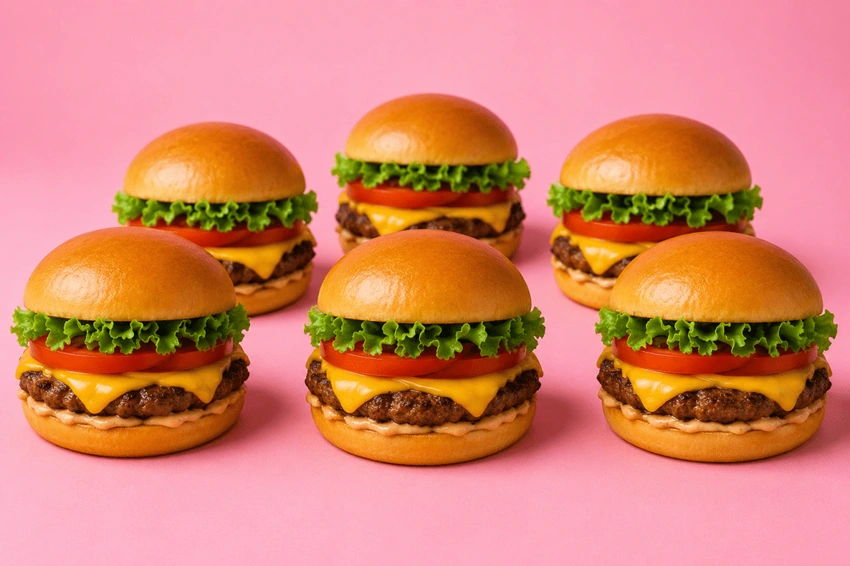
Have you ever looked at a digital menu or an online food advertisement and felt a strange, unsettling disconnect? The image is perfect, perhaps too perfect. Every bagel sandwich looks flawlessly symmetrical, every ice cream scoop impossibly round, every burrito unnervingly smooth.
It's a subtle unease, a gut feeling that something is just… off.
It's the “sameness problem” of generative AI, particularly in the realm of food imagery.
While the promise of AI for quickly sprucing up restaurant menus sounds tempting, the reality often falls flat. The models, trained on vast datasets, identify patterns to create what they think is appealing.
The catch? Their definition of “appealing” is a narrow, homogenized aesthetic that lacks the organic imperfections and subtle variations that make real food look appetizing.
Take, for instance, a burrito where the cheese is so bubbly and melty it transcends deliciousness and ventures into avant-garde art. Or shrimp that seem genetically modified to curl into perfect, identical circles, what some call “Lovecraftian food horrors.” These aren't just minor visual glitches; they're symptoms of a deeper issue. The images become so ordinary, so perfectly generic, that they lose their soul.
As Alex Lisle, CTO of Reality Defender, succinctly puts it,
It's almost like an alien trying to make a pizza without understanding its core principles.
This analogy hits the nail on the head. AI can replicate visual patterns, but it struggles to capture the underlying essence, the messy, delicious truth of food. The result is often a sterile, uncanny valley experience that makes customers instinctively recoil.
This isn't just a challenge for restaurant owners trying to cut costs on photography. It points to a broader limitation in how current generative AI models perceive and recreate the world. They learn from what already exists, identifying common denominators, which can lead to a bland uniformity.
Lisle also notes that, frankly, "A lot of this stuff looks like a Chili's menu from 2015." While nostalgic for some, it's not exactly the cutting edge of culinary appeal.
Companies like Reality Defender are emerging to combat this, offering AI-detection and content-verification tools. Their existence highlights the growing need to distinguish between genuinely creative, authentic content and the subtly manufactured output of AI.
The Future of Flavorful AI
The takeaway here isn't that AI is inherently bad for visual content. Rather, it's a critical call to action for developers and users alike.
We need to demand more from our AI, models that understand nuances, embrace imperfections, and break free from sterile perfection.
The goal should be to use AI to augment creativity, not to replace authenticity with an unappetizing sameness.
Our taste buds, and our wallets, will thank us.

Login to comment.
No thots yet. Be the first to share your thoughts!