America's Robot Race: Inside the Global Humanoid Challenge

America's Robot Race: Inside the Global Humanoid Challenge
The US is pushing for homegrown humanoid robots, but a key challenge looms: global supply chains dominated by China. We dive into the aspirations, realities, and the fierce tech competition.
The Global Humanoid Robot Race: Where Ambition Meets Reality
We're seeing a clear push for the United States to lead the charge in humanoid robotics. It's an exciting vision, robots that look and move like us, transforming industries from healthcare to logistics. But let's be real for a moment: the journey to building these advanced machines, especially ones made entirely on American soil, is anything but straightforward.
We're talking about a challenge of a totally different magnitude.
Take Robo Inc., for example. Founded by a serial entrepreneur who's tackled everything from drone photography and bitcoin mining to importing protective gear during the COVID-19 pandemic, this venture aims to plant a flag for US robotics.
But even a seasoned go-getter like this entrepreneur, who plans to procure components globally while manufacturing some in-house, quickly hit a stark realization: China has near-total dominance over the supply chain for critical robot parts. Trying to build a robot entirely free of Chinese components? Not practical.
Companies that attempt this often find themselves with a significantly more expensive product, not necessarily a better one. It's simply more cost-effective to import certain parts, like high-performance batteries or the aluminum skeletons that form a robot's body. As one insider put it,
There are some pieces that are already dialed in - what are you doing changing them?
It's about a strategic imperative. China has explicitly designated robotics as a strategic priority, investing heavily and building a formidable manufacturing ecosystem. This sets up a fascinating, and frankly, intense competition on a global scale.
We've already seen the United States and China vying for supremacy in artificial intelligence and semiconductors.
Now, humanoid robots are increasingly emerging as the next major battleground in this tech rivalry.
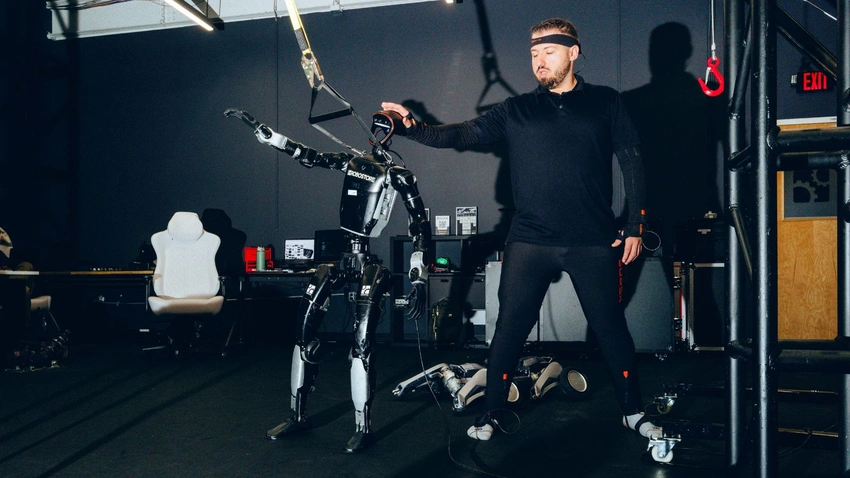
From his office in Plainview, New York, where Robo Inc.'s workshop is littered with spare robot heads and hands as engineers build custom parts for warehouse and healthcare applications, the founder finds himself caught between the aspiration of US domestic production and the undeniable reality of global interdependencies. The prediction? We're likely heading toward a more fragmented global market for humanoids.
Chinese robot companies will continue to dominate their home turf, while US companies like Robo Inc. will focus on competing for customers primarily within the United States.
What does this mean for the future?
It's a testament to innovation, adaptability, and the sheer grit required to navigate complex global dynamics.
While the dream of an entirely US-made humanoid robot faces significant hurdles, the drive to push boundaries and establish a robust domestic robotics industry remains strong.
The competition is fierce, the supply chains are intricate, but the ambition to build the next generation of human-like machines is very much alive.
