Rumor of Nigeria Banning white and British models sparks Global Debate on race in Ads

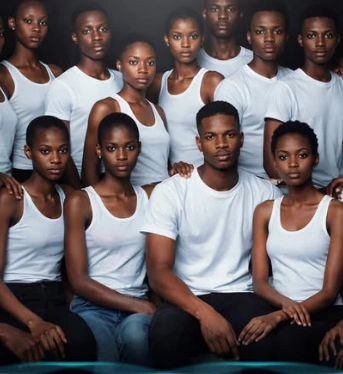
Rumor of Nigeria Banning white and British models sparks Global Debate on race in Ads
A viral post claims Nigeria banned white and British models from advertising, amplified by Elon Musk and other accounts. The allegation lacks evidence and fuels a broader debate on race, representation, and accountabilit
From Tuesday to Thursday, several of the high-follower mini-blog accounts of X circulated a rumor that Nigeria had banned white and British models from all advertising. The initial post, which was posted on Tuesday, was further popularized with the testimony of some high-profile personalities, among them being Elon Musk, the owner of the platform, and this resulted in users from other countries also taking it.
The X account Wild Videos was the one who originally posted it on Tuesday. The post reads,
“Nigeria becomes the first country to ban white & British models in all advertising. ‘We have 200M beautiful people here.. we will use our own.”
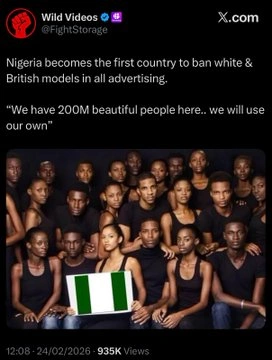
Some people presented the assertion as evidence of reverse racism, whereas other people demanded that European countries should impose matching restrictions against Black immigrants.
An account, @Fenrirtheicewo1, posting as Fenrir the Ice Wolf, wrote on February 24: “Isn’t this racism and segregation? How is this ok and everything else has to include them?”
The language used in the reactions targeted racism and segregation, which showed the policy as an exclusionary measure against particular groups instead of a standard regulatory decision. Musk's response, which lasted only two seconds as a "hmm" generated part of the reactions because he had supported conservative nationalist policies throughout his career in both the United States and European nations.
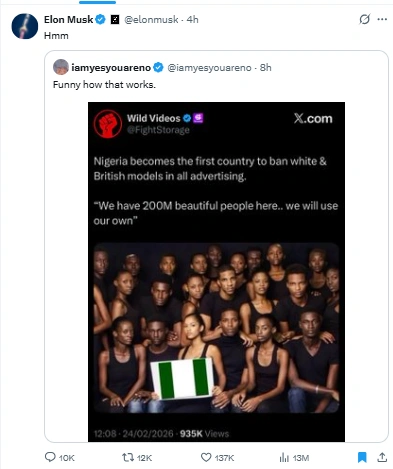
The statement that claims Nigeria has prohibited "white and British models" contains false information, according to the facts.
The Actual Fact
FIJ found that the original directive was issued on August 22, 2022, by the Advertising Regulatory Council of Nigeria (ARCON), which serves as the official organization that controls advertising and marketing communications in Nigeria. In the directive, ARCON stated that starting from October 1, 2022, all foreign models and voice-over artists would be banned from appearing in advertisements that targeted the Nigerian marketplace. The policy applies to all foreign nationals regardless of their race or country of birth.
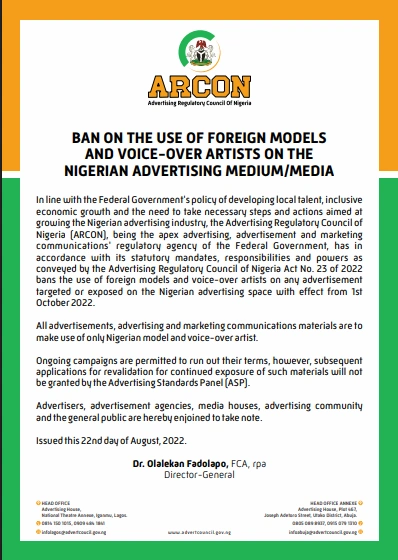
The directive says that the measure is in line with the Federal Government's goal of developing local talent and encouraging economic growth in the Nigerian advertising industry that includes everyone. It says that all ads shown in Nigeria must use Nigerian voice-over artists and models. Existing campaigns could continue, but renewal requests for more exposure would not be granted. The Advertising Regulatory Council of Nigeria Act No. 23 of 2022 gave rise to the policy, which was signed by ARCON's Director General, Olalekan Fadolapo.
Restricted By Nationality, Not Race
Unlike what has been portrayed in the media, ARCON is not restricting models based on their race, but rather, they are implementing regulations that will be enforceable based on the nationality of the model. For example, a black British model will be limited in their advertising work in Nigeria just as a white American or Asian European model if they are not a citizen of Nigeria.
Furthermore, the Regulation does not stop foreign people from coming into Nigeria to live and work in other industries. The Regulation only applies to advertising materials that are targeted at the Nigerian consumer market.
The most important point to clarify is that this is not a new Regulation. The original Regulation was issued nearly four years ago and went into effect in October 2022. The news reports that were written do not indicate that there has been a new Regulation covering the ban of any specific British or white model. As of the date of this report, there has been no official communication from ARCON that indicates there is any new ban on any model outside of the 2022 Regulation.
