How CRM in Software Engineering Is Transforming Business Solutions
How CRM in Software Engineering Is Transforming Business Solutions
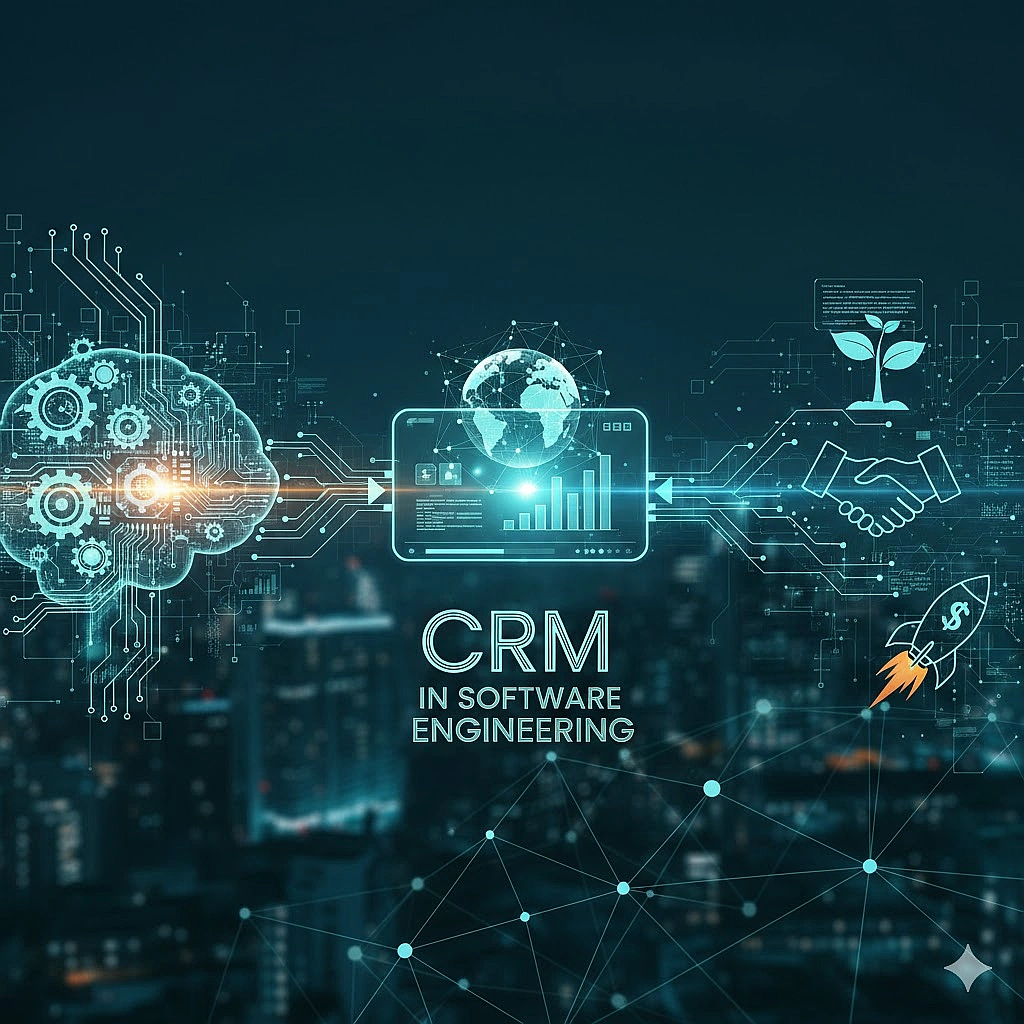
In today's fast-paced digital world, businesses can no longer afford to treat customer relationships as an afterthought. Every interaction, every lead, every touchpoint matters. That's where CRM in software engineering comes into play — transforming how companies operate, scale, and grow. In this post, we'll dive deep into CRM in software engineering and CRM development, see how they're reshaping business landscapes, and highlight what this means for forward-thinking organizations (like yours).
Introduction: Why CRM & Software Engineering Must Go Hand in Hand
Think of your customers as the heartbeat of your business. A great product can bring them in, but meaningful engagement and retention keep them. As companies grow, the number of interactions, channels, and data points explodes. Without a robust system in place, you risk dropping balls, losing context, and frustrating customers.
That's where combining CRM with software engineering becomes a game-changer. Rather than just deploying an off-the-shelf CRM tool, crm development ensures your system evolves alongside your business — tailored, flexible, and deeply integrated. In essence, CRM in software engineering 🔗 lets you turn transactional data into strategic insight and action.
In this blog, we'll walk through what CRM means in a software engineering context, explore how its development has evolved, examine challenges, and peek into future trends.
What Exactly Is CRM in Software Engineering?
CRM: More Than a Rolodex Replacement
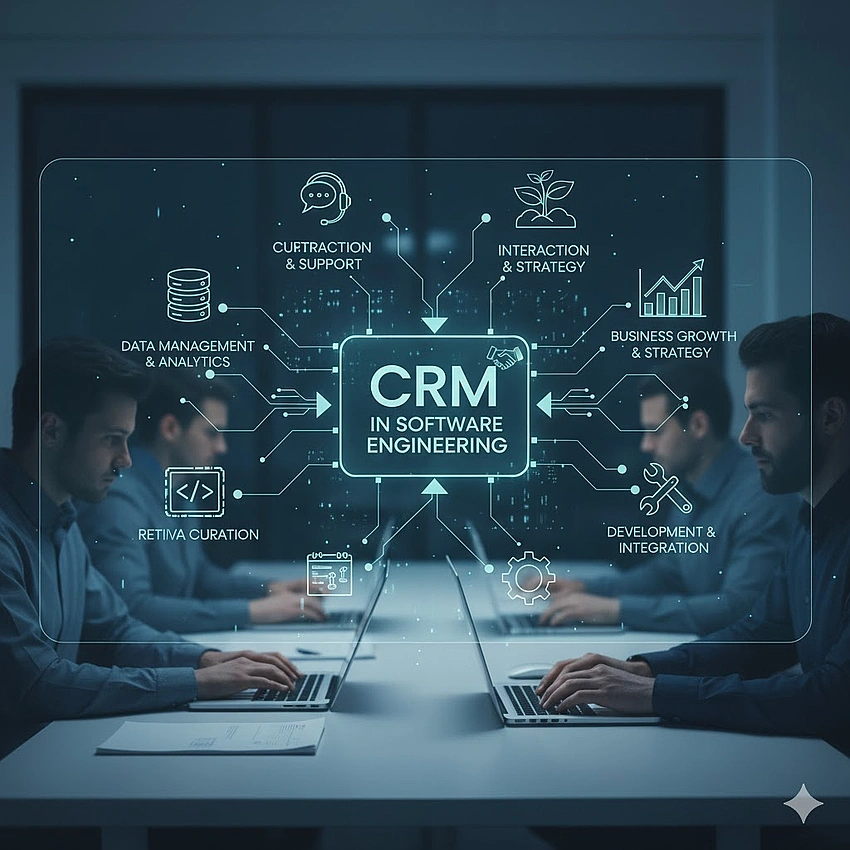
Customer Relationship Management (CRM) is commonly thought of as software to store contacts and track leads. But that definition is outdated. Modern CRMs unify sales, marketing, support, analytics, and more — offering a 360° view of every customer.
Melding CRM with Engineering Principles
When you embed CRM into your software engineering processes:
- It becomes a core system, not an afterthought.
- CRM features are built with scalability, modularity, and maintainability in mind.
- Your development teams treat CRM workflows (lead capture, scoring, lifecycle transitions) like any other mission-critical module.
- Upgrades, integrations, customization — all work smoothly as your architecture evolves.
In short: crm in software engineering means designing, building, and evolving your CRM as a first-class software system — rather than bolting it on as a "nice-to-have."
Why Off-the-Shelf Won't Always Cut It
Off-the-shelf CRM systems are great for many businesses. But when your processes become unique, your data flows complex, or you require deep integrations, these rigid systems start to hamper you. That's where crm development (custom building or heavily customizing CRM systems) comes in — providing flexibility, control, and differentiation.
The Evolution of CRM Development
The Early Days: Simple Contact & Lead Trackers
Initially, CRMs were simple databases: names, emails, deals, and notes. They were digital Rolodexes with basic workflows. For many small businesses, that was enough.
The Cloud & SaaS Revolution
With cloud computing and SaaS adoption, CRM systems moved online. Users no longer had to host servers; updates became seamless; accessibility exploded. CRMs like Salesforce, HubSpot, and Zoho led the way.
The Era of Integrations & Modular Architectures
As businesses adopted more software (ERP, CMS, marketing tools), the need to integrate became crucial. Modern CRMs became modular — plug into other services via APIs and microservices.
Intelligence, Automation & Predictive Analytics
Now we're in the era of intelligence. CRM systems are embedding AI/ML, chatbots, predictive lead scoring, and advanced analytics. You don't just store data — you derive insights.
Thus, crm in software engineering isn't just about building databases — it's about weaving intelligence, automation, and adaptability into systems that grow with you.
Key Features That Make Modern CRMs Powerful
Let's talk about what sets the next-gen CRMs (especially custom-built ones) apart. These are the features you should expect if you're aiming to lead — not just lag.
Unified Customer Hub & 360° Views
Every interaction — inquiry, email, purchase, support ticket — should tie back to a central customer profile. A holistic view empowers better decision-making (and no more "why didn't we know this before?" moments).
Advanced Data Analytics & Predictive Insights
With proper instrumentation, your CRM development can include:
- Lead scoring models (who's likely to convert)
- Churn prediction
- Segment-level insights
- Trend detection over time
These insights help you act — not just report.
Workflow Automation & Orchestration
Think beyond "send email when lead status changes." In a custom CRM, you can:
- Chain multistep campaigns (email → call → nurture)
- Trigger internal alerts
- Automate handoffs (sales → success)
- Enforce SLAs and escalations
Deep Integration Capabilities
CRMs seldom stand alone. A strong architecture ensures smooth interaction with:
- ERP, finance, billing
- CMS/content systems
- Marketing automation
- Chat & communication tools
- Data warehouses / BI systems
Custom Dashboards, Reporting & Visualizations
Every business has unique KPIs. Custom CRM development allows building dashboards that align with those metrics, supporting informed decisions in real time.
Scalability, Performance & Security
As your user base grows and your data volume explodes, performance must not suffer. In crm in software engineering, you build with:
- Proper data partitioning
- Caching & indexing strategies
- Audit trails & role-based access
- Encryption, data masking, compliance support
Without these, your CRM is a ticking time bomb.
How CRM in Software Engineering Transforms Business Operations
Let's get concrete. What real improvements can you expect by tightly combining CRM with software engineering?
✅ Enhanced Customer Engagement & Satisfaction
Because your CRM is tailored to your journey, you can respond to customers faster, personalize communication, and predict what they need next.
✅ Break Down Silos Among Teams
Sales, marketing, support, operations — all working off the same data. No more "I didn't know that was already done," or manual Excel handoffs.
✅ Data-Driven Decision Making
With real-time dashboards, predictive metrics, and well-integrated data, decision-making becomes proactive rather than reactive.
✅ Greater Efficiency & Productivity
Automation handles repetitive workflows. Engineers, marketers, and sales folks spend time on value-add tasks, not manual operations.
✅ Personalization at Scale
With analytics and segmentation, you can tailor messaging, recommendations, and experiences. That helps in retention, cross-sell, and upsell.
✅ Competitive Differentiation
When your CRM is custom-built, you can build unique features your competitors don't have — frictionless onboarding, edge reports, or internal workflows that become secret weapons.
The Role of Software Engineers in CRM Development
Let's zoom in on how software engineers bring CRM systems to life (and keep them running smoothly).
System Design & Architecture
Engineers choose data models, modular layers, APIs, microservices, and integration patterns. They ensure the CRM can scale, evolve, and remain maintainable.
Front-End / UX / UI
The user interface must be intuitive. Engineers—and sometimes designers—bridge functionality and ease-of-use. After all, a robust CRM is worthless if your team can't use it.
Backend & Data Engineering
From database schemas to indexing, caching, ETL pipelines, and data flows — this is the backbone. Engineers ensure data integrity, performance, and security.
Integration Engineering
Connecting with third-party tools, external APIs, and legacy systems is a significant component. Engineers build adapters, webhooks, sync mechanisms, and error-handling layers.
Testing, QA & Reliability
Unit testing, integration tests, performance testing, stress testing — they all guard against breakdowns. Continuous integration (CI) and continuous deployment (CD) pipelines help deliver updates safely.
Maintenance, Upgrades & Iteration
A CRM is never done. Engineers continuously refine features, handle bug fixes, ensure backward compatibility, and evolve modules as business needs shift.
Security & Compliance
Data protection is non-negotiable. Engineers implement access controls, audit logs, encryption, backups, and compliance with GDPR, HIPAA, or other relevant standards.
Collaboration with Stakeholders
Engineers closely collaborate with product teams, sales, marketing, and customer success to ensure the CRM supports real business workflows — closing the gap between code and value.
Real-World Applications & Case Studies
Theory's great, but real stories inspire. Here are hypothetical + illustrative case studies and industry use cases where crm in software engineering made a difference.
🏥 Healthcare: Patient Relationship & Follow-up
A hospital group built a custom CRM to track patient interactions: appointment reminders, follow-up care, feedback, billing, and care continuity. By integrating with EMR (electronic medical records), they reduced no-shows by 30%, improved patient satisfaction, and cut administrative overhead.
🛒 Retail / eCommerce: Omnichannel Customer Journeys
An online brand developed a CRM that ingested data from the web, mobile app, chat, and in-store. Their system automatically segmented VIP customers, triggered personalized discounts, and predicted churn. They saw a 20% lift in repeat purchases and better lifecycle value.
💼 B2B SaaS: Lead Scoring & Customer Success
A SaaS company built a custom lead scoring system that combined usage analytics, product behavior, and demo interactions. Their CRM triggered outreach by the success team or sales team at optimal times. The result: conversion climbed and churn dropped.
🏗 Manufacturing / Industrial: Complex Sales Cycles
In industries with long sales cycles and multiple stakeholders, they built custom workflows in CRM — from proposal generation to approvals, technical reviews, and after-sales service. It reduced miscommunications, shortened cycles, and improved margins.
✨ Thoth-style Content/Media Business (Hypothetical)
Imagine a content platform (similar to Thoxt) building a CRM to manage creators, sponsors, advertisers, and readers. Each group has unique lifecycles. The custom CRM helps:
- Track creator onboarding & quality metrics
- Automate outreach to sponsors
- Monitor ad campaigns and performance
- Manage payments, disputes, and analytics
With a tailored CRM, the platform can scale, maintain high service quality, and keep all stakeholders delighted.
Challenges in CRM Development: What to Watch Out For
Of course, building your own CRM (or heavily customizing one) is not without challenges. Awareness is key to mitigating risks.
🔒 Data Privacy & Regulatory Compliance
Handling customer data means obeying laws (GDPR, CCPA, HIPAA, etc.). Your CRM must support data deletion, consent, data masking, and transparency.
🔗 Integration Complexity
Legacy systems (ERP, finance, inventory) may not be API-friendly. Syncing data, avoiding duplication, handling failures — these require careful engineering.
🎢 Scalability & Performance Bottlenecks
What works for 100 users may break at 10,000. Proper architecture (sharding, caching, scaling) is vital to avoid future collapse.
👥 User Adoption & Change Resistance
A system is only as good as its adoption. Training, onboarding, intuitive UI, and stakeholder buy-in are crucial. Many CRMs fail because users find them too cumbersome or irrelevant.
🧩 Feature Creep & Overengineering
It's tempting to build "everything." But that leads to priority creep, delays, and unusable features. Focus on MVP and evolve smartly.
📊 Data Quality & Governance
Garbage in, garbage out. Ensuring clean, deduplicated, updated data is more complex than it looks. Processes, validation, and cleanup routines are needed.
🔄 Maintenance Burden
Custom systems need constant attention — bug fixes, upgrades, evolving compliance, and architecture refactors. You must budget for that.
💸 Time & Cost
Developing a CRM can get expensive. Always weigh the ROI. In many cases, integrating or customizing existing platforms might be more economical.
The Future of CRM in Software Engineering
What's next? Let's peer ahead at exciting trends and what they might mean.
🤖 AI, ML & Predictive Automation
Expect CRMs to become more autonomous — predicting future actions, auto-scheduling follow-ups, crafting contextual content, and even handling simple customer requests via chatbots.
🔀 Multi-Experience & Conversational Interfaces
Voice, chat, AR/VR, IoT — CRMs will adapt to new interfaces. Talking to your CRM via voice or interacting via chat seamlessly will be more common.
🧬 Hyper-Personalization & Next-Gen Segmentation
CRMs will dig deeper: dynamic segments, behavior-based triggers, micro-segments, individual customer journeys—everything customized, everywhere.
☁️ Headless / API-First Architectures
CRMs will drift further away from monolithic UIs — instead, offering robust APIs that let you build front ends (mobile, web, embedded) your way.
🌀 CRM as Platform — Ecosystems, Marketplaces
Much like app stores, CRMs will host plug-ins, extensions, and ecosystems where third parties build modules your business can adopt.
🔐 Privacy-by-Design & Data Ownership Models
With rising awareness, CRMs will embed privacy controls deep inside — data portability, customer control, encryption, consent management.
🌐 Decentralized Data & Blockchain
Some innovative CRMs may explore decentralized identity, distributed ledgers for audit trails, and trust layers controlled by users.
How to Start Your CRM Journey (Practical Steps)
If you're convinced (or at least intrigued) and want to begin, here's a practical roadmap:
1. Clarify Business Goals & Use Cases
Don't start with features. Begin with business outcomes. Which processes need improvement? What KPIs will change?
2. Audit Existing Systems & Data
What you already use (ERP, marketing, support tools) — map data sources, compatibility, gaps, and pain points.
3. Define MVP Scope
Pick essential features first — lead capture, basic workflow, reporting, and integrations. Launch fast, iterate.
4. Choose Technology Stack
Decide between monolithic vs microservices, database tech, messaging systems, API frameworks, and front-end frameworks.
5. Design Data Models & Integration Layers
Think through entities (leads, accounts, contacts, interactions), relationships, sync mechanisms, and error handling.
6. Build & Iterate with Agile
Use sprints, continuous feedback, user testing, and incremental delivery. Don't build everything in one monolithic push.
7. Plan for Scalability & Security from Day One
Don't defer these to "phase 2." Build secure authentication, RBAC (role-based access), logging, encryption, and performance considerations early.
8. Promote User Adoption
Train your teams, gather feedback, make UI simple, and provide incentives. The best tech fails if people don't use it.
9. Monitor, Measure & Improve
Track metrics (lead-to-deal conversion, engagement, response times). Use dashboards. Continuously refine features.
10. Expand with New Features & Intelligence
Once your foundation is stable, add AI-based scoring, chat automations, predictive modules, integrations, and more intelligent workflows.
Conclusions & Takeaways
Building a CRM is no longer just a "nice to have" for growing businesses — when tied into software engineering, it becomes a strategic backbone. CRM in software engineering means thinking of customer systems as mission-critical software: scalable, intelligent, integrated, and evolving.
By investing in crm development, companies gain control, flexibility, and differentiation. Yes, there are challenges — from integration complexity to adoption hurdles — but with careful planning and execution, the payoff is enormous: enhanced customer relationships, streamlined operations, and deeper insights.
If you're thinking about stepping into this space (or refining your current CRM setup), now is the time. A well-built, engineered CRM can evolve from 'tool' to 'strategic weapon.
