We Don't Talk Anymore

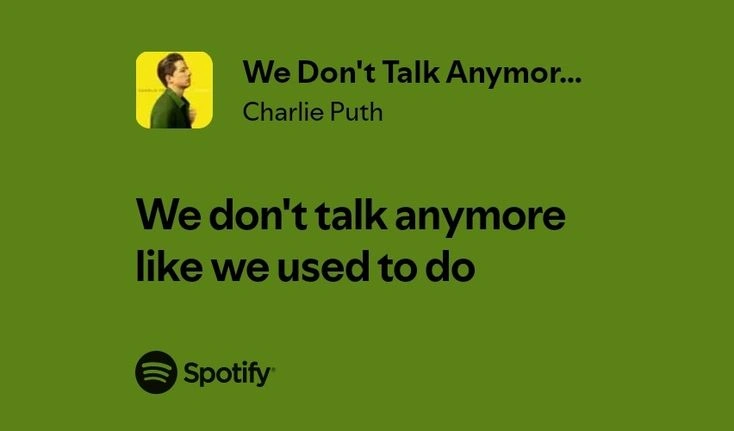
We Don't Talk Anymore
We Don't Talk Anymore
There is something really strangely difficult about endings that arrive quietly.
Not every relationship ends with a clear argument, a dramatic goodbye, or a moment that allows you to say, this is where everything changed. Sometimes two people simply begin speaking less. Replies take longer. Conversations lose detail. Familiarity fades in ways so gradual that by the time silence becomes obvious, it has already settled in.
And then one day, without ever deciding it properly, you realize: we don’t talk anymore.
What makes this kind of ending painful is that nothing visible seems broken enough to justify how much it hurts. There is no single scene to return to, no sharp event to explain why someone who once knew the smallest details of your day now exists outside your daily life entirely.
Yet silence has its own weight.
Often, it is heavier than words because silence leaves too much room for interpretation. A goodbye gives shape to loss; silence leaves it unfinished.
When you stop talking to someone who once occupied a large part of your emotional routine, you not only lose the person, but also the rhythm built around them. The small habits remain longer than expected. Reaching for your phone when something happens. Thinking of how you would phrase a story to them. Seeing something ordinary and instinctively imagining their reaction.
These habits outlive contact because memory is slower than reality.
That is why silence after closeness feels so strange. Your mind often continues the conversation long after the conversation itself has ended.
There is also something particularly painful about losing a person who once knew your ordinary self. Not just the curated version, not the version that appears in public, but the version built through repeated everyday moments: late conversations, unnecessary details, moods explained without effort, silences that did not require explanation.
You miss being understood without introduction.
You miss someone who knew what certain days meant, why certain songs mattered, why some moods required no explanation.
And yet, life continues in a way that feels almost unfairly normal.
Classes continue. Deadlines remain. Friends speak. Days pass. The world does not pause simply because someone has become distant.
That is one reason quiet endings can feel lonely: externally, nothing dramatic is happening, while internally something significant has shifted.
The phrase we don’t talk anymore sounds simple, but it contains many things beneath it: distance, pride, timing, unresolved feelings, sometimes mutual protection, sometimes emotional exhaustion.
Sometimes people stop talking because there is too much left unsaid. Sometimes because saying more would only reopen what cannot be repaired. Sometimes because silence becomes easier than explaining how much has changed.
And sometimes there is no clear reason except that closeness no longer survives naturally.
This can be difficult to accept because modern relationships often teach people to look for clear causes. We want explanations that feel proportional to loss. But many connections fade not through dramatic betrayal, but through small shifts repeated quietly.
One of the hardest parts of not talking anymore is realizing that care can remain even when contact ends. People often assume silence means complete emotional closure, but that is rarely true. It is possible to stop speaking and still think in someone’s direction. To move through life while certain memories still arrive unexpectedly. To genuinely wish someone well while no longer being part of their daily world.
Sometimes two people who once spoke every day eventually become people who only exist in memory, without either person becoming entirely unimportant.
And perhaps maturity is learning that not every ending needs to become bitterness to be real.
Sometimes we don’t talk anymore is not a statement of resentment. It is simply an acknowledgment of distance: of two lives that no longer meet where they once did.
That does not make the silence easy.
It only makes it honest.
What remains, then, is learning how to carry that honesty gently. To accept that not every absence demands resolution. To understand that some people leave behind no dramatic wound, only a quiet awareness that part of your emotional landscape once included them.
And though silence can feel heavy, eventually it becomes less sharp.
Not because the past mattered less, but because you begin building new rhythms around your own life again.
The habits slowly change. The instinct to reach out softens. The silence stops feeling like a question and starts becoming simply part of what happened.
And somewhere within that quiet acceptance, you realize something difficult but peaceful:
We don’t talk anymore.
But what existed still mattered.
