Can Algorithms Understand Living Systems?

Can Algorithms Understand Living Systems?
Can Algorithms Understand Living Systems?
At first glance, algorithms and living systems seem to belong to entirely different worlds. An algorithm is structured, precise, and rule-based: a sequence of instructions designed to solve a problem or process information. A living system, by contrast, appears fluid, adaptive, and unpredictable. Cells change their behavior depending on context, organisms respond to environments in complex ways, and biological systems often behave differently even when conditions look similar.
Yet one of the most fascinating scientific questions today is whether these two worlds can meaningfully meet: can algorithms truly understand living systems?
This question sits at the heart of Computational Biology, a field where biology, mathematics, and computer science increasingly intersect. As biological data grows more detailed and abundant, scientists rely on computational methods not only to store information but to interpret patterns that human observation alone would struggle to detect.
But understanding life through algorithms is not as simple as processing numbers. Life carries complexity that often resists clean rules.
Every living system operates through enormous networks of interaction. Inside a single human cell, thousands of genes, proteins, signaling pathways, and chemical reactions continuously influence one another. These processes do not occur in isolation. A small molecular change can affect multiple pathways, and the same signal may produce different outcomes depending on timing, environment, or cellular state.
This complexity creates one immediate challenge for algorithms: biological systems are not fully predictable in the way engineered systems often are.
For example, gene expression analysis uses computational models to identify which genes become active under specific conditions. Instead of examining one gene at a time, algorithms process thousands simultaneously, revealing patterns linked to disease, development, or environmental response.
Without computational methods, such analysis would be nearly impossible at modern scale.
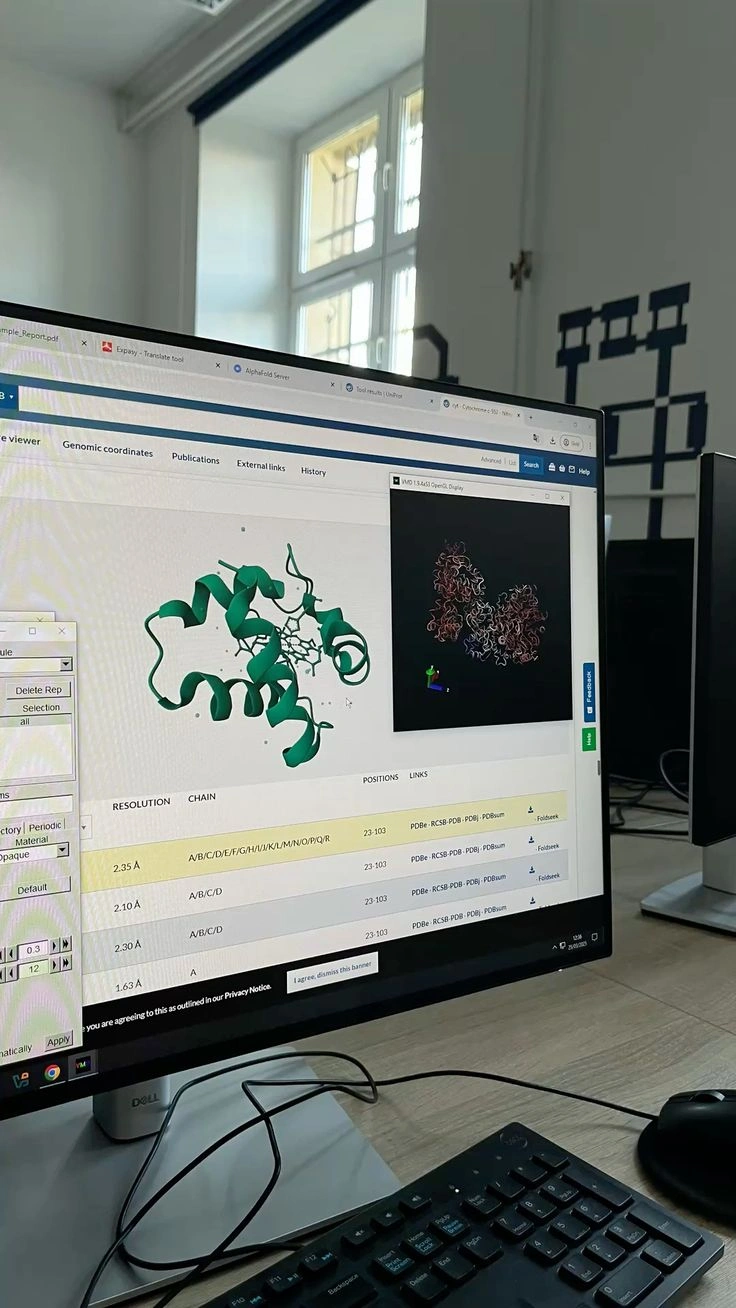
The same applies to protein folding, one of biology’s most difficult problems for decades. Proteins are chains of amino acids that fold into three-dimensional structures, and their shape determines function. Predicting this structure from sequence alone was historically extremely difficult because tiny interactions create enormous structural possibilities.
Recent algorithmic advances dramatically improved this area by learning patterns from large biological datasets. Instead of manually calculating every physical interaction, machine learning systems began identifying likely structural outcomes through trained pattern recognition.
This showed something important: algorithms may not “understand” life in a human sense, but they can detect biological structure in ways that produce highly useful predictions.
Still, prediction is not identical to understanding.
This distinction matters scientifically and philosophically.
Algorithms are especially valuable because living systems contain patterns too subtle for direct observation. Evolution, for instance, leaves traces across genomes that computational tools can compare across species. Disease progression leaves molecular signatures invisible to ordinary inspection. Drug discovery increasingly depends on computational screening because potential molecular interactions are too numerous for manual testing.
In these cases, algorithms extend scientific vision.
They do not replace biology; they sharpen it.
At the same time, living systems constantly remind researchers that biological complexity resists simplification. Two patients with the same diagnosis may respond differently to the same treatment. Two cells with nearly identical conditions may behave differently because biological systems include randomness, adaptation, and history.
This means algorithms must often learn from imperfect, noisy, incomplete data.
Unlike many engineered systems, biological systems evolved rather than being designed for clarity. Evolution prioritizes survival, not simplicity. As a result, biological pathways contain redundancy, overlap, and exceptions.
Science increasingly advances not because algorithms fully replace human understanding, but because they expand what humans can ask.
A researcher today can investigate biological questions once considered unreachable because algorithms make hidden patterns visible.
In that sense, algorithms do not fully understand life the way living scientists do.
But they help humans understand life more deeply than ever before.
And perhaps that is the most important achievement: not artificial understanding replacing biological thought, but computational tools becoming partners in revealing how complex life truly is.

Login to comment.
No thots yet. Be the first to share your thoughts!