Staged Argument: The monetization of domestic conflict

Staged Argument: The monetization of domestic conflict
Staged Argument: The monetization of domestic conflict
Noticed the disturbing trend of "staged arguments" on social media? Let's analyze how monetizing domestic conflict turns partners into antagonists and intimacy into cheap rage bait.
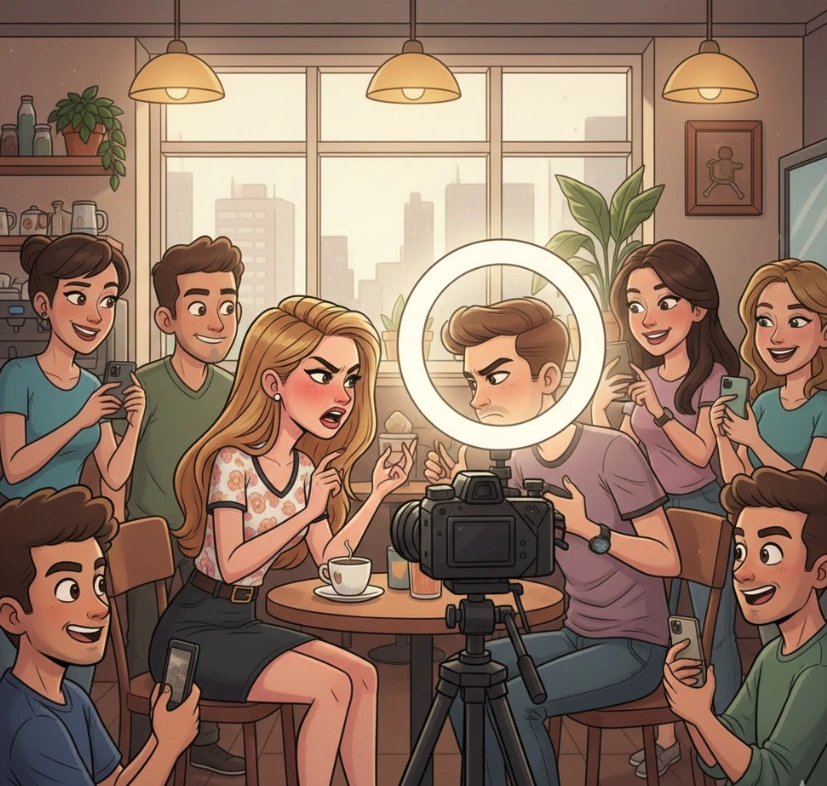
It starts with a familiar setup. A phone is propped up against a coffee mug or wedged precariously on a dashboard. The lighting is harsh, the camera angle slightly askew to suggest candidness. Then, the text overlay appears: POV: My husband forgot our anniversary again or Things my boyfriend does that send me into a coma. What follows is a sixty-second skit of rolling eyes, exaggerated sighs, and a partner who looks suspiciously like a deer in headlights, or worse, a bad actor waiting for his cue.
This the architecture of the "Staged Argument," a corner of the internet where domestic friction isn't a problem to be solved, but a script to be performed. As an English Lit grad, I spend my life analyzing narrative arcs, but the stories we are telling about our relationships on TikTok and Instagram Reels are becoming less like a Jane Austen romance and more like a dystopian distinct reality show where the prize is algorithmic relevance and the cost is intimacy.
The Monetization of the "Ick"
I cannot tell you how many times I've opened the Reels tab on Instagram and been bombarded with Indian couples staging a fight, a girl 'trying' to fight her boyfriend only for, plot twist, him being romantic, or another plot twist, the guy breaking up with her.
We have entered an era where "relatability" is the highest form of currency. Creators quickly realized that while aspirational content (perfect dates, roses, sunsets) gets likes, conflict gets comments. Rage bait is the engine of the engagement economy. By framing a partner’s minor transgressions like leaving a towel on the floor, chewing loudly, breathing wrong, as a public spectacle, we invite strangers to weigh in on the jury of our love lives.
It’s a strange commodification of vulnerability. In literature, a foil character exists to highlight the protagonist's traits. In these videos, real-world partners are reduced to foils. They become the antagonist in the 15-second narrative of the creator's day. The "husband" or "girlfriend" is flattened into a trope: the incompetent man-child, the nagging shrew, the clueless gamer. It is a caricature of connection sold back to us as authentic reality.
Life on the Front Stage
Sociologist Erving Goffman famously distinguished between the "front stage" (where we perform for an audience) and the "back stage" (where we relax and are our true selves). The danger of the Staged Argument trend is that it destroys the back stage. When you view your kitchen, your car, and your bedroom as potential sets for a viral clip, you never truly stop performing.
Instead of feeling the depth of a fight between a couple onscreen, we feel second hand embarrassment at having to watch what should've been private. Or worse, never have been performed.
When we start scanning our interactions for "content potential," we detach from the moment. Instead of feeling annoyance that he forgot to take out the trash, the brain pivots: Is this funny? Is this relatable? Can I put trending audio over this? The partner is no longer a human being with whom you are building a life; they are a prop. They are an NPC (Non-Player Character) in the video game of your social media growth strategy.
The Erosion of Trust
There is a profound difference between venting to a friend over coffee and broadcasting a grievance to millions. One seeks support; the other seeks an audience. The long-term psychological effect of this is the erosion of safety. Relationships require a sacred circle of privacy where you can be messy, wrong, and unpolished without fear of being captioned and posted.
If the goal is truly to explore the nuances of human cohabitation, video is often too blunt an instrument. It lacks the introspection required for actual relationship analysis. I guess this is why I like writing now, perhaps it is where the resurgence of long-form blogging offers a necessary corrective. We truly need emerging as spaces for written reflection, allowing for the kind of nuanced, thoughtful storytelling that a 60-second clip simply cannot hold. Instead of watching an obviously staged fight, I'd rather read about the complexities of marriage or the friction of cohabitation with the depth of an essayist, rather than the theatrics of a reality star. It forces the creator to sit with their thoughts, rather than stage them for a dopamine hit.
The Final Act
The problem isn't that we fight; it's that we are forgetting how to fight without an audience. When we turn our arguments into skits, we prioritize the punchline over the resolution. We train ourselves to perform outrage rather than communicate needs.
So, the next time your partner does something annoying, resist the urge to reach for the ring light. And they will, because they are human. But instead of recording it, leave the scene unrecorded. Some stories aren't meant for the timeline; they're meant to be lived, resolved, and kept in the quiet, unmonetized corners of the back stage.
