People We Meet on Vacation And The Romance of Return


People We Meet on Vacation And The Romance of Return
People We Meet on Vacation And The Romance of Return
A thoughtful take on Netflix's People We Meet on Vacation, showing how its year-by-year chapters turn timing into the romance's engine. Delays, geography, and unspoken truth shape a love that almost happens.
There is a very specific kind of modern romance story that does not quite believe in destiny, but still wants coincidence. It is sceptical about grand fate but addicted to the small miracle of timing. People We Meet on Vacation (Netflix’s film adaptation of Emily Henry’s bestselling novel) understands this tension intimately. It is a romance built on the most precarious of structures: one week a year, one set of locations, two people who can never quite admit that the “friendship” they are protecting is, in fact, a love story they are refusing to live.

Even if you know where the narrative is headed, the pleasure is not in surprise. It is in delay. In how longing is stretched across geography, years, and unspoken truths, until the audience feels it like sunburn.
Plotting intimacy: one week a year as narrative engine
At its core, People We Meet on Vacation runs on a deceptively clever structure: annual holidays become the chapters of a relationship. This is not just a gimmick for montage-friendly travel scenes (though yes, the film is visually invested in romance as tourism). It is also a literary architecture, reminiscent of epistolary novels and fragmented modern narratives, where intimacy is assembled through selective moments rather than continuous domestic time.
Poppy is a travel writer, restless and dissatisfied beneath her extroverted sparkle. Alex, by contrast, is the kind of person whose love language is planning, routine, restraint. Their relationship begins not with sparks but with proximity: a shared car journey back to Ohio, the “forced room-sharing” trope repurposed into something gentler and more interior.

The holidays, over time, is where romance hides when it cannot bear to speak its name. They can tell themselves it is tradition, not devotion. They can pretend it is friendship, not dependence. The film’s emotional strength lies in how clearly it shows the self-deceptions that people build to remain safe.
Poppy and Alex
Poppy and Alex belong to a recognisable lineage: manic-ish dream girl energy meets emotionally cautious man; chaos meets order. But the film is at its best when it refuses to flatten this into stereotype.
Poppy is not simply “too much” in the quirky sense. Her charm often reads like armour: performance as survival. Alex’s steadiness, too, is not just boring competence. It is also fear. He is a person who has made a shrine out of control because desire is terrifying.
This is why the film works: it understands romantic tension as a clash of worldviews. Poppy believes life should expand. Alex believes it should be protected. Their love story, then, becomes a debate about how one ought to live: as accumulation or as preservation. That is a surprisingly serious question for a Netflix rom-com to ask, and the film’s adaptation choices largely honour that seriousness.
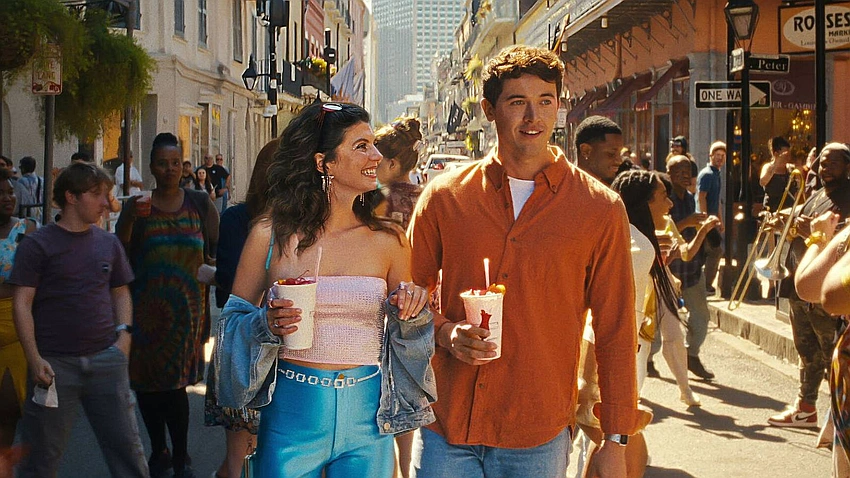 The aesthetics of the getaway
The travel element is not just scenic decoration. In romance narratives, travel often signifies permission: you can feel things elsewhere that you cannot permit yourself at home. Holiday spaces suspend consequence. They allow new selves.
But People We Meet on Vacation also uses travel as an irony. Poppy’s job is literally movement, yet she is emotionally stuck. Alex’s preference is home, yet he is pulled into motion by Poppy year after year. What appears to be a breezy rom-com device becomes a pointed metaphor: mobility does not equal freedom, and stability does not equal safety.
This is where the film’s tone becomes quietly literary. It is less about “will they” than about what it means to postpone your own life for the sake of not disrupting someone else’s. That emotional postponement is the film’s true setting, more than Barcelona or any other postcard location.

Adaptation as translation
One of the ongoing questions with book-to-screen romance adaptations is whether cinema can reproduce interiority. Emily Henry’s work thrives on voice: witty, self-aware, but also raw in its admissions about loneliness and the fear of being unlovable.
From interviews, Henry has indicated that she served as an executive producer, with the director being open to collaboration. That context matters because the film does not feel cynical or merely algorithmic. It feels like an attempt to translate a sensibility rather than simply extract plot.
What survives best in translation is the tonal doubleness: the jokes are real, but so is the ache. The film understands that romantic comedy is not the opposite of sadness. It is often sadness with better lighting.

Romance in an era of burnout
It is difficult to watch People We Meet on Vacation without thinking about how contemporary romance functions as cultural therapy. We live in an era of exhaustion: social, economic, emotional. In that context, the film’s fantasy is not extravagant wealth or dramatic obsession. It is simpler and more radical: the fantasy that someone knows you across time.
That is the seduction of the “one week a year” premise. It implies loyalty without demands, continuity without claustrophobia. Until, of course, it becomes unbearable, because humans cannot live on annual doses of intimacy. The film’s ultimate emotional argument is quietly subversive: you cannot make a home out of temporary happiness.
And maybe that is why it resonates. Not because it offers escapism, but because it offers recognition: so many of us are living in structures of delay, postponing the life we want until it feels permissible.
By the end, People We Meet on Vacation becomes what the best rom-coms always are: a story not about finding love, but about choosing it. It is glossy, yes. It is charming, yes. But it is also, in its own accessible way, a film about emotional cowardice and the slow violence of unsaid things.
#TheSubtleRomance #PeopleWeMeetOnVacation #NetflixFilm #TimingInLove #RomanticDrama
