Safety vs. Compassion: Supreme Court's Stray Dog Order Divides India

Safety vs. Compassion: Supreme Court's Stray Dog Order Divides India
The Supreme Court has ordered the removal of stray dogs from Delhi’s streets amid rising dog bite cases. Explore the implications and reactions from animal rights advocates.
Within six to eight weeks, the Supreme Court has mandated that all stray dogs in Delhi, Noida, Gurugram, and Ghaziabad be removed from the streets and placed in shelters. The ruling was made at a hearing regarding the increase in dog bites. The court declared that "infants and young children should not at any cost fall prey to stray dog bites leading to rabies" and described the situation as "extremely grim."

Civic bodies are required by the order to immediately establish shelter space for a minimum of 5,000 dogs, hire personnel for vaccination and sterilisation, install CCTV in shelters, establish a helpline for bite incidents, and consider forming a special task force. Anyone interfering with this drive could be found in contempt of court, and no dog caught will be put back on the streets.
Under the Animal Birth Control (ABC) Rules, which mandate that vaccinated and sterilized dogs be returned to their original locations, animal rights organizations have criticized the order, calling it "cruel," "impractical," and "illegal." Housing Delhi's estimated 10 lakh stray dogs is "simply impossible" and would result in "chaos and suffering," according to PETA India.
Dr. Mini Aravindan of PETA warned, “Displacement and jailing of dogs has never worked. Such actions will not curb the dog population, reduce rabies or prevent bites.”
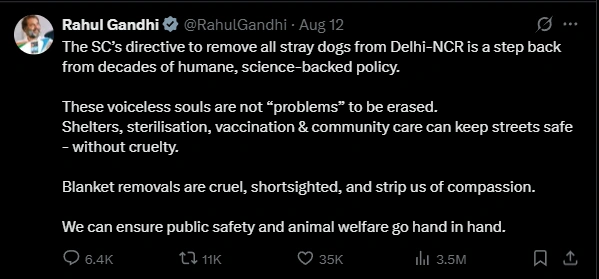
Rahul Gandhi, the leader of the Congress, referred to the action as
"a step back from decades of humane, science-backed policy," emphasizing that "voiceless souls are not problems to be erased" and that animal welfare and public safety "go hand in hand."
While TMC MP Saket Gokhale has asked the Chief Justice of India for a review, Priyanka Gandhi Vadra stated that there is "a better way" to handle the matter.
Stars have joined the opposition as well. Varun Dhawan and Janhvi Kapoor wrote, "These aren't just'stray dogs.'" In a cold, heartless city, they are the ones who wait outside your tea stall for a biscuit. While filmmaker Siddharth Anand referred to the ruling as a "death warrant" and urged people to petition against it, singer Chinmayi Sripaada called it a "death sentence" and connected it to religious symbolism. With the caption, "Please do your part, big or small, it all adds up," comedian Vir Das shared images of his adopted Indies and encouraged others to adopt and support NGOs.

Alternatives have been proposed by activists, such as enforcing laws against illegal breeding and abandonment, establishing controlled feeding areas, boosting adoption of Indian dogs, and bolstering sterilisation and vaccination programmes.
Many locals, on the other hand, agree with the decision, believing it is an essential step in stopping hostile dog packs and safeguarding kids. "No one should have to risk the life of their three-year-old child because someone somewhere is compassionate about stray dogs," one parent wrote online, expressing the belief that safety must come before compassion. Others challenge activists who disagree with the decision to adopt the animals themselves.
Less than two months remain for civic organizations to start mass removal efforts, construct and staff shelters, guarantee CCTV monitoring, and begin vaccinating and sterilizing seized dogs. The Supreme Court has denied all requests for intervention, stating that it is acting to safeguard public safety rather than to appease popular opinion. The Delhi government has promised to put the order into effect as soon as possible. As the authorities work to meet the deadline, petitions, demonstrations, and adoption drives are anticipated to take place over the next few weeks.
Ultimately, this case underscores a fundamental tension in Indian society: how to balance compassion for animals with the right of citizens to live in safety. While the court's intentions appear to be rooted in protecting the public, its sweeping directive has created a legal and logistical quagmire, forcing a re-evaluation of how India manages its burgeoning stray animal population. The debate is a reflection of a deeper societal conflict, one that the judiciary is now tasked with navigating.
