Applications of Wireless Temperature Probes in Modern HVAC Systems

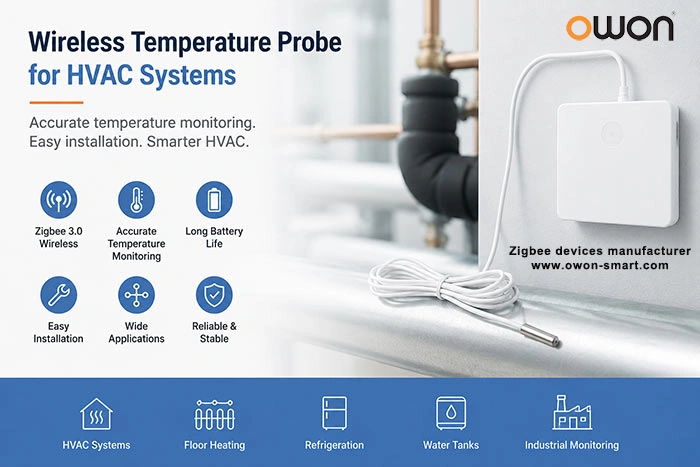
Applications of Wireless Temperature Probes in Modern HVAC Systems
Zigbee probe temperature sensor with Zigbee2MQTT and Home Assistant support for freezer, aquarium, HVAC and smart monitoring applications.
Introduction
As HVAC systems become more connected and energy-efficient, accurate temperature monitoring has become essential for system performance, preventive maintenance, and energy optimization.
While traditional wired sensors remain common, many installers and system integrators are now choosing wireless temperature probes 🔗 to simplify installation and expand monitoring capabilities.
Whether monitoring supply water temperature, floor heating loops, refrigeration equipment, or HVAC pipelines, wireless probe sensors provide greater installation flexibility without sacrificing measurement accuracy.
This guide explains how wireless temperature probes work, where they are used, and what to consider when selecting one for modern HVAC systems.
What Is a Wireless Temperature Probe?
A wireless temperature probe combines a temperature sensing probe with wireless communication technology.
Unlike standard room temperature sensors that only measure ambient air, the probe can be installed exactly where temperature needs to be monitored, such as:
- Water pipes
- HVAC supply lines
- Floor heating systems
- Refrigeration equipment
- Boilers
- Chillers
- Storage tanks
The wireless transmitter then sends temperature data to a gateway, building management system (BMS), or IoT platform for monitoring and automation.

Why HVAC Systems Need Wireless Temperature Probes
Modern HVAC systems contain many locations where ambient temperature does not accurately represent system performance.
Examples include:
Hydronic Heating
Monitor water supply and return temperatures.
Floor Heating
Measure loop temperature for stable floor comfort.
Air Handling Units
Monitor pipe and coil temperatures.
Chillers
Track chilled water temperature.
Heat Pumps
Monitor water circuits and optimize system efficiency.
Wireless installation is particularly valuable for retrofit projects where running communication cables would be expensive or impractical.
Benefits of Wireless Temperature Probes
Easier Installation
No signal wiring required.
Flexible Deployment
Install sensors wherever measurement is needed.
Lower Installation Costs
Ideal for retrofit HVAC projects.
Remote Monitoring
View temperatures through BMS, IoT platforms, or mobile applications.
Better Energy Management
Accurate data enables improved control strategies and predictive maintenance.
Typical HVAC Applications
<table><tbody><tr><td data-row="1">ApplicationWhy Use a Wireless Probe</td></tr><tr><td data-row="2">Floor Heating</td><td data-row="2">Monitor water loop temperature</td></tr><tr><td data-row="3">Boilers</td><td data-row="3">Supply and return water monitoring</td></tr><tr><td data-row="4">Heat Pumps</td><td data-row="4">Improve operating efficiency</td></tr><tr><td data-row="5">Chillers</td><td data-row="5">Water temperature monitoring</td></tr><tr><td data-row="6">Fan Coil Units</td><td data-row="6">Pipe temperature monitoring</td></tr><tr><td data-row="7">Refrigeration</td><td data-row="7">Internal cabinet temperature</td></tr><tr><td data-row="8">Cold Chain</td><td data-row="8">Continuous storage monitoring</td></tr></tbody></table>Wireless vs Wired Temperature Probes
<table><tbody><tr><td data-row="1">WirelessWired</td></tr><tr><td data-row="2">Easy installation</td><td data-row="2">Requires cabling</td></tr><tr><td data-row="3">Ideal for retrofit</td><td data-row="3">Better for fixed installations</td></tr><tr><td data-row="4">Flexible deployment</td><td data-row="4">Limited by cable routing</td></tr><tr><td data-row="5">Lower installation cost</td><td data-row="5">Higher labor cost</td></tr><tr><td data-row="6">Suitable for IoT systems</td><td data-row="6">Often connected directly to controllers</td></tr></tbody></table>For new commercial buildings, both solutions have their place.
For existing buildings and retrofit projects, wireless sensors often provide a faster and more cost-effective deployment.
Choosing the Right Wireless Temperature Probe
Before selecting a wireless probe, consider:
- Temperature measurement range
- Probe cable length
- Battery life
- Wireless protocol (Zigbee, LoRaWAN, Wi-Fi, Bluetooth)
- Integration with BMS or IoT platforms
- Compatibility with Home Assistant or Zigbee2MQTT
- Industrial protection level
- Long-term maintenance requirements
For commercial HVAC deployments, interoperability and long-term reliability are often more important than simply choosing the lowest-cost sensor.
An Example for Zigbee-Based HVAC Projects
For Zigbee-based HVAC systems, one example is the OWON THS317-ET Zigbee Temperature Sensor 🔗.
It combines:
- Zigbee 3.0 communication
- 2.5-meter external temperature probe
- Battery-powered operation
- Wide temperature measurement range
- Zigbee2MQTT compatibility
- Home Assistant integration
This type of sensor is suitable for monitoring HVAC pipelines, floor heating systems, refrigeration equipment, water tanks, and other locations where accurate contact temperature measurement is required, while allowing the wireless module to remain outside enclosed spaces for reliable communication.
Conclusion
Wireless temperature probes are becoming an important part of modern HVAC systems.
Compared with traditional wired solutions, they simplify installation, reduce retrofit costs, and provide flexible deployment for commercial buildings and industrial facilities.
For HVAC contractors, building automation integrators, and OEM manufacturers, selecting the right wireless probe helps improve monitoring accuracy, energy efficiency, and long-term system reliability.
As Zigbee and open IoT ecosystems continue to grow, wireless probe sensors are expected to play an increasingly important role in smart HVAC and building automation projects.
FAQ
What is a wireless temperature probe?
A wireless temperature probe measures temperature through an external sensing probe and transmits data wirelessly to a gateway or monitoring platform.
Where are wireless temperature probes used in HVAC systems?
They are commonly used in boilers, chillers, floor heating systems, heat pumps, refrigeration equipment, and HVAC pipelines.
Are wireless temperature probes better than wired sensors?
Neither is universally better. Wireless probes are typically preferred for retrofit projects and locations where running communication cables is difficult, while wired sensors may be suitable for fixed installations with existing cabling.
Can wireless temperature probes work with Zigbee2MQTT?
Yes. Some Zigbee-based wireless temperature probes support Zigbee2MQTT, enabling integration with Home Assistant and other open-source automation platforms.
How do I choose a wireless temperature probe?
Consider the temperature range, probe length, battery life, wireless protocol, installation environment, and compatibility with your HVAC control or building management system.
