What Makes a Smart Hotel Truly "Smart"? A Complete Guide for Modern Travelers

What Makes a Smart Hotel Truly "Smart"? A Complete Guide for Modern Travelers
Learn how smart hotel systems use IoT and automation to improve guest experience, reduce energy costs, and enable efficient hotel management.
What Is a Smart Hotel and Why It Matters
A smart hotel is transforming the hospitality industry by integrating automation and connected technologies into everyday operations. Instead of relying on manual controls, modern hotels are adopting intelligent systems that enhance both guest experience and operational efficiency.
From lighting and temperature control to energy management, these solutions allow hotels to operate more efficiently while providing a more comfortable and personalized stay. In many modern deployments, hotels rely on integrated smart hotel IoT solution 🔗 platforms to connect devices such as thermostats, sensors, and control systems into one unified system. As digital expectations increase, this approach is quickly becoming the new standard across global hospitality markets.
Key Features of Modern Smart Hotel Rooms
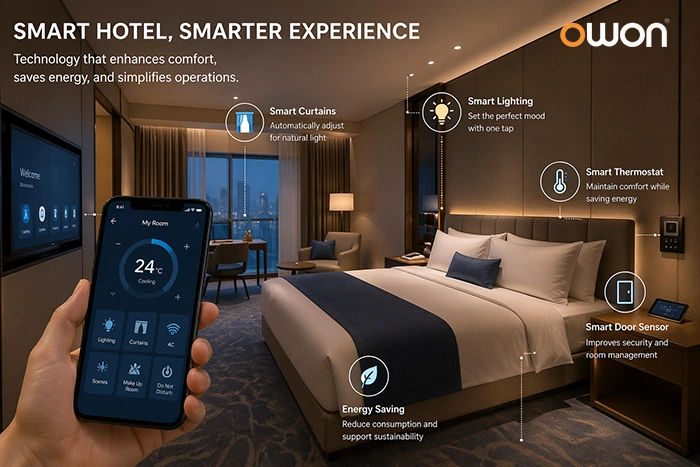
Modern hotel rooms are equipped with intelligent technologies designed to automate daily interactions.
Automated Climate Control
Smart thermostats adjust temperature based on occupancy and user preferences, ensuring optimal comfort and reducing unnecessary energy usage.
Motion-Based Lighting
Lighting systems can respond to occupancy by automatically turning on when guests enter and switching off when rooms are empty.
Energy Optimization
Energy-saving strategies are implemented through automation, reducing power consumption without affecting guest comfort.
Connected Guest Experience
Guests can control lighting, temperature, and other devices through mobile apps or centralized control panels.

How a Smart Hotel System Works
A smart hotel operates through a network of interconnected devices that communicate in real time.
Typical system components include:
- Motion sensors for occupancy detection
- Door and window sensors for monitoring room status
- Thermostats for HVAC automation
- IoT gateways for communication
When a guest enters the room, sensors activate lighting and climate systems. When the room is unoccupied, the system automatically switches to an energy-saving mode.
Why Smart Hotel Technology Is Growing
The adoption of smart hotel technology is increasing due to both operational and customer-driven factors.
Lower Operational Costs
Automation helps hotels reduce electricity usage and improve energy efficiency.
Improved Guest Satisfaction
Personalized environments create a better guest experience, leading to higher ratings and repeat bookings.
Centralized Management
Operators can monitor and manage multiple rooms through a unified platform.
Integrated Smart Hotel Solutions vs Standalone Devices
A smart hotel is not simply a collection of devices—it is a fully integrated system.
Instead of using isolated products, modern deployments combine:
- Occupancy detection
- Environmental monitoring
- HVAC control
- Energy management
For example, multi-sensors can detect motion, temperature, and humidity simultaneously, enabling more advanced automation logic.
Door and window sensors 🔗 also support energy-saving scenarios by detecting open or closed states and triggering system responses.
Solution providers like OWON integrate these technologies into scalable systems designed for real-world hotel projects.
The Future of Smart Hospitality Systems
The future of the smart hotel will focus on deeper automation, data-driven insights, and sustainability.
Hotels will increasingly rely on connected systems to optimize operations, reduce energy consumption, and enhance guest experiences. As green building standards evolve, intelligent control systems will play a critical role in achieving these goals.
How to Start a Smart Hotel Upgrade Project
For hotel owners and system integrators, upgrading to an intelligent hospitality system does not have to be complex.
The first step is to evaluate existing infrastructure, especially HVAC systems, lighting control, and energy usage patterns. This helps identify where automation can deliver the highest return on investment.
Next, choosing the right communication protocol—such as Zigbee—is critical for ensuring system scalability and stability in multi-room deployments.
It is also important to select solution providers that offer not only devices but also integration support, ensuring compatibility with property management systems and cloud platforms.
In real projects, combining thermostats, occupancy sensors, and door/window sensors allows hotels to quickly implement energy-saving strategies without major structural changes.
By taking a phased approach, hotels can gradually upgrade their systems while maintaining normal operations and minimizing disruption.
Conclusion
The smart hotel represents the future of hospitality.
By combining automation, IoT, and intelligent control, hotels can improve efficiency while delivering better guest experiences. As adoption continues to grow, these systems will become a fundamental part of modern hotel operations.
smart hotel systemhotel iot solutionsmart hotel automationhotel energy systemhotel room automationsmart hospitality system hotel energy managementiot hotel solution

Login to comment.
No thots yet. Be the first to share your thoughts!