This Biennale Is Asking Art to Give Up Control

This Biennale Is Asking Art to Give Up Control
This Biennale Is Asking Art to Give Up Control
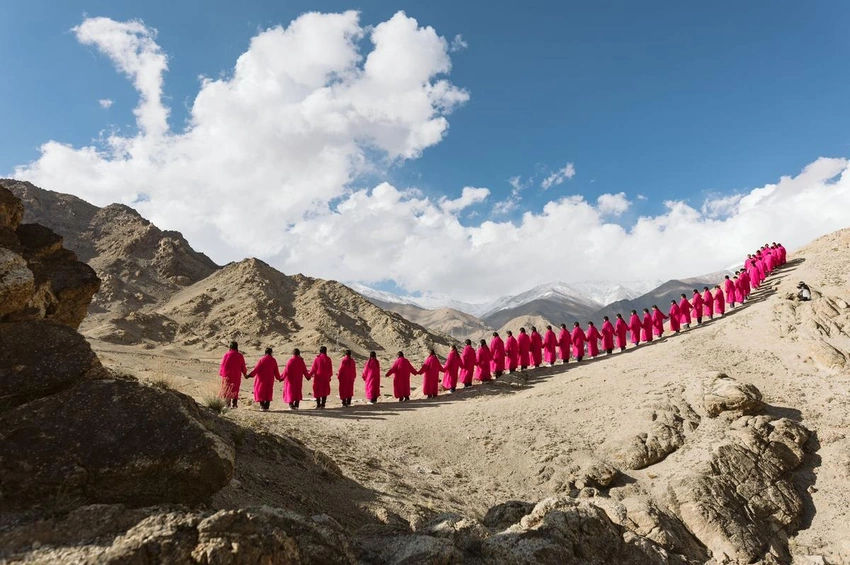
A radical biennale in Ladakh is asking a provocative question: what happens when the landscape refuses to remain a backdrop for art?
When I think of world-famous biennales, I am immediately transported to Venice, and my mind conjures images of pavilions, galleries, carefully controlled rooms and enough institutional architecture to tell you exactly where the art begins and where it ends. Then there is sā Ladakh, which has decided to stage its inaugural edition at elevations above 3,000 metres, over a 230-kilometre stretch of the Leh–Kargil corridor. And I wonder why, for that reason alone, this is not equally world-famous.
The landscape here does not behave like a museum at all, and there is no monumentality to be captured either. You, the visitor, are subjected to interference from cold gusts, rain, and difficult terrain. You travel through villages to reach the work, and the journey becomes part of what you have seen by the time you arrive. An installation cannot be neatly separated from the mountain behind it, the river beneath it or the road that made you spend hours getting there.
That is the particular gamble at the heart of sā Ladakh: Signals from Another Star. What happens to contemporary art when the landscape hosting it is too large, too vulnerable and too alive to function merely as a backdrop?
The Road Is Part of the Exhibition
The inaugural 2026 edition unfolds across Leh, Basgo, Likir, Nurla, Lamayuru, Henasku, Mulbekh and Kargil. That geography changes the basic rhythm of looking at the artworks. You do not drift from one polished gallery room to another. You move, are forced to pause and then finally acclimatise, and carry on. And then repeat! The mountains remain present even when you are trying to concentrate on something made by a human being.
I find that fascinating because contemporary art has spent decades celebrating site-specificity while often allowing “site” to remain an elegant theoretical word. sā Ladakh makes the idea far more physical. Here, the place can alter what you see. A change in the weather can interfere with an encounter. A work might look different by the time you return. The visitor is not given the luxury of gauging the art independently as if it exists separately from its conditions.
Some Artworks Are Designed to Disappear
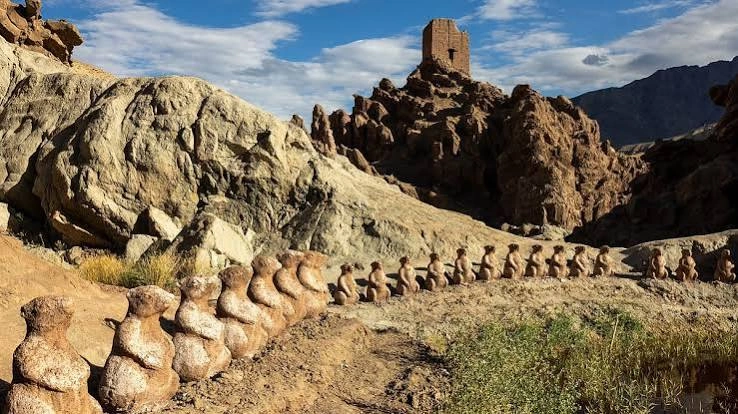
It's particularly striking to note that most of these works use the landscape's own materials. At Basgo, Chemat Dorjey Serthi's Burrowed in Time uses earthen marmot forms to evoke the animal's diminishing presence in Ladakh and the ways human habitation has embedded itself within the cliffs. Urgain Zawa's Remnants of Belonging, installed at Nurla, works with river-smoothed stones, weathered timber and local soil.
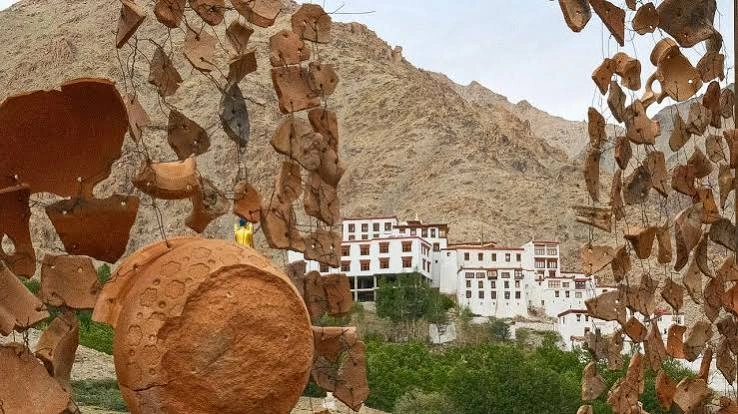
But Amrit Karki's Rising from the Soil and Soaring to the Sky takes the idea further. Traditional Himalayan carpet motifs are made from local earth across rooftops in Lamayuru, where footsteps and mountain winds will gradually alter them. Their disappearance is built into the work. Shupiwe Chongwe's Vessel, made with master potter Rigzen from native clay and wildflower seeds, is also intended to return to the soil.
That feels important. Regeneration is a word that cultural institutions have become extremely fond of using, sometimes to the point that it begins to acquire only cultural currency and nothing more. Here, in Ladakh, it is harder to keep the idea abstract. The artwork can disperse. Material can return to the ground. The landscape eventually gets the last word.
And somewhere in that process, the visitor becomes implicated too. You are not simply standing before an object. You are walking through a chain of relationships that will continue after you leave.
Ladakh Is Not Just Something to Look At
This may be where the biennale's politics become most interesting for me. Ladakh has long been vulnerable to being consumed as an image: mountains, monasteries, roads disappearing into enormous expanses of rock. The spectacular view arrives before anything else has the chance to speak.
sā Ladakh appears to be pushing against that habit by insisting on a more grounded encounter with the region. Its founders—mountaineer Tenzin Jamyang, artist Raki Nikahetiya and habitat designer Sagardeep Singh—have developed the initiative around local knowledge, education and community participation alongside artistic practice.
The project also extends beyond the exhibition through workshops, residencies and community-led initiatives, including the Above 3000m Fellowship for Ladakhi artists. The biennale seems to ask cultural tourism to do something increasingly difficult: stay with a place long enough for the view to become complicated.
The Mountains Remember the Routes We Forget
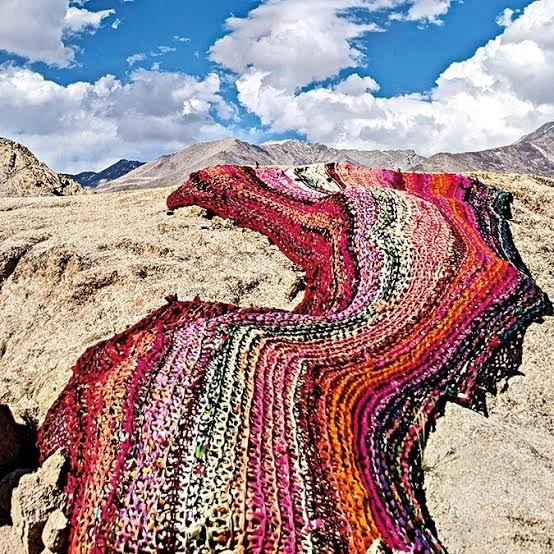
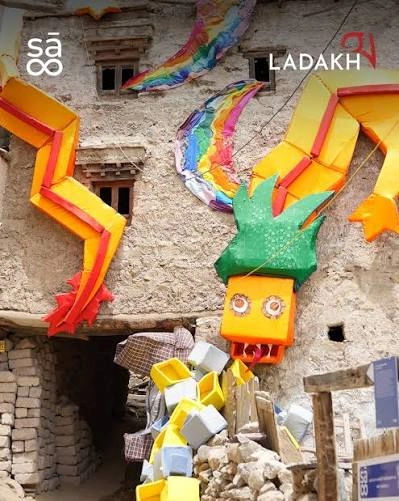
Several works turn towards Ladakh's cultural memory. At Mulbekh, on the historic Silk Route, Stanzin Samphel's The Memory of Routes considers traces left by movement through the mountains. Zahara Batool's Invisible Threads uses crimson sheep's wool woven by local Kargil women within the abandoned stone structures of Hunderman.
Tenzin Olden responds to the vernacular architecture of Old Leh Town through clay relief, while Stanzin Wangail's MANMO invokes a mythic water spirit beneath Leh Palace. These works are concerned with memory, but not in the frozen sense museums often prefer. Routes change. Communities adapt. Landscapes are altered by climate change and tourism. How preservation may begin to look less like keeping everything exactly as it was and more like figuring out how to live with what remains may be one of Ladakh's most urgent lessons.
Is This Really a Biennale?
The most interesting thing about sā Ladakh may be that the answer is not as obvious as it sounds. There are installations, artists and sites. There is a route that can be mapped. But the project is attempting something that conventional biennales often struggle to do: surrender a degree of control.
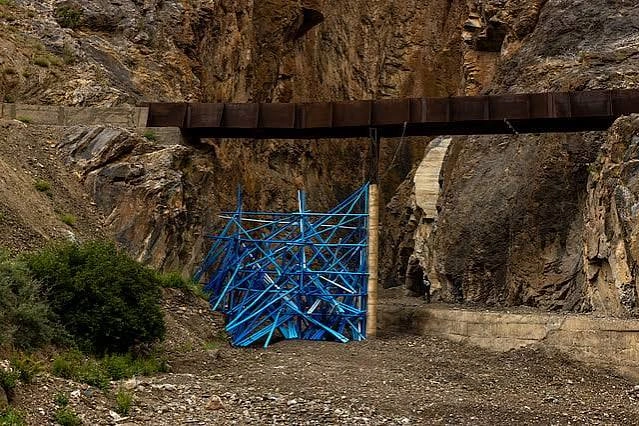
Denizay Apusoglu and Jonas Voegeli's Ground Control considers the speculative future of lithium extraction through nomadic wool, natural dyes and gathered twigs. Hylozoic/Desires transforms a footbridge over the Nurla River into an acoustic encounter with hundreds of bells. Ayan Biswas's The Land is Alive brings endangered alpine flora and traditional healing knowledge into a bioplastic structure.
Yet the real provocation lies beyond any individual artwork.
What if the future of the biennale is not a bigger pavilion, a more famous curator or another spectacular object designed for the Instagram feed? What if contemporary art has to learn how to give up some of its control?
That is the reveal hidden inside sā Ladakh. The absence of walls is not simply an aesthetic gimmick. It is an admission that art does not arrive in an empty world. It has to contend with weather, memory, communities and the consequences of occupying a place.

Login to comment.
No thots yet. Be the first to share your thoughts!