Kite String Tragedies Spike on Makar Sankranti Across India

Kite String Tragedies Spike on Makar Sankranti Across India
Deadly nylon kite strings, dubbed Chinese manjha, claim several lives during Makar Sankranti, prompting calls for stricter bans and safer celebrations.
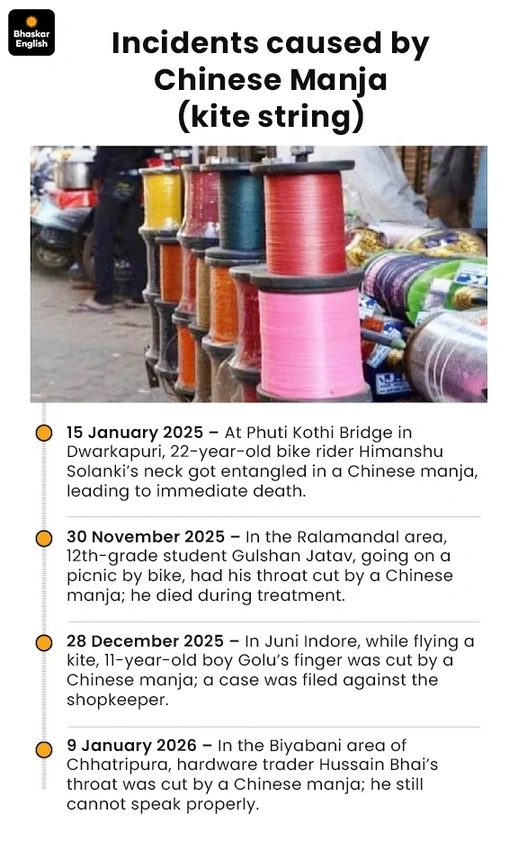
The festive mood of Makar Sankranti is being marked by tragedy as nylon kite strings, commonly called manjha, turn deadly across the country. In Indore, a 45-year-old man, Raghubir Dhakad, bled heavily after his throat was slit by a kite string while riding a motorcycle. He was on his way to collect his daughter from a hostel when the accident happened, and he breathed his last before help could arrive. This is one of several fatalities blamed on the aggressive, glass-coated nylon strings that are used to slice rivals' kite lines.
In Bidar, Karnataka, 48-year-old Sanjukumar Hosamani was killed on his way to bring his daughter home from a hostel when the same dangerous string caused a deep neck wound. He tried to call his daughter as he lay bleeding, but the ambulance could not reach him in time. Across Uttar Pradesh’s Jaunpur, a teacher died after a neck injury from manjha, followed by reports of another fatality when a stray piece of string struck a young man riding a bike. The spate of incidents shows the scale of risk on a day traditionally celebrated with kites soaring in the sky.
The strings at the center of these tragedies are nylon and often marketed as “Chinese manjha,” linked to imports from China in earlier years. Their coarse, razor-like edges make them effective for cutting rival lines, but they can also sever flesh and muscle, and even cause near-decapitations. A wave of concern has prompted legal action: the Indore bench of the Madhya Pradesh High Court has warned about the dangers and underscored that kite flying, though enjoyed by children, should be supervised by parents and carried out with safety in mind.
Officials and health experts are calling for stronger enforcement of bans on the dangerous nylon strings, better regulation of kite markets, and public awareness campaigns during the festival season. While some states have moved to curb the sale and use of manjha, the incidents highlight the ongoing risk of a tradition meant to celebrate the sun’s exit from winter. Community leaders are urging communities to celebrate with safer alternatives and to report unsafe sales, with the aim of preventing further tragedies in future celebrations.
