NASA Reveals Dramatic Bubble Formed By Infant Sun-Like Star

NASA Reveals Dramatic Bubble Formed By Infant Sun-Like Star
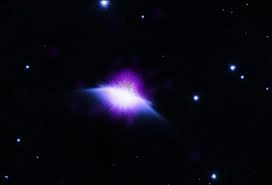
NASA's Chandra X-ray Observatory reveals the first detailed view of an astrosphere around a young Sun-like star. The star's winds carve a vast bubble in space, helping scientists understand how such winds sculpt their su
It has been seen by the astronomers for the first time how a much younger model of the Sun is forming a huge bubble in space. The NASA Chandra X-ray Observatory was used to discover it. This gaseous bubble, known as the astrosphere, fully surrounds the young star. This bubble is formed by strong particle winds that are released by the surface of the star and fill the bubble with hot gas. It expands, pushing back the cold gas and dust of the surrounding galaxy, as it expands, as reported by NASA.
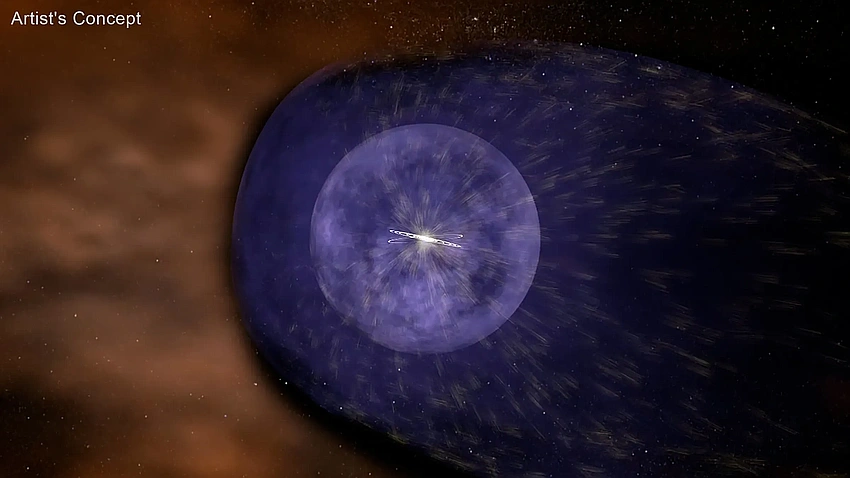
There is an analogous envelope around our Sun called the heliosphere. It is created by the solar wind and serves as a protective layer. It stretches way beyond the planets within our solar system and protects the Earth against powerful cosmic rays. It is the first occasion that scientists were able to obtain a clear picture of the astrosphere of a Sun-like star. Normally, these stars are seen as one bright point; in this image, a diffuse radiation of the star can also be seen, though faintly.
The team was led by Carey Lisse of the Johns Hopkins University in Baltimore, and published in the Astrophysical Journal. Lisse has said that scientists have been observing the outer astrosphere of the Sun for many decades, yet they could not actually view it. According to him, the new information provided by Chandra helps us to know the structure of the astrosphere of the Sun and how the Sun has evolved over billions of years, as it moves through the galaxy.
What is the Star HD 61005?
This star, HD 61005, is approximately 120 light-years away which is a short distance as far as space is concerned. It is very similar to the Sun because it has a similar mass and temperature, and it is significantly younger. HD 61005 is approximately 100 million years old, with the Sun being 5 billion years old.
Members of the particle stream coming out of the surface of HD 61005 are far stronger because of its youthfulness. These are three times slower than the Sun, and 25 times denser. Such strong winds promote the establishment of such a gaseous bubble and give hints to the level of activity of our Sun in the billions of years past.
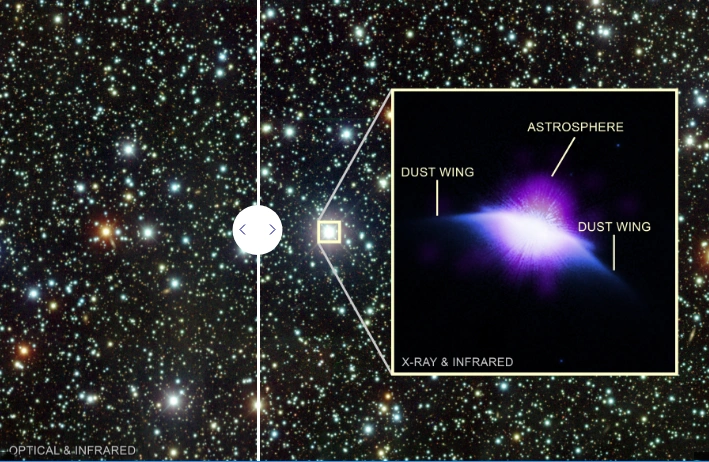
Co-author Scott Wolk of the Center of Astrophysics | Harvard and Smithsonian, said that people are subjected to the Sun daily not only through its light, but also through the solar wind, which penetrates space. The wind may pose an impact on satellites and even astronauts who travel to the Moon or Mars. According to him, this picture of the astrosphere of HD 61005 gives valuable insights about the wind patterns on the Sun at the early years.
Why It Was Named "Moth"
The HD 61005 star system was named Moth by astronomers due to the abundance of dust that surrounds it, such that when infrared telescopes are used, the moth wings appear. These are in the form of plumes consisting of material that remains after the formation of stars in the same way that the Kuiper Belt is located in our solar system.
The Hubble Space Telescope has observed that the interstellar material around HD 61005 is one thousand times denser than the material around our Sun.
#AstrosphereDiscovery #Astrosphere #NASA #Chandra #Astronomy
