Budget 2026-27: India bets on debt-led prudence over deficits

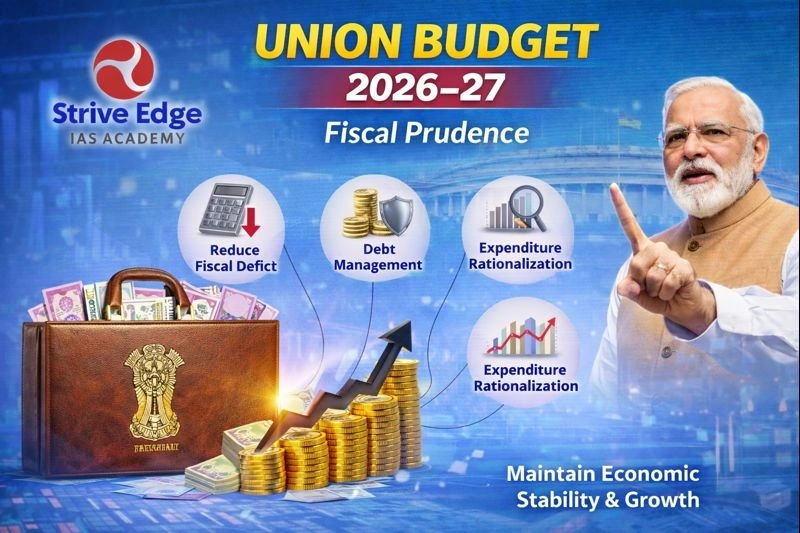
Budget 2026-27: India bets on debt-led prudence over deficits
The budget pivots to debt trajectories as the main anchor, outlining nominal GDP growth assumptions and gradual consolidation amid global uncertainties.
India's Union Budget 2026-27 marks a shift in how the government frames its fiscal policy. Rather than chasing deficits as the sole compass, the budget anchors prudence on debt trajectories, with nominal GDP growth playing a central role in shaping consolidation paths.
Inflation is expected to rise modestly, with the GDP deflator projected to move higher than the household budget impact, and real growth seen in the 6.8% to 7.2% range alongside a nominal growth projection around 10%. The central question for fiscal math is not a one-off deficit but how debt will evolve over the medium term. A key note from JP Morgan’s Sajjid Chinoy explained that if nominal GDP grows around 10% on average over the next five years, the Centre could reduce its deficit from 4.4% of GDP in FY26 to about 3.6% by FY31, bringing central debt to roughly 50% of GDP.
However, a more cautious scenario—where nominal GDP grows 9%—would require a larger consolidation, with the deficit needing to fall to about 3.0% of GDP and primary deficit reducing by about 0.4% of GDP each year. In this framework, the primary deficit bears much of the burden, while interest payments as a share of GDP are expected to ease over time.
On the spending and tax side, the budget emphasizes the quality of spending rather than sheer magnitude and signals reforms aimed at lowering input duties. In a press conference, Finance Minister Nirmala Sitharaman noted that tax reform measures are being contemplated as part of Union Budget 2026-27, set against global uncertainties and tensions. The focus remains on debt stabilization as the long-run anchor, with near-term consolidation guided by nominal growth trajectories and the trajectory of primary deficits.
Analysts highlight that the debt-centric framework could help stabilize markets and provide a clearer path for investment, provided the consolidation pace remains disciplined and policy implementation is credible. The crucial test will be sustaining the momentum of spending reform and ensuring that tax reforms translate into real efficiency gains for businesses and households. The government’s emphasis on the “quality of spending” could translate into better outcomes if coupled with targeted, growth-enhancing investments, while maintaining fiscal discipline.
