How a Sacramento shop turned a battered 1966 Ford Mustang into a Tesla — and why it matters

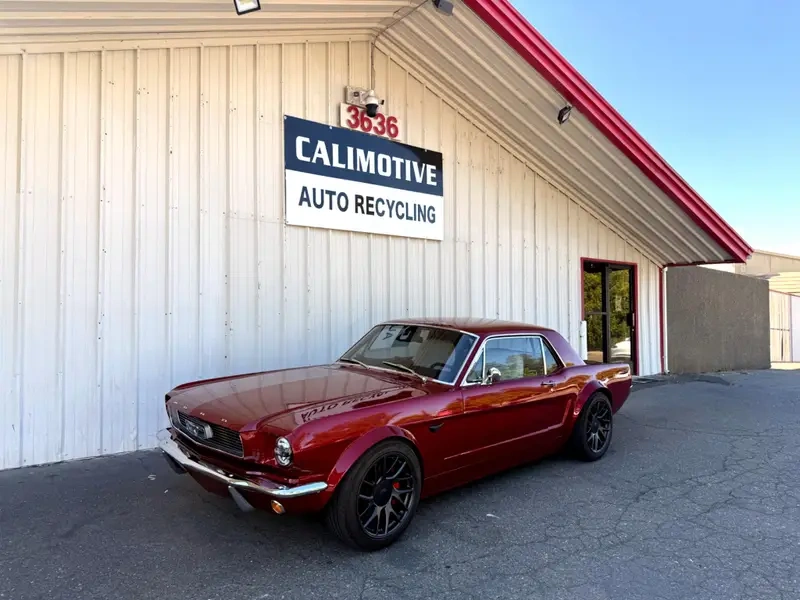
How a Sacramento shop turned a battered 1966 Ford Mustang into a Tesla — and why it matters
How a Sacramento shop turned a battered 1966 Ford Mustang into a Tesla — and why it matters
Calimotive transforms a 1966 Mustang into a tech-forward restomod, swapping in a Tesla Model 3 drivetrain
When you imagine a 1966 Ford Mustang, you picture chrome bumpers, a throaty V-8 and a soundtrack to Saturday-afternoon cruising. What you don’t immediately picture is a 15-inch touchscreen, over-the-air updates and Tesla’s Autopilot cameras tucked behind classic flanks. That’s the point of the oddball build out of Sacramento: Calimotive, a Tesla parts and recycling business, has taken a faded Mustang shell and given it the mechanical and digital heart of a 2024 Tesla Model 3 — complete with the company’s advanced driver-assist systems.
What He Did
Owner Yaro Shcherbanyuk bought a tired, straight-six 1966 Mustang on Facebook Marketplace and, over roughly two years of work with his father and brother, gutted and re-skinned the coupe so it could accept Model 3 underpinnings: motors, battery pack, wiring, steering rack, suspension subframes and even the center console and touchscreen interface. In practice the team grafted three sections of Model 3 floor and shortened the Tesla battery casing so the pack would fit within the Mustang’s wheelbase and proportions. The result drives and behaves like a modern EV while retaining the Mustang’s vintage silhouette.
How Deep the Swap Went
This wasn’t a simple motor-in-the-engine-bay swap. Calimotive effectively performed a partial body-and-skateboard integration: they cut and welded Model 3 chassis sections into the Mustang, flared the fenders and extended rocker panels to hide the high-voltage battery, and relocated the charging inlet to the old gas-cap area. They also installed Tesla cameras and modules to enable features such as Sentry Mode, Autopilot and Full Self-Driving (FSD) functionality — a nontrivial engineering task because the Mustang’s bodylines and geometry differ significantly from a Tesla’s production sedan.
The numbers (cost, time, capability)
Shcherbanyuk estimates the whole build cost about $40,000: roughly $10,000 for the donor Mustang, about $15,000 for the Tesla components and the balance for fabrication, parts and paint. The conversion took about two years from start to finish with around eight months of hands-on labor. On a practical level, the finished car showed roughly 194 miles of range at around an 80% state of charge during a public demonstration, and the dual-motor Model 3 setup gives it performance in the ballpark of modern Teslas Road & Track’s reporting suggests the dual-motor hardware is capable of roughly 400 hp and abundant torque, implying brisk acceleration compared with the original pony-car era performance.
The Tricky part: making Tesla tech play nicely with a 1960s body
Integrating Tesla’s electronics and driver-assist suite required experimentation. Calimotive had to find suitable mounting points and sightlines for the cameras, calibrate sensors and accept compromises: certain firmware updates and features that assume Tesla’s original sensor layout don’t behave identically on a reworked chassis. For example, the builder reported that FSD required roughly 2,000 miles of calibration driving to get cameras dialed in and that for now and some functions like FSD after dark are unreliable because of headlight illumination and sensor placement differences. The car also can’t expect the exact same firmware lifecycle as a factory Model 3.
Calimotive is, at base, a Tesla parts recycler and reseller. The shop’s business model exposed the owner to customers who were already attempting conversions with salvaged Tesla components, which is what inspired the shop to build a proof-of-concept. That matters for two reasons: first, it demonstrates how EV components are enabling an entire cottage industry of “electromods” that marry classic aesthetics to modern drivetrains; second, it shows that factory EV architecture, especially skateboard battery packs and modular motor assemblies, makes conversions more feasible today than the piecemeal EV projects of previous decades.
Purists, practicality and the regulatory landscape
As you might expect, not everyone applauds. Some collectors consider the destruction of an unrestored classic’s drivetrain sacrilegious. From a practical standpoint, conversions change crash dynamics, weight distribution and vehicle type classification; those factors can affect inspections, registration and insurance in some jurisdictions. Builders also face questions about software licensing and updates when they install manufacturer ECUs and services on non-factory vehicles. Calimotive’s build shows it can be done, but it also highlights the craftsmanship and regulatory vigilance required to do it safely and legally.
The Takeaway for the wider Automotive World
Calimotive’s Mustang is more than a headline-grabbing one-off; it’s proof-of-concept for an expanding subculture. For owners who value classic design but want modern reliability, emissions-free daily drivability and driver-assist technology, an electromod such as this offers a compelling middle ground. For OEMs and parts suppliers it signals demand for more plug-and-play crate EV packages that preserve classic looks while delivering modern performance and safety. Finally, it raises questions about how OEM software ecosystems will treat third-party vehicles built around their hardware, a conversation regulators and manufacturers will increasingly need to engage with.
#MustangRestomod #TeslaTech #EVConversion #Calimotive #AutoInnovation
