Antimatter: The Ultimate Engine for Interstellar Travel?

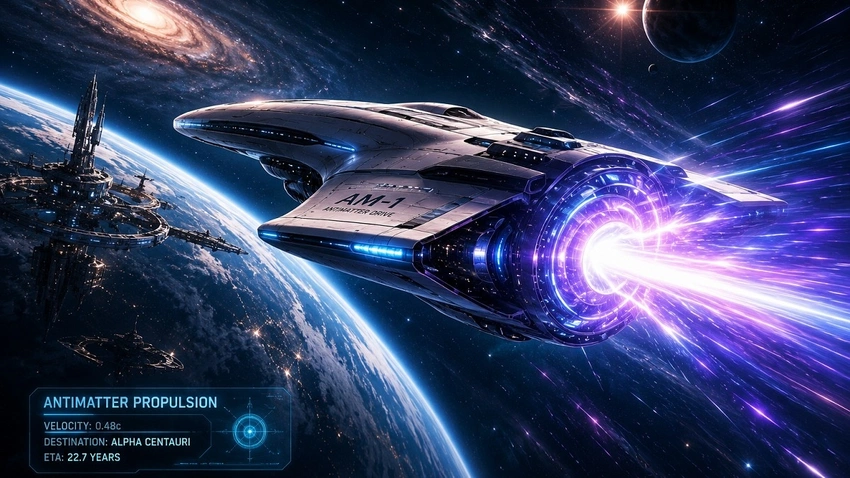
Antimatter: The Ultimate Engine for Interstellar Travel?
Imagine zipping across galaxies! Antimatter propulsion isn't sci-fi anymore, it's a real scientific frontier. Could this revolutionary tech finally unlock interstellar travel and reshape our cosmic destiny? Dive into the
The Race for Antimatter: How Futuristic Space Tech Could Reshape Our Universe
Humanity has always gazed at the stars with an insatiable longing, dreaming of journeys beyond our cosmic neighborhood. For centuries, interstellar travel remained firmly in the realm of science fiction, limited by the immense distances and our current propulsion technologies. But what if there was a way to significantly shorten those cosmic commutes, making distant star systems not just visible, but visitable? Enter antimatter propulsion, a concept once confined to textbooks and fantastical tales, now emerging as a serious contender for the future of space exploration.
Antimatter isn't just a quirky scientific curiosity; it's a powerhouse. When matter and antimatter meet, they annihilate each other in a burst of pure energy, following Einstein's iconic E=mc². This reaction is by far the most efficient energy source known, dwarfing nuclear fission or fusion. Imagine harnessing even a tiny fraction of that power. The idea behind antimatter propulsion is to use this incredible energy release to accelerate a spacecraft to speeds that are a substantial fraction of the speed of light. This isn't just about going faster; it's about fundamentally changing the scale of the universe accessible to us.
The implications are mind-boggling. Our nearest star system, Alpha Centauri, is over four light-years away. With current rocket technology, a journey there would take tens of thousands of years – a multi-generational trip. But with antimatter engines, that same journey could potentially be reduced to mere decades, or even less. Suddenly, probes could reach exoplanets orbiting other stars within a human lifetime, bringing back invaluable data or perhaps even preparing for human colonization. We could transcend our solar system's boundaries and become a truly interstellar species.
Of course, the path to such a future is riddled with challenges. Producing antimatter is incredibly difficult and expensive. We're talking about creating grams of it, which currently requires vast amounts of energy and time using particle accelerators. Then there's the challenge of safely storing it in a magnetic field, ensuring it never touches ordinary matter until needed. And designing a propulsion system that can effectively convert the annihilation energy into directional thrust is an engineering feat of epic proportions. These aren't trivial hurdles; they require breakthroughs across multiple scientific and engineering disciplines.
Despite these obstacles, the scientific community and visionary entrepreneurs are actively exploring these possibilities. The potential rewards are simply too immense to ignore. The race to master antimatter isn't just a technical competition; it's a philosophical one. It represents humanity's drive to explore, to understand, and to push the boundaries of what is possible. It could unlock access to new resources, provide solutions to terrestrial challenges, and ultimately, secure the long-term survival and expansion of our civilization.
Could antimatter propulsion truly reshape our universe? It certainly has the potential to redefine our place within it. From a species confined to one planet, we could become explorers of the galaxy. The dream of reaching for the stars isn't just a dream anymore. With continued research, innovation, and perhaps a touch of cosmic audacity, antimatter could be the key to turning humanity's greatest aspiration into an astonishing reality. The universe awaits, and with antimatter, we might finally be able to answer its call.
