Swedish Election Deadlock: Left-Wing Bloc Inches Ahead as Votes Counted

Swedish Election Deadlock: Left-Wing Bloc Inches Ahead as Votes Counted
Sweden's general election is on a knife-edge! Discover why the left-wing bloc holds a slender lead, the controversial role of the far-right, and what this means for Sweden's next government.
Sweden's general election is proving to be a nail-biter, with the outcome still too close to call as vote counting continues. Early on Monday, the left-wing bloc held a marginal lead, maintaining a slender advantage over their right-wing rivals. Projections suggest that the Social Democrats, led by current opposition leader Magdalena Andersson, could secure a three-seat majority in the Riksdag, Sweden's parliament.
The race for leadership pits Andersson against the conservative Prime Minister Ulf Kristersson, whose four-party coalition relies on the support of the hard-right Sweden Democrats (SD). Kristersson has openly stated his intention to offer cabinet positions to the SD if he manages to form the next government.
The Sweden Democrats, founded by Nazi sympathizers in the 1980s, were historically shunned but became Sweden's second-largest party in 2022, campaigning heavily on issues of violent crime and immigration. Despite the left-wing bloc's current lead, both Andersson's Social Democrats and the far-right SD have reportedly seen a decrease in support compared to previous elections.
The Social Democrats are tracking towards their worst result in over a century, while the SD appears to be losing ground for the first time since their entry into the Riksdag in 2010.
Conversely, other parties within the left-wing bloc, including the Left Party, Greens, and Centre Party, have increased their support.
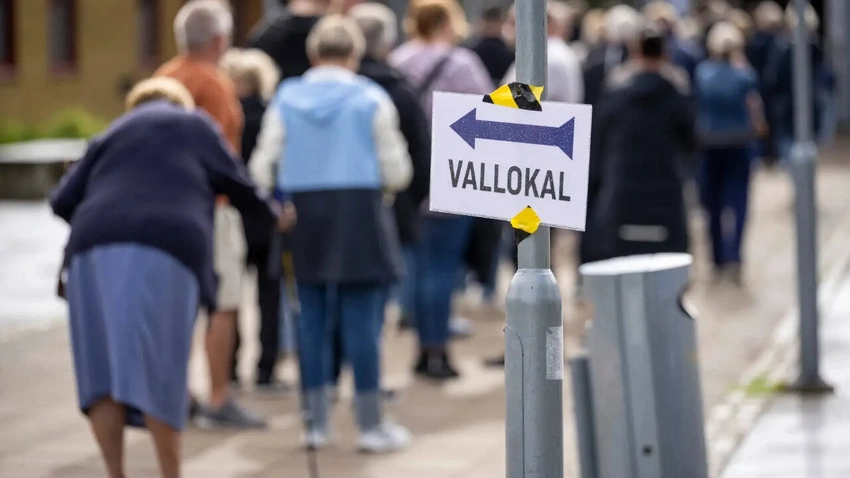
Voter turnout also saw a decline, dropping by four points from the 2022 poll to approximately 80%.
Leaders on both sides have acknowledged the uncertainty of the outcome. Andersson urged her supporters to await the final results, noting that if current trends hold, "Sweden will have a new government." Kristersson echoed the sentiment of an open question, stating, "The voters have had their say, but we still don't have a final result.
Which government will lead Sweden in the coming years is still an open question.
Key issues dominating the election campaign included national security, rising gang crime, and welfare spending. Sweden's political landscape often leads to coalition and minority governments due to its proportional representation system, which elects
mandates" or "seats" in parliament. A party must secure at least 4% of the vote to enter the Riksdag.
With 94% of votes reported, the left-wing bloc stood at 176 mandates against the right-wing bloc's 173, highlighting the extremely tight margin. The final count will determine whether Sweden moves towards a government led by Andersson, emphasizing cooperation, or one under Kristersson, with the significant and controversial involvement of the Sweden Democrats.
The nation, and indeed Europe, watches closely as the final ballots are tallied. #SwedenElection #SwedishPolitics #Election2026 #Europe

Login to comment.
No thots yet. Be the first to share your thoughts!