Northern Lights Dazzle UK, Visible Down to South Coast!

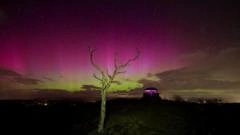
Northern Lights Dazzle UK, Visible Down to South Coast!
The mesmerizing Aurora Borealis lit up skies across the UK, thrilling stargazers from Scotland to England's south coast. Discover why this rare celestial event was so widespread and how you might catch a glimpse next!
Residents across the United Kingdom were treated to an extraordinary celestial display on Friday and Saturday evenings as the Northern Lights, also known as the Aurora Borealis, illuminated skies far beyond their usual northern haunts. This stunning natural phenomenon, typically associated with regions near the Arctic Circle, was visible as far south as Devon, Hampshire, and Kent, astonishing sky-gazers nationwide.
The Met Office confirmed that these widespread sightings were a direct result of significantly increased solar activity. The Sun unleashed powerful solar eruptions called coronal mass ejections (CMEs) towards the end of last week. These CMEs send a stream of charged particles hurtling towards Earth.
When these particles interact with our planet's magnetic field, they are guided into the atmosphere, especially towards the polar regions.
The subsequent collision with oxygen and nitrogen atoms emits the vibrant, coloured light we observe as aurora.
What made this event particularly special was the intensity of the geomagnetic storm. While auroras are usually visible in the north of the UK when activity levels reach around 200nT (nanotesla), on Saturday evening, these levels soared to an incredible 600nT. This exceptional strength allowed the aurora to be seen across the entire UK, including its southernmost parts, a truly rare occurrence.
For those who missed the spectacle, there's still a glimmer of hope.
The Met Office indicated that sightings might remain possible across Scotland and similar geomagnetic longitudes under clear skies until Tuesday.
Experts also point to 2026 as a potential peak year for aurora-spotting, as the Sun is currently in a heightened state of activity within its 11-year natural cycle.
To best view the aurora, it's recommended to look northwards, away from city lights, and use a mobile phone camera, which can capture colours our eyes struggle to perceive in low light.
This rare and breathtaking event left many Britons in awe, highlighting the incredible beauty of our universe and the powerful forces at play in our solar system.
