Elon Musk Cheers AfD's Rise in Germany, Fueling Far-Right Connections

Elon Musk Cheers AfD's Rise in Germany, Fueling Far-Right Connections
Tech billionaire Elon Musk publicly praised Germany's far-right AfD after their election win, deepening concerns about his global influence on anti-immigrant and nativist politics. Discover the controversial ties.
Germany's political landscape is buzzing after the far-right Alternative für Deutschland (AfD) party secured a significant victory in a recent state election, bringing them closer to forming the country's first state-level far-right government since World War II. The news was met with enthusiasm by none other than tech mogul Elon Musk, who posted "Gut gemacht!" (well done!) on X, congratulating AfD leader Alice Weidel.
This was just one of many posts from the Tesla and SpaceX CEO celebrating the AfD's success.
The AfD was quick to reciprocate, with Saxony-Anhalt leader Ulrich Siegmund thanking Musk for his support and calling him a "visionary." Siegmund himself has drawn criticism for advocating less focus on Germany's WWII responsibility in schools and for employing former members of a banned neo-Nazi youth group among his top staff.
Musk's vocal support for the AfD is part of a broader pattern of his engagement with the global far-right.
In recent years, he has increasingly used his influence to back anti-immigrant activists, illiberal leaders, and nativist parties.
His views on immigration, politics, and race, frequently shared on X, have become strikingly similar to many AfD policies.
This has fostered a "symbiotic relationship" where Musk boosts the party, and they, in turn, offer adulation, helping to spread their far-right ideologies in both Germany and the US.
His political involvement extends beyond Germany. Musk has appeared alongside Argentina's Javier Milei, honored Italy's Giorgia Meloni, and even spoke at a rally for UK anti-Islam activist Tommy Robinson, where he claimed immigration was causing "the destruction of Britain." He also engaged with German climate crisis skeptic Naomi Seibt, who promoted the AfD to him in private messages.
In a late 2024 opinion column for the German outlet Die Welt, Musk openly endorsed the AfD, describing them as "the last spark of hope" for a Germany he claimed was on the brink of "economic and cultural collapse." He controversially argued the party wasn't extreme, pointing to Weidel's same-sex partner from Sri Lanka as evidence.
As Musk's political role grew, he continued to leverage his platforms. In early 2025, he hosted a livestream for Alice Weidel, which researchers noted significantly boosted her visibility on X and led to increased German media coverage. This demonstrates Musk's considerable "agenda-setting effect" on traditional media in Germany.
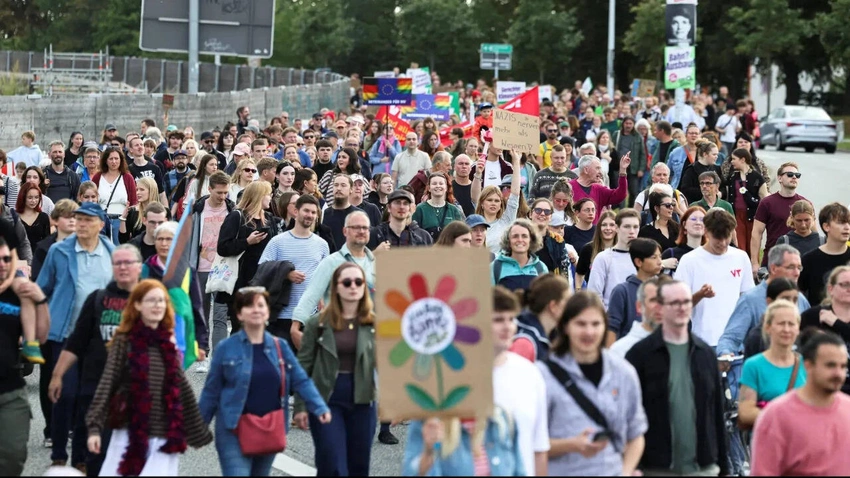
However, the AfD's rising influence isn't without significant opposition.
Mass protests have erupted across Germany, with a large turnout in Erfurt actively blocking access to the AfD's annual conference. These demonstrations underscore a strong public resistance to the far-right party's agenda, even as mainstream parties maintain a strategy of isolation, refusing any collaboration with the AfD.
