Inside George Lucas’s $1 Billion Museum, Where Star Wars Meets Frida Kahlo
Inside George Lucas’s $1 Billion Museum, Where Star Wars Meets Frida Kahlo
Inside George Lucas’s $1 Billion Museum, Where Star Wars Meets Frida Kahlo
A look at how George Lucas’s $1 billion museum collapses the boundaries between fine art, pop culture and visual storytelling, asking who gets to decide what deserves to be called art.
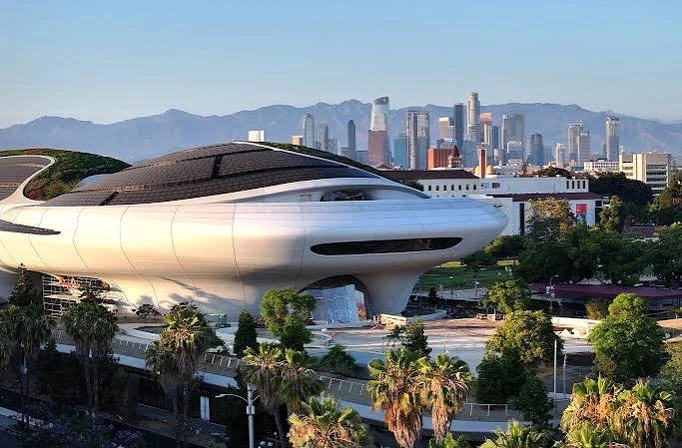
It's actually hilariously George Lucas when the filmmaker's building a $1 billion museum and then making the building itself look like a spacecraft that has landed in Los Angeles. The Lucas Museum of Narrative Art rises out of Exposition Park in a vast silver curve, five storeys high and spread across 300,000 square feet. It took 17 years to get here, after plans for San Francisco and Chicago fell apart, and now it sits next to the University of Southern California, Lucas's old university, as if the final destination had been hiding in plain sight. I expected Star Wars. I did not expect the museum to be so interested in the argument that a comic book, a Norman Rockwell painting and a film still might belong to the same cultural conversation.
A Museum About Pictures That Refuse to Behave
The Lucas Museum calls its subject “narrative art”, which sounds straightforward until you actually walk through the building. The inaugural display contains around 1,300 works drawn from a permanent collection of more than 40,000, arranged across more than 30 galleries and roughly 100,000 square feet of exhibition space. The organising principle is storytelling rather than the conventional hierarchy of painting, sculpture and photography.
The galleries move through themes such as adventure, motherhood, community, romance and science fiction. There are dedicated spaces for artists including Norman Rockwell, N.C. Wyeth and Frank Frazetta, alongside rooms devoted to manga, comics and children's illustration. It is the sort of collection where a visitor can encounter a work by Frida Kahlo and then turn a corner and meet the Cowardly Lion from The Wizard of Oz.
That collision is the whole point. Lucas's argument is that images have always been one of humanity's ways of transmitting myths. The museum, therefore, treats illustration as something more than decoration placed beside a story. The image is part of how the story survives.
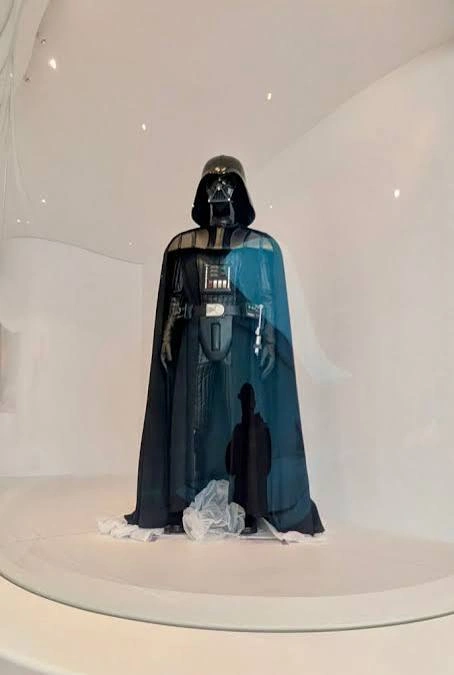
Then You Find Darth Vader
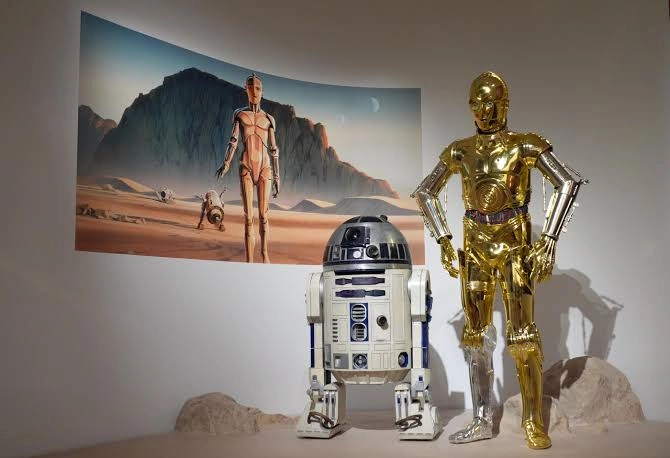
Of course, there is no version of this museum in which George Lucas can escape Star Wars. The funny thing is how restrained the franchise actually is. Less than ten per cent of the museum is dedicated to Star Wars, despite the fact that the collection contains models of R2-D2, C-3PO, Darth Vader and a Stormtrooper, along with seven full-sized vehicles from the films. Luke Skywalker's landspeeder is there, too.
Elsewhere, the museum gets wonderfully unpredictable. There is a 1940 Frida Kahlo self-portrait, Banksy, photographs of Louis Armstrong and the Beatles, and John Dominis's image of the Black Power salute at the 1968 Olympics. The photography galleries place celebrity and history in the same visual field, which makes the museum feel less like a shrine to one filmmaker and more like a gigantic archive of the things that have taught people how to imagine themselves.
Even the gardens continue the game. Bronze Star Wars figures appear outside among the landscaping, while the building contains two theatres, a research library and the Skywalker Grill on the rooftop. The park itself is open without a museum ticket, making the institution feel deliberately porous rather than sealed off from the city around it.
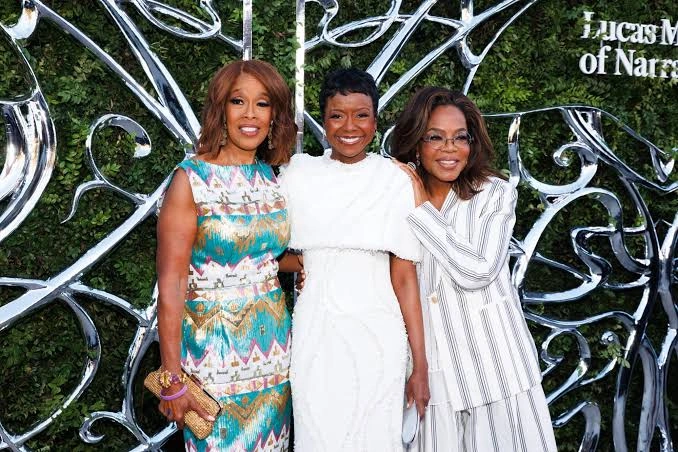
And Then Hollywood Arrived
The opening night was almost too perfectly cast. The event brought together people from the different worlds the museum is trying to put into the same room. Steven Spielberg, Guillermo del Toro and Greta Gerwig were among the co-chairs, alongside Tom Cruise, Lewis Hamilton and Pharrell Williams. The guest list included Oprah Winfrey, Leonardo DiCaprio, Robert De Niro, Al Pacino, Samuel L. Jackson, Nicolas Cage and Eva Longoria. Then Mark Hamill and Hayden Christensen arrived, which is probably the closest a museum opening can get to having its own mythology walk down the carpet.
The night eventually became another piece of narrative art itself. A choir performed in the main lobby. Oprah and Samuel L. Jackson narrated a drone show above the museum, with images transforming into references to Captain America, Banksy's Girl With Balloon, Frida Kahlo, R2-D2 and the Millennium Falcon. Later, the Black Eyed Peas performed while guests danced into the night. It is a wondrously closed circle—a museum born to celebrate the craft of storytelling, baptised in the awe of silver-screen royalty looking up to witness a giant tale breathe life into the ceiling.
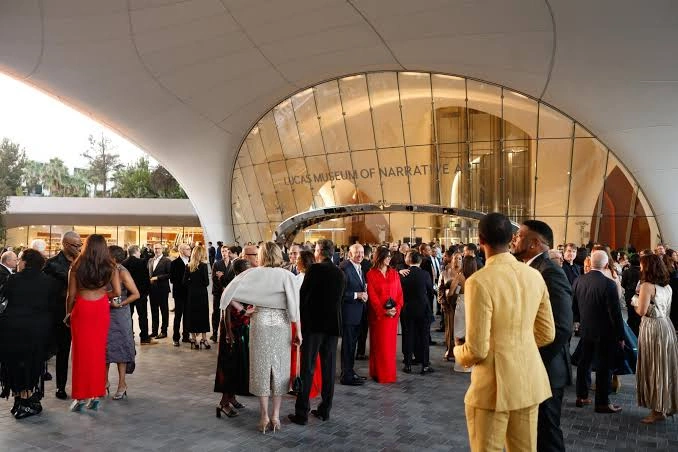
Maybe the Museum Is Really About Who Gets to Be Serious
The most interesting thing about the Lucas Museum is not the amount of money behind it, although $1 billion is impossible to ignore. It is the cultural gamble underneath the money. For decades, museums have tended to separate the things people are supposed to admire from the things people are simply supposed to love. A Frida Kahlo portrait belongs to art history. A Star Wars prop belongs to fandom. A comic belongs somewhere in between, forever waiting for somebody to explain why it deserves a wall.
Lucas has built a museum where those categories keep bumping into each other. That is why the building feels almost like an enormous pop-culture memory palace. You enter expecting George Lucas and keep finding yourself confronted with the much longer history of how humans have made pictures to understand the stories they inherit. Maybe the most revealing object in the museum is therefore not Darth Vader or the Millennium Falcon. It is the idea that they can stand in the same institution as Frida Kahlo without either side having to apologise for being there.
After spending $1 billion proving that argument, George Lucas has finally built himself a museum where pop culture no longer has to ask permission to call itself art.
