6 Brutal Truths to Crack Your First Job and Build a Career in 2026


6 Brutal Truths to Crack Your First Job and Build a Career in 2026
6 Brutal Truths to Crack Your First Job and Build a Career in 2026
The job market is cooked, but you don't have to be. Forget the college lies; here is the survival guide on hard skills, real projects, and the secret backup plan you need.
The job market right now is… not great. Whether you’re graduating in Delhi, Bangalore, London, or NYC, the "dream job" everyone promised you feels more like a myth. You’ve got the degree, you’ve done the modules, and you’ve probably sent out 200 applications only to get ghosted by an AI bot. It’s frustrating. It’s scary. And honestly, it feels a bit like a scam.

But here is the truth, people are still getting hired. They just aren't the ones following the old "study hard, get a degree, get a job" formula. That formula is broken. If you want to survive 2026, you need a new playbook, and the only person who can help you, is yourself.

Here is the deep dive into the 6 brutal truths you need to hear to actually make it.
1. Pick a Lane (But Keep Your GPS On)
In college, they tell you to be well-rounded. In the real world, being well-rounded often just means you’re not particularly good at anything specific. Employers are looking for specialists and doer, no managers. They have a specific problem, and they want a specific tool to fix it.
Focus on a particular industry or skillset. If you’re into Fintech, learn the regulations, the players, and the tech. If you’re into green energy, understand the supply chain, it's finances. You need to become "the guy" or "the girl" for a specific thing. However, don’t be rigid. The world moves fast. If you decide you only want to work in "Social Media Marketing for Vegan Dog Food Brands," you might find yourself out of a job pretty quickly.
Have a focus, but stay flexible. Think of it like a "T-shaped" skill set: have a broad understanding of many things, but go deep into one. If your industry takes a hit, be ready to pivot your deep skill to a new sector.
2. Hard Skills are Your Armor (Soft Skills are Just the Polish)
There’s a lot of talk about "soft skills" like communication, empathy, and leadership. Don't get me wrong, they matter. But here is the secret: you can learn how to send a professional email or run a meeting in a week. You can’t learn Advanced Statistics or Full-stack Engineering in a week.
Hard Skills (Learn These Now): Python / Java / Rust, Financial Modeling & Valuation, Law and Legal Frameworks, Structural Engineering and Design, Advanced Data Analytics, Engineering and Engineering design, Econometrics, etc. Yes, they all sound boring and difficult, but that's what you get hired for! as long as you run away from these, don't expect employers to take you seriously.
Soft Skills (Learn on the Job): Basic Sales / Pitching, Making "Aesthetic" PPTs, AI Prompt Writing, Event Coordination, Team Communication, Team Management, etc.

Hard skills are things that are difficult for others to replicate. If you know how to build a complex financial model or write clean, scalable code, you have a value that isn't easily replaced by a "generalist."
Soft skills like sales and marketing are often better learned by actually doing them in a high-pressure environment anyway. Focus your "unemployed time" on the stuff that requires a textbook and deep focus.
3. Projects > Degrees (And Why Internships are a Trap)
This might hurt, but 99% of internships are a waste of time, because in a fast-paced company, nobody has the time to actually teach an outsider. You usually end up doing the work that's too boring for the full-timers. You aren't "learning the business"; you’re just a temporary ghost in the office.
Stop looking for someone to give you an opportunity and start building your own. Employers today are cynical. They’ve seen thousands of resumes with the same 8.5 CGPA. What they haven't seen is a graduate who says, "I didn't have a job, so I built a working prototype of a micro-lending app for local farmers."

Applied projects build confidence, so when you build something that actually works, you stop feeling like a student and start feeling like a professional. In an interview, talk about proof of work, the bugs you hit and how you fixed them. That's what employers actually want to discuss. They want to know how you think, not how well you can memorize a syllabus.
If you're an engineer, build a machine. If you're a writer, build a newsletter with 500 subs. If you're in finance, manage a public "paper trading" portfolio and explain your logic. Do not wait for permission to be talented.
4. Become Your Own Customer
One of the biggest mistakes fresh grads make is being "academic." They look at a business from the outside like a science experiment. To be valuable, you need empathy. You need to understand the "Who." Who is using this product? What is their biggest headache?

If you want to work in the cycling industry, you better be out there on two wheels, getting sweaty and feeling the gear shifts. If you want to be a Dev, use the apps you’re trying to build for. Understand where the UI is annoying. Learn and build the whole thing. If you’re in Finance, who is reading your reports? Is it a stressed-out CEO who only has 30 seconds? Then make your data digestible for that person.
When you understand the customer, or better yet, when you are the customer—you stop suggesting "cool ideas" and start suggesting "useful solutions." That shift in mindset is the difference between an entry-level employee and a future manager.
5. The "Free" Mindset (The Ultimate Career Hack)
This is the most controversial point, but hear me out. In the beginning, your salary is the least important part of your compensation. Wait, don't close the tab yet. I’m not saying you should be exploited. But you should be willing to work for free or for very little if and only if the "Learning ROI" is massive.
Think of it this way, you just paid thousands for a degree that didn't give you a job. Working for 3 months at a top-tier startup for "free" is actually a much cheaper and more effective education than your fourth year of college was.
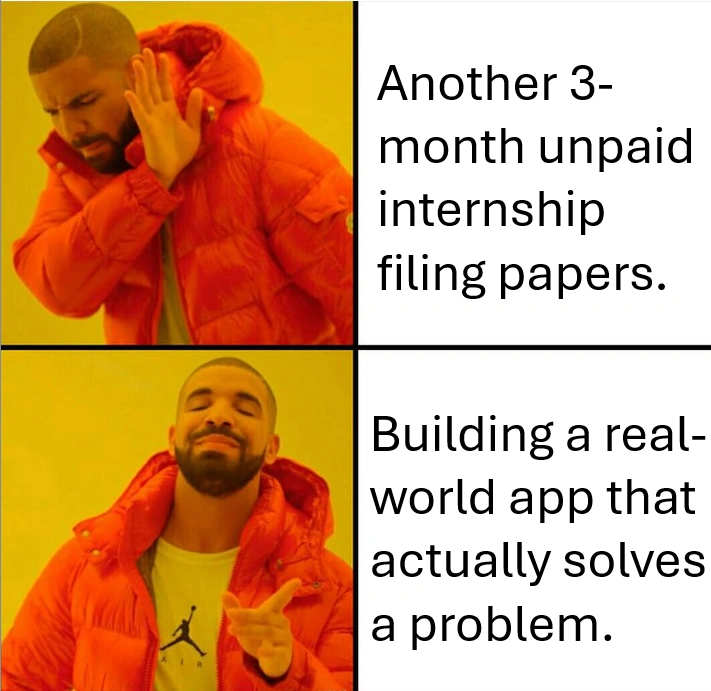
Attitude is everything. Telling an employer, "I'm so hungry to learn this industry that I'll work for free for a month to prove my value," is a power move.
In reality, most good employers won't actually let you work for free. They'll find a budget because they respect the hustle. But even if they don't, the experience you gain in 3 months of real-world doing will make you much more hireable for the next job that does pay well. Money will come. Right now, you are trading your time for Capital-E Experience. Don't let a small starting salary stop you from joining a rocket ship.
6. The "Secret" Entrepreneurial Backup Plan
Here is a scary thought, you will likely be fired or laid off at some point in the next 5 years. It’s not personal; it’s just how the economy works now. You need to be an entrepreneur in hiding.
While you are working your 9-to-5, you should be constantly learning how the business actually makes money. Where do the leads come from? How does the billing work? What are the biggest complaints from clients?
Keep your intentions secret. Your boss doesn't need to know that you're dreaming of starting your own agency or tech firm. But you should be preparing for it every single day. Build your personal brand with substance, not just on LinkedIn or Thoxt. Network with people outside your company. Keep a "swipe file" of business ideas you see in your daily work.
Being ready to go solo isn't just a backup plan, it's what gives you the confidence to be a better employee. When you aren't terrified of losing your job, you take more risks, you speak up more, and ironically, you become more valuable to your employer.
@abhishek for CareerNuts
