Netaji Bose’s Strategic Vision Guides India, Says CDS Chauhan

Netaji Bose’s Strategic Vision Guides India, Says CDS Chauhan
Defence Chief Gen. Anil Chauhan links Netaji’s integrated approach to today’s security challenges, urging Indian-led strategic innovation.
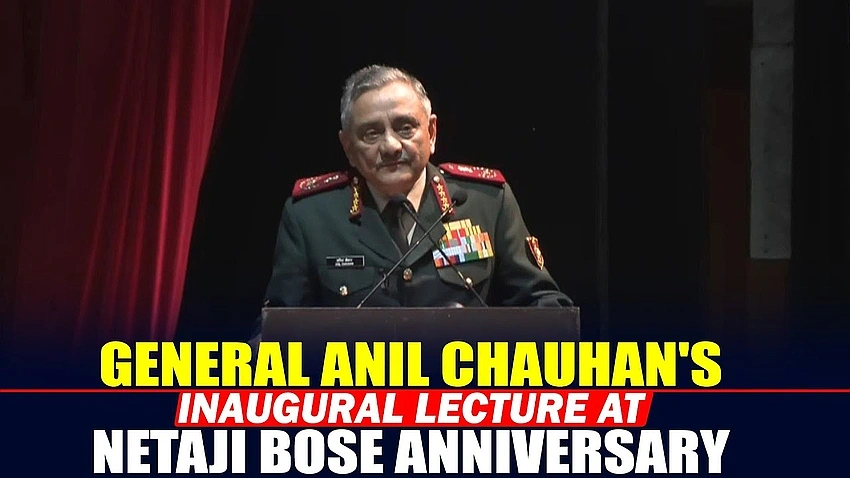
Defence Chief General Anil Chauhan delivered a keynote at Jawaharlal Nehru University on Netaji Subhas Chandra Bose's birth anniversary, arguing that Bose's strategic vision remains highly relevant in a volatile, polycentric global order. He described Bose as someone who blended political vision, diplomacy and military operations into a coherent national project, noting that Bose “created a government, built an army, planned campaigns, negotiated alliances and managed logistics.”
Chauhan emphasized that national security today extends beyond traditional military concerns. His framework centers on three concentric circles: securing the nation, defending it, and at the core, maintaining military preparedness. In his view, security now encompasses land, people and ideology, and these elements must be coordinated with forces and diplomacy to protect national interests in a rapidly changing world.
Highlighting Bose’s foresight, the CDS pointed to Bose’s push for indigenous arms production as early as 1944, drawing a parallel with today’s emphasis on self-reliance. He recalled the negotiations with Japan to secure the Andaman and Nicobar Islands—renamed Shaheed and Swaraj—as India’s first sovereign territory, a testament to Bose’s practical diplomacy and strategic realism. He also noted that the Indian National Army’s attrition rate was the highest faced by any army, yet its legacy unified diverse groups across regions, castes and faiths.
Chauhan urged a renewed focus on Indian-led strategic innovation to respond to evolving threats. He underscored that national security requires a holistic approach—protecting land, securing the people and defending our shared ideology—while leveraging domestic capabilities and prudent alliances. The remarks also came amid calls from Anita Bose Pfaff for Indians to support the return of Netaji’s ashes to India, underscoring the enduring resonance of Bose’s legacy in contemporary discourse.
