Ultra‑Rare CRIB Blood Group Found in Kolar Woman, First in the World

Ultra‑Rare CRIB Blood Group Found in Kolar Woman, First in the World
A woman from Karnataka surprises doctors with a new blood group. What does this mean for science and medicine? Dive into this extraordinary medical breakthrough.
A South Indian woman from Karnataka's Kolar district has been found to have a new blood group that has never been identified anywhere in the world. When a 38-year-old woman was admitted to a Kolar hospital for heart surgery, this extraordinary case was made public. Although she had the most common blood group, O Rh+, none of the available O-positive blood units fit her. For additional investigation, the hospital forwarded the case to the Rotary Bangalore TTK Blood Center's Advanced Immunohematology Reference Laboratory.

“Using advanced serological techniques, our team found that her blood was ‘panreactive’, incompatible with all test samples. Recognising this as a possible case of a rare or unknown blood type, the team collected blood samples from 20 of her family members to search for a compatible match, but none of them were a match. The case was managed with utmost care, and with collaborative effort from her physicians and family, her surgery was successfully completed without the need for transfusion,” said Dr Ankit Mathur from the Rotary Bangalore TTK Blood Centre.
In the meantime, blood samples from her and her family were sent to Bristol, UK's International Blood Group Reference Laboratory (IBGRL). According to Dr. Mathur, a previously unidentified blood group antigen was discovered after ten months of intensive investigation and molecular testing.
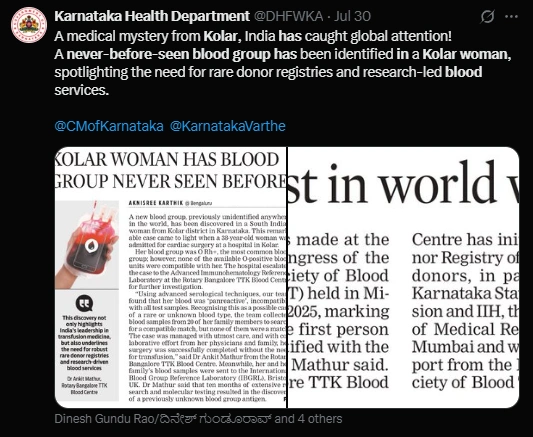
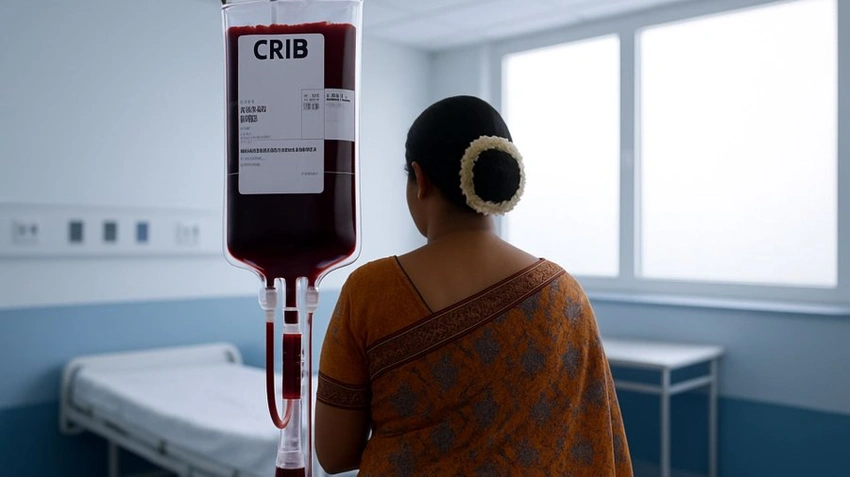
This belongs to the Cromer (CR) blood group system and has been formally dubbed CRIB in honor of its place of origin, where "CR" stands for "Cromer" and "IB" for "India" and "Bangalore." The woman was the first person in the world to be identified with the CRIB antigen, according to Dr. Mathur, who made the historic announcement at the 35th Regional Congress of the International Society of Blood Transfusion (ISBT), which was held in Milan, Italy, in June 2025.
In collaboration with Karnataka State Blood Transfusion and IIH, the Indian Council of Medical Research center in Mumbai, and with technical assistance from the International Society of Blood Transfusion, Rotary Bangalore TTK Blood Center has launched a Rare Donor Registry of voluntary blood donors.
There is no denying the importance of the CRIB discovery. It highlights the shortcomings of existing blood-typing systems as well as the value of global cooperation in resolving medical mysteries. However, it also highlights a weakness: patients with unknown rare antigens might evade the usual safety precautions.
CRIB promotes investment in targeted antibody panels and genomic screening tools while also enhancing international medical databases. Conversely, depending too much on expensive molecular diagnostics could put a strain on healthcare systems, especially in environments with limited resources.
Blood banks around the world will have to update their procedures if more people with CRIB are discovered. But in the meantime, medical professionals are uncertain about how many rare antigens are still unknown. And in these unidentified situations, how can one best prepare for emergency transfusions?

Login to comment.
No thots yet. Be the first to share your thoughts!