Daisy Chain Fields: Olivia Rodrigo and the Making of a Feminist Pop Utopia

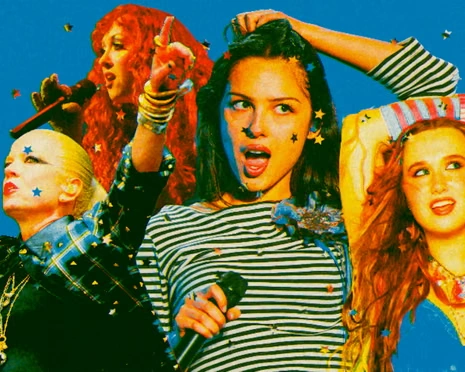
Daisy Chain Fields: Olivia Rodrigo and the Making of a Feminist Pop Utopia
Daisy Chain Fields: Olivia Rodrigo and the Making of a Feminist Pop Utopia
Olivia Rodrigo’s Daisy Chain Fields festival united Chappell Roan, Mitski, Bikini Kill, Stevie Nicks and more in a bold celebration of women across musical generations.
There is something almost literary about the name Daisy Chain Fields. It suggests flowers threaded together, individual forms made stronger through their arrangement, and a field that belongs not to one person but to a gathering. That logic sits at the centre of Olivia Rodrigo’s Daisy Chain Fields, the all-women music festival she founded at Great Park in Irvine, California, on 29 August 2026.
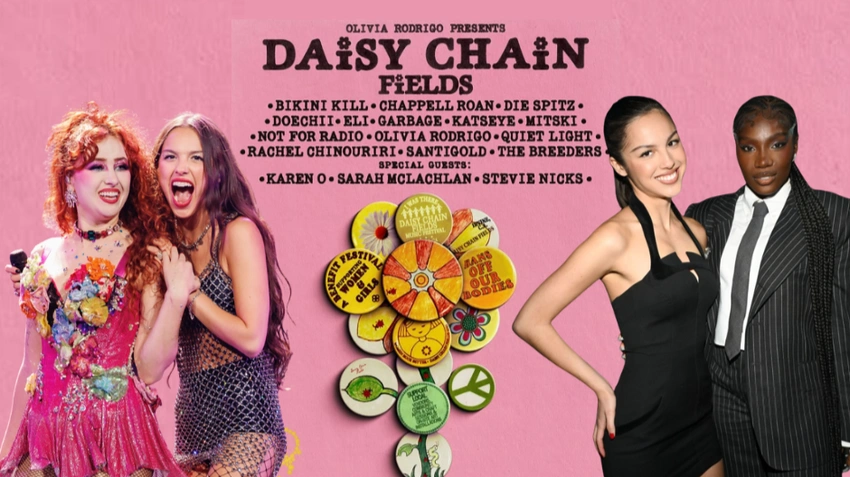
The festival brought together artists from radically different musical generations and traditions, including Chappell Roan, Doechii, Mitski, Bikini Kill, Garbage, The Breeders, Santigold and KATSEYE, alongside Rodrigo herself. Special appearances from Stevie Nicks, Sarah McLachlan and Karen O further extended its sense of musical lineage. Rather than constructing a festival around a single genre, Rodrigo created a temporary world in which different versions of womanhood in popular music could occupy the same space.
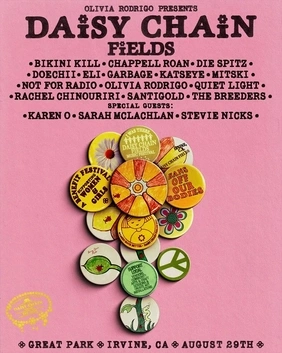
That is perhaps what makes Daisy Chain Fields more interesting than the simple description of it as an "all-female festival". It is less about uniformity than juxtaposition.
From Lilith Fair to the present
The most obvious historical ancestor is Lilith Fair, the festival founded by Sarah McLachlan in the late 1990s in response to an industry that frequently treated multiple women on the same bill as commercially undesirable. Rodrigo has spoken about Lilith Fair as a major inspiration, and the presence of McLachlan at Daisy Chain Fields made that connection almost circular. A festival born from one generation's frustration became the blueprint for another generation's intervention.
Yet Daisy Chain Fields does not simply reproduce the politics of the 1990s. Its musical vocabulary is considerably more fragmented. Riot grrrl pioneers stand alongside contemporary rap, hyperpop-adjacent pop, indie rock and mainstream chart music. Bikini Kill and The Breeders carry the historical memory of alternative feminist music cultures, while artists such as Roan, Doechii and KATSEYE represent newer forms of pop stardom.
The result is almost genealogical. The festival makes visible the relationships between women who might otherwise be separated by genre, age or industry category.
Music as collective language
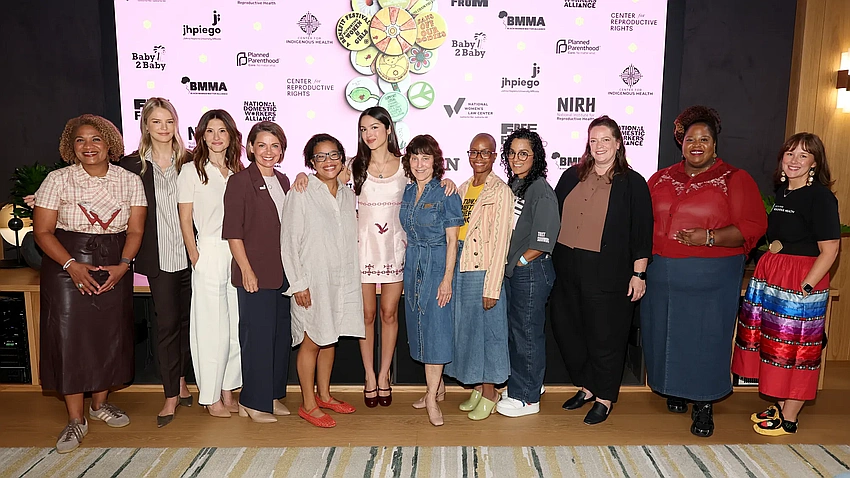
There is also an important distinction between representation and community. Daisy Chain Fields was not designed merely to demonstrate that women can occupy a festival bill. Its structure attempted to turn the festival itself into a social space.
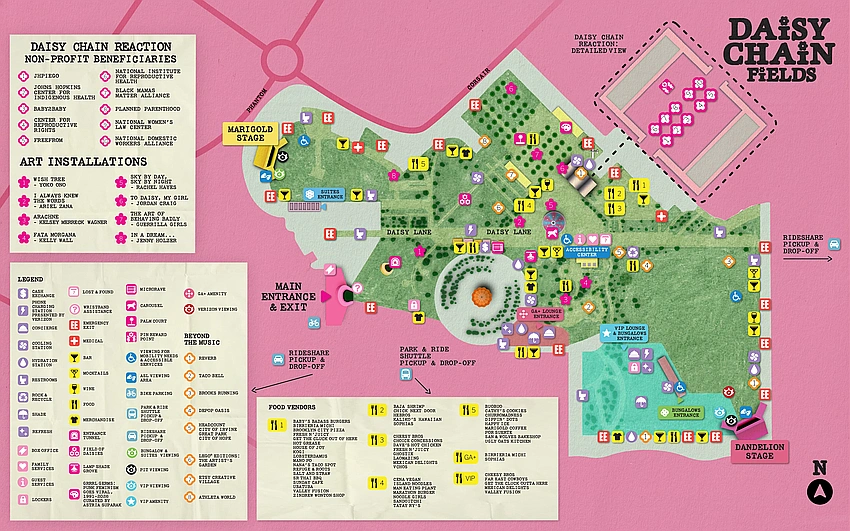
Alongside performances, the event included nonprofit organisations, educational resources, community art experiences and other activations. Proceeds were directed towards organisations working across reproductive rights, maternal health, economic empowerment, domestic violence prevention and gender equity.
This makes the festival feel closer to an argument than a conventional commercial spectacle. The music provides the emotional vocabulary, while the organisations provide a political one. One does not have to choose between pleasure and seriousness. Dancing, screaming lyrics and learning about women's rights can exist within the same cultural experience.
That combination matters because pop music has always been particularly good at turning private emotion into collective recognition. A song begins as somebody's story and becomes, through an audience, something larger. Daisy Chain Fields applies the same principle to activism.
 The importance of generations
The festival's most compelling quality may ultimately be its sense of inheritance. Rodrigo is only 23, yet her festival placed her alongside artists whose careers had already shaped the cultural landscape before she became a star.
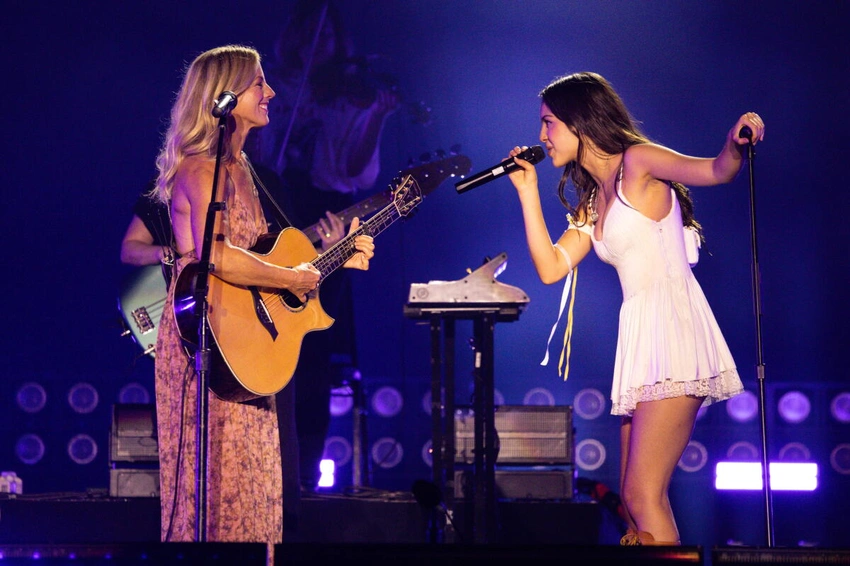
That generational exchange became literal during Rodrigo's closing performance. Sarah McLachlan and Stevie Nicks joined her onstage, while Alanis Morissette appeared in place of Karen O. Rodrigo and McLachlan performed together, and Rodrigo later joined Nicks for "Landslide". Around 45,000 people reportedly attended the festival, turning the final performance into a meeting point between different eras of women's songwriting.
The image is almost symbolic: a young pop star singing with artists whose music helped create the cultural language she inherited. The festival's title begins to make more sense here. A daisy chain is not one flower made larger. It is a sequence of separate flowers, each retaining its own form while becoming part of something collective.
Beyond the celebrity festival
There is, inevitably, a tension in an event of this scale. Daisy Chain Fields is still a celebrity-led festival, built around one of the biggest young pop stars in the world. It exists within the machinery of the entertainment industry it is also attempting to critique. That contradiction should not be ignored.
But neither should the practical effect of using celebrity as infrastructure. The festival announced a $10 million donation to organisations working for women's rights and reproductive justice, with the associated nonprofits gaining access to an audience that might not ordinarily encounter their work. The Associated Press reported that the event ultimately raised $20 million for women's wellbeing, including a $10 million contribution from Melinda French Gates' Pivotal Ventures.
The significance of Daisy Chain Fields therefore lies less in the fantasy that music can solve political problems than in its understanding of what music can do. It can gather people. It can create emotional identification. It can make unfamiliar causes part of ordinary cultural life.
A field of its own
Daisy Chain Fields arrives at an interesting moment for Olivia Rodrigo. Her career has moved from the intimate melodrama of teenage heartbreak towards something broader, where songwriting, feminism, activism and celebrity increasingly overlap. The festival gives those interests a physical form.
Its greatest achievement may be that it refuses to make political engagement feel separate from joy. There is no requirement that empowerment must look solemn. Sometimes it looks like 45,000 people singing together. Sometimes it looks like an old song being handed from one generation to another. Sometimes it looks like a field full of women who have come not simply to watch their favourite artists, but to recognise themselves in a much larger cultural story.
Daisy Chain Fields is therefore more than another entry in the increasingly crowded festival calendar. It is an attempt to imagine what happens when the audience becomes a community, when a lineup becomes a lineage, and when pop music becomes a meeting place for both memory and action.
#DaisyChainFields #OliviaRodrigo #WomensMusic #MusicFestival #LiveMusic

Login to comment.
No thots yet. Be the first to share your thoughts!