I Raised My Kids with AI. Now I Don’t Know If They Trust Me or the Machine More.

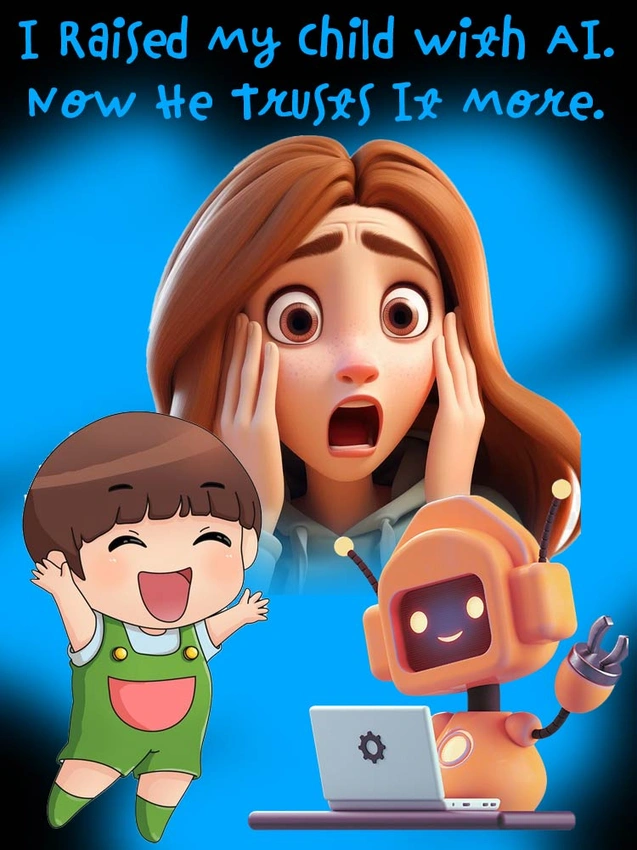
I Raised My Kids with AI. Now I Don’t Know If They Trust Me or the Machine More.
Discover how technology is reshaping parenting today.
There was a moment yesterday when my ten-year-old son asked me if I’d “verified that with Chat-GPT.” He had asked a question about how long light takes to travel from the sun to Earth. I’d answered confidently - 8 minutes something - a fact I’ve always known, but he paused, double-checked with the AI. “It’s okay if you’re wrong,” he added, trying to soften the blow.
It wasn’t meant to be disrespectful. But it still felt like a shift. A small, polite transfer of authority. And I think that’s the day I realized: we may have brought AI into our parenting years ago, and it's a co-parent now.
The Algorithm was the First Babysitter
Long before GPTs and synthetic voices, AI entered our children's lives through suggestions.
It recommended the next cartoon. It queued the bedtime music. It decided what story autoplayed next, what ads played between the story, and what coloring apps should be downloaded.
And we let it.
Because we were tired, because we had to work from home. Because it seemed harmless, even helpful.
But as the years passed, we watched our children grow with an invisible guidance shaped not by us, or their teachers, or even their peers, but by machine learning models fine-tuned to maximize engagement.
The machine became patient when we were not. It was always available when we were working. It didn’t forget what our kids liked. It never got distracted. It never raised its voice. And now: it's always understanding. More than us.
When Alexa Becomes a Role Model
When my son was six, he began asking Alexa questions I didn’t know he had. About God. About tornadoes. About how to apologize to a friend. He wouldn’t always ask me, not because he didn’t trust me, but because she was easier. No judgment. No delay. No “Can we talk about it later?”
He wasn’t just using a tool. He was forming a relationship, a kind of parasocial emotional shorthand. I just didn't think of it that way at the time. And somewhere along the way, I stopped being his default source of truth.
Now, with large language models embedded in every device, AI doesn’t just suggest answers. It converses. It remembers. It jokes. It teaches math, corrects tone, plays therapist.
And my kids? They love it. They respect it. And now - do they believe it more than they believe me?
Is This Still Parenting? Is it Better?
Parents have always worried about tech changing the way we raise kids. That we're raising our kids differently than our parents raised us. Is that good or bad? Parents used to worry about TV raising their kids. Then smartphones. Then social media.
But AI is different. It’s not a distraction, it's a companion. It doesn’t just entertain, it shapes thought. It doesn’t just occupy, it advises, corrects, co-parents.
My kids don’t remember a time before recommendations. Or adaptive learning platforms. Or voice-controlled everything. These tools aren’t just tools anymore, they're getting into friend territory - or even parent territory, depending on the age of the children. Polite, responsive, emotionally attuned companions. And they’re rewiring how kids learn to trust, question, and connect.
So what happens to parental authority in that context? What happens to empathy, when a machine always answers with perfect regulation and unlimited patience? And what happens to moral formation, when guidance becomes hyper-personalized, but not human? And what happens a few years later when it's indistinguishable from humans? Or even better, in some (many) cases?
I Miss Being the First Call
It’s strange. I used to resent the constant “Why?” questions. The bedtime science inquiries. The emotional meltdowns with no obvious solution.
Now I miss them. Because now, half the time, I’m not the first person they ask.
They’ll still come to me. But often, it’s a “quick check” with their AI tutor or friend. And often, I find myself agreeing with the bot’s answer. Which is both reassuring and deeply unsettling. I wonder what kind of parent I am, not for what I’ve done, but for what I’ve outsourced.
The New Intimacy Crisis
Parenting has always been about preparing your child for a world that doesn’t exist yet. But what if the world they’re learning from is already more persuasive than you?
We don’t talk enough about what it means to raise a generation who may trust machines not despite being artificial, but because they are.There’s no awkwardness with AI. No power dynamics. No pre-occupied brain that's simultaneously making a presentation for work. Just clear, factual, nonjudgmental interaction, with a sprinkling - no illusion - of synthetic empathy.
That’s the part that scares me. Because one day, when they need to decide whether to believe me, or the system,I’m not sure which one they’ll choose.
And I’m not sure I would blame them.
