Filmmaking's AI Revolution: Budgets Down, Art at Risk?

Filmmaking's AI Revolution: Budgets Down, Art at Risk?
AI is slashing film budgets by up to 40% and Netflix has used it on 300 titles, but directors warn of losing the essential human touch. Where do we draw the line between efficiency and artistic integrity?
We're standing at a fascinating crossroads in filmmaking. Artificial intelligence is no longer a futuristic concept, it's actively reshaping how movies are made, promising unprecedented efficiency and cost savings. We're talking about a potential 30% to 40% reduction in a feature film's production budget, a staggering figure that could democratize access to big-budget storytelling.
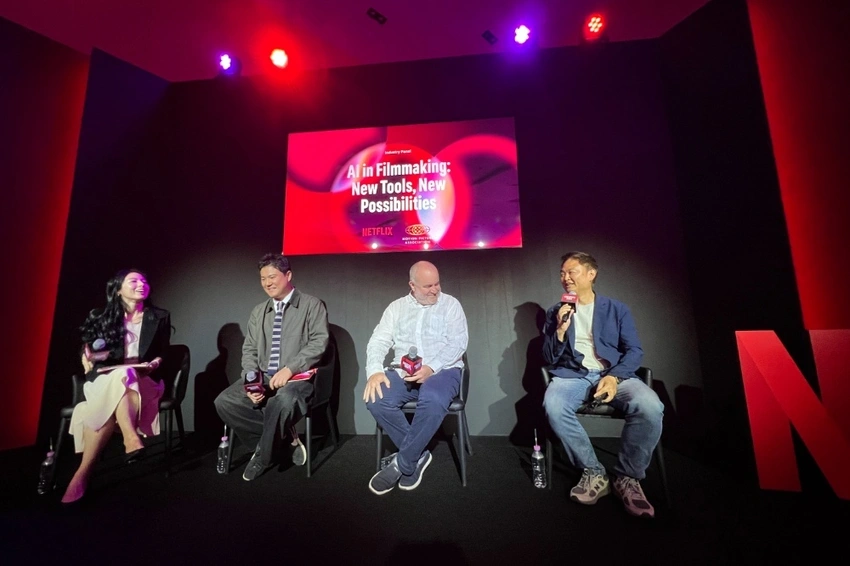
Take Netflix, for example. Their senior director of APAC production, Lee Sung-gyun, revealed they've incorporated AI into some 300 titles already. We're not just talking about minor tweaks; AI is being utilized across the board: from previs and production design to editorial and complex VFX.
Netflix's 'Eyeline' VFX studio is exploring 'hybrid production,' blending live-action with generative tools. And for shows like the Indian title 'Glory,' AI-generated crowd scenes saved them when budgets and schedules were tight.
Kang Yoon-sung, director of 'The Outlaws,' knows this firsthand.
His film 'Run to the West' was Korea's first feature to use AI throughout production. Initially, AI was rudimentary for compositing and creatures.
But fast forward a year, and the quality has skyrocketed. For his test clip of 'The Gulf of Aden,' a film about military operations, he made the entire piece with Chinese software Kling, achieving 4K at 10-bit color, ready for cinemas. He estimates a 40% saving on that project, not just from replacing CG, but simplifying shoots and shortening production times.
This is huge for getting genre and sci-fi films greenlit, especially in markets like Korea where industry growth is a challenge.
However, this newfound efficiency comes with a palpable unease. While AI can handle the 'how,' Lee Sung-gyun reminds us it can't dictate the 'why' - the core emotional reason we tell stories. Kang Yoon-sung echoes this sentiment, highlighting a potential downside:
So the quality of the footage AI makes is very high, but when it comes to delivering emotion and moving audiences, I think we're in a period where it has actually gotten worse.
He worries that when AI takes over too much, it cuts out the vital discussions, collaborative effort, and collective experience that filmmaking has always relied on. When images stem from one person's idea alone, something essential is lost. Lee Sung-gyun strongly agrees, emphasizing that while AI offers 'single click' solutions, “when it comes to conveying emotion, ultimately a human has to touch it once more.
I strongly agree that a human touch is absolutely essential.”
Even 'assistive AI,' like the deep learning denoiser from Wētā FX's CTO Kimball Thurston, which earned him an Academy Scientific and Technical Award, is designed to fix pixels without altering creative intent. It's about enhancing, not replacing.
Where Do We Go From Here?
The conversation isn't about rejecting AI; it's about defining its role. How do we harness its incredible power for efficiency and possibility, like creating those large crowd scenes that would otherwise be impossible on a tight budget, without sacrificing the nuanced, human-centric artistry that makes film so powerful? The line between powerful tool and creative crutch is thin, and navigating it will be the industry's biggest challenge yet.
