Government greenlights ₹7,280 crore scheme to ramp up rare earth magnet production

Government greenlights ₹7,280 crore scheme to ramp up rare earth magnet production
Government greenlights ₹7,280 crore scheme to ramp up rare earth magnet production
The government has approved a seven-year plan worth Rs 7,280 crore to build a full domestic REPM supply chain—from rare earth oxides to finished magnets—backed by Rs 6,450 crore in sales incentives, targeting 6,000 MTPA
A plan to encourage the production of sintered rare earth permanent magnets (REPM) with a total cost of Rs 7,280 crore was approved by the government on Wednesday. This includes five years of sales-linked incentives totalling Rs 6,450 crore on REPM sales.
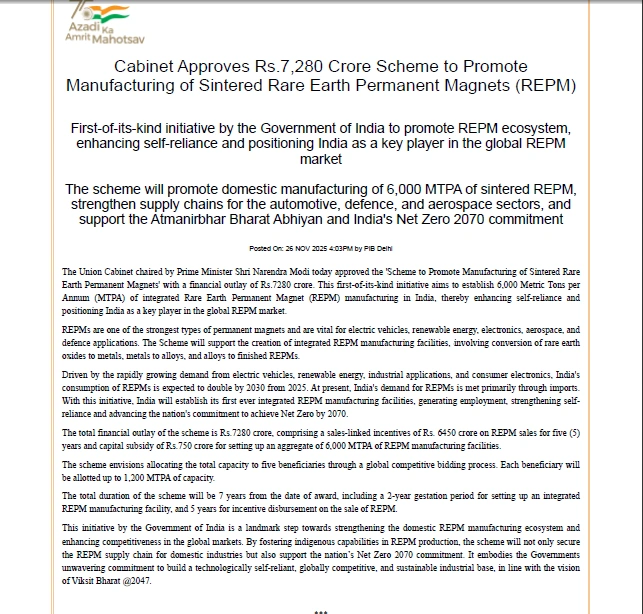
The government claims that the program will facilitate the development of integrated manufacturing facilities that encompass the whole value chain, from rare earth oxides to metals, metals to alloys, and alloys to completed REPMs. Five units with capacities of 1,200 MTPA each will contribute to the initiative's creation of a 6,000 MTPA manufacturing capacity. The seven-year plan will include two years for establishing manufacturing facilities.
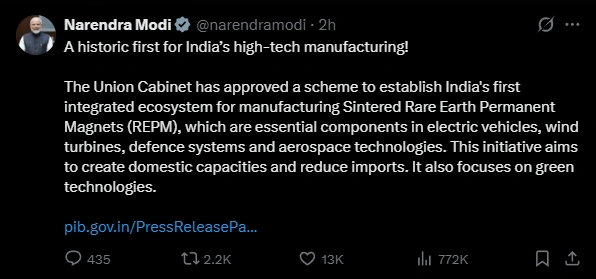
By 2030, India's REPM consumption is expected to have doubled from 2025 levels. The project aims to create a strong domestic ecosystem for REPMs, which are essential parts of renewable energy technologies, electric vehicles, and defence systems. Approximately 60% of the world's rare earth mining and nearly 90% of its refining and processing capacity are currently controlled by China. It tightened supply to India's automotive and electronics industries in April by imposing restrictions on REPM exports.
India has positioned itself to be a major player in the world market for rare-earth permanent magnets with this momentous announcement. With a goal of 6,000 MTPA of integrated Rare Earth Permanent Magnet, the plan will strengthen India's manufacturing capabilities. The goal is to increase self-reliance and make India one of the few REPM suppliers worldwide.
Despite controlling about 90% of the world's rare-earth production, China's reliance on the dragon carries risks due to the uncertainty surrounding its trade negotiations with the United States. India's strategy aims to draw in international players who could assist in increasing India's production of rare-earth permanent magnets and guaranteeing supplies to EV manufacturers, defence units, automakers, and the electronics sector, among others.
