AI Data Centers Collide with Philly's Industrial Past

AI Data Centers Collide with Philly's Industrial Past
Philadelphia residents, scarred by pollution, are fighting plans for new AI data centers. Discover why communities are pushing back against the tech boom in areas already impacted by heavy industry.
The booming demand for Artificial Intelligence is sparking a nationwide push for new data centers, but not everyone is welcoming these tech hubs with open arms. Across the United States, communities are raising concerns about the environmental and energy impact of these massive facilities, especially in areas already scarred by heavy industry.
Philadelphia is now at the forefront of this contentious debate, as local residents and activists push back against potential data center construction.
For residents like Shawmar Pitts, the threat of new industrial development isn't theoretical; it's a painful echo of the past. Pitts, a lifelong resident of Southwest Philadelphia's Grays Ferry neighborhood, grew up next to what was once the East Coast's largest oil refinery. After an explosion in 2019, the refinery finally shut down, but its legacy of pollution and chronic health issues remains etched in the community.
It wasn't until Pitts encountered the environmental justice group Philly Thrive in 2018, tabling about a proposed refinery expansion, that he connected the dots. He recalled seeing a list of refinery-related illnesses and realizing,
My mother has this, my sister has that, my next-door neighbor suffers from this - every house, someone has something on that list.
This stark realization turned him into an advocate.
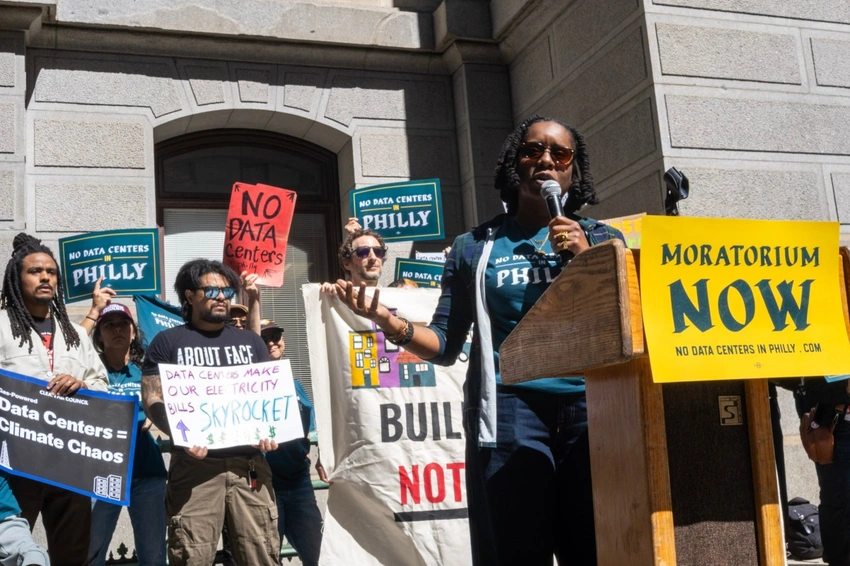
Pitts, now a managing co-director of Philly Thrive, is leading the charge for a data center moratorium in Philadelphia. Although no formal construction proposals have been made, city officials have identified two potential sites: one in Northeast Philadelphia and another, unsettlingly, in Pitts' own Grays Ferry neighborhood. Communities nationwide, particularly those with limited resources, are resisting new data centers.
However, the pushback is especially fierce in places where the impact of heavy industry is still deeply felt.
At a recent rally at Philadelphia's City Hall, Philly Thrive board president Sonya Sanders voiced the community's unequivocal stance:
We don't want data centers. We don't want the pollution, we don't want the noise, and we know they're not going to bring us more jobs.
Sanders shared a heartbreaking personal story, linking her husband's death from a rare bone cancer in 2020 to the emissions from the now-defunct refinery.
"In my eyes, they killed him," she asserted. "The pollution killed him. I believe he would be here today if he wasn't silently murdered, because it was the pursuit of profit that killed him." Her powerful testimony highlights the deep-seated mistrust and trauma stemming from past industrial practices.
While a new data center might not have the same immediate environmental footprint as a massive oil refinery that processed 335,000 barrels of crude oil daily, the environmental implications are still significant. The intense global race to dominate the AI industry is projected to dramatically increase energy consumption.
BloombergNEF predicts that by 2035, U.S. data centers will consume more natural gas than Germany and Japan combined, nearly double their projection from just nine months prior. Although natural gas burns cleaner than other fossil fuels like oil, it's far from harmless.
Burning one cubic foot releases the equivalent of 60 grams of carbon dioxide, and the additional demand from data centers is expected to generate an extra 1 million metric tons of greenhouse gas pollution daily, accounting for roughly 12% of current U.S. greenhouse gas emissions.
The long-term health consequences of such pollution are dire.
Harvard University researchers found in 2021 that fossil fuel air pollution is responsible for one in five deaths worldwide, a figure expected to rise in the age of AI.
As communities like Grays Ferry grapple with the lingering effects of past industrialization, the prospect of new energy-intensive developments like AI data centers raises critical questions about environmental justice, public health, and the true cost of technological advancement.
#AIdataCenters #Philly #EnvironmentalJustice #NoDataCentersInPhilly
