How to Select a Boiler Thermostat for Residential and Multi-Family Heating Systems

How to Select a Boiler Thermostat for Residential and Multi-Family Heating Systems
Learn how to choose the right boiler thermostat for European heating systems, comparing wired, wireless, Wi-Fi, and Zigbee solutions.
Choosing a boiler thermostat is no longer simply a matter of replacing an old wall controller with a newer digital model. Modern European heating projects increasingly require better scheduling, easier installation, remote management, domestic hot water control, and integration with connected heating devices.
For homeowners, a thermostat affects comfort and energy use. For HVAC contractors, system integrators, property developers, and building operators, the decision also influences installation time, future maintenance, system scalability, and compatibility with wider building automation platforms.
The right choice therefore depends less on the number of features listed on a product page and more on whether the thermostat matches the actual heating system and project requirements.
Start with Boiler Compatibility
Before comparing displays, mobile apps, or wireless protocols, confirm how the heating system operates.
European buildings commonly use combi boilers, system boilers, or heat-only boilers. These systems do not always require the same control arrangement.
A combi boiler typically provides both space heating and domestic hot water from a single unit. In many installations, the thermostat mainly controls the central heating demand, while hot water is supplied on demand.
A system boiler usually works with a separate hot water cylinder. These projects may require independent scheduling or switching for both heating and domestic hot water.
Heat-only boilers are also commonly connected to external pumps, valves, cylinders, or traditional heating control systems. The thermostat must therefore fit into a broader control arrangement rather than operate as an isolated room device.
This is why the first question should not be:
Which thermostat has the best features?
It should be:
Is the thermostat electrically and functionally compatible with the boiler system?
For professional projects, installers should also confirm the relay type, power supply, wiring arrangement, and whether additional control channels are required. A product that looks suitable at first may create unnecessary installation work if these details are ignored.

Decide Whether Wired or Wireless Installation Is More Practical
The installation method can have a major impact on project cost.
Wired boiler thermostats remain a reliable option for new construction or major renovation projects where cabling can be planned in advance. They provide a direct physical connection and do not depend on radio communication between the thermostat and receiver.
However, rewiring is not always practical in existing homes, apartments, hotels, or occupied buildings. Opening walls, replacing cable routes, and repairing finishes can quickly increase labour time and disruption.
A wireless boiler thermostat can be more suitable for retrofit projects because the wall controller communicates with a receiver installed near the boiler. This allows the thermostat to be positioned in a more appropriate location without installing a new control cable.
Wireless installation is particularly useful when:
- the existing thermostat location gives inaccurate temperature readings;
- the property is already occupied;
- wall damage must be minimized;
- several rooms or apartments are being upgraded;
- installation time must be reduced.
Wireless does not automatically mean smart, however. Some wireless thermostats use proprietary RF communication only, while others connect through Wi-Fi, Zigbee, or another building communication protocol.
The communication method should therefore be evaluated separately from the physical installation method.
Consider How the Thermostat Will Be Managed
A basic programmable thermostat may be sufficient for a single home where occupants control heating locally. Larger or professionally managed projects usually require more flexibility.
A modern boiler thermostat may provide weekly scheduling, holiday mode, temporary temperature override, boost control, frost protection, and remote management through a gateway or application.
The value of these functions depends on the project.
For example, weekly scheduling is useful in homes and offices with predictable occupancy patterns. Boost mode can provide temporary heating or hot water without changing the full schedule. Away mode is valuable in rental properties, second homes, and managed apartments where heating should remain protected but reduced during unoccupied periods.
For multi-property projects, remote control can also reduce unnecessary site visits. Property managers may need to adjust settings, check room conditions, or support occupants without sending a technician to every location.
The important point is to choose functions that solve real operating problems rather than selecting the thermostat with the longest feature list.
Evaluate Heating and Domestic Hot Water Control
Not every boiler thermostat controls both space heating and domestic hot water.
This distinction is especially important in European system-boiler installations with separate hot water cylinders. A thermostat may provide excellent room temperature control but still require another timer or controller for hot water.
Where heating and DHW need independent management, check whether the thermostat supports:
- separate heating and hot water schedules;
- manual hot water boost;
- independent switching outputs;
- configurable daily or weekly programmes;
- suitable receiver connections.
Combining these functions in one control system can simplify operation for the user and reduce the number of separate wall controls.
However, contractors should not assume that every installation needs dual-channel control. Combi boiler projects may operate differently, so the required functions should be confirmed based on the heating design.
Compare Connectivity According to the Project
There is no single communication technology that is best for every boiler thermostat installation.
The following comparison is more useful when based on the project environment rather than on product labels alone.
<table><tbody><tr><td data-row="1">Connectivity optionTypical useMain advantageMain consideration</td></tr><tr><td data-row="2">Wired control</td><td data-row="2">New construction and planned renovation</td><td data-row="2">Stable direct connection</td><td data-row="2">Additional cabling may be required</td></tr><tr><td data-row="3">Proprietary RF</td><td data-row="3">Individual home retrofits</td><td data-row="3">Simple wireless installation</td><td data-row="3">Limited integration with other devices</td></tr><tr><td data-row="4">Wi-Fi</td><td data-row="4">Standalone connected homes</td><td data-row="4">Direct internet and app access</td><td data-row="4">Depends on Wi-Fi coverage and network access</td></tr><tr><td data-row="5">Zigbee</td><td data-row="5">Apartments, hotels, and integrated heating projects</td><td data-row="5">Scalable mesh networking and device integration</td><td data-row="5">Requires a compatible Zigbee gateway</td></tr></tbody></table>Wi-Fi can be appropriate when one thermostat needs direct connection to a home network. It is familiar to consumers and often provides straightforward app control.
Zigbee becomes more relevant when the thermostat is part of a wider connected system. A Zigbee boiler thermostat 🔗 can communicate through a gateway and operate alongside smart radiator valves, temperature sensors, occupancy sensors, door or window sensors, and other automation devices.
This makes Zigbee attractive for multi-room, apartment, hospitality, and property-management applications where several devices must work together.
Plan for Future Heating-System Expansion
One of the most common selection mistakes is choosing a thermostat only for the current installation.
A property may initially need simple boiler switching, but later require room-by-room heating control, energy management, remote monitoring, or centralized management across multiple units.
Future expansion may include:
- smart radiator valves;
- additional room sensors;
- occupancy-based heating control;
- window-open detection;
- centralized gateway management;
- integration with a property or building platform.
Selecting a thermostat with suitable connectivity from the beginning can make these upgrades easier.
This is especially important for apartment developments and hospitality projects. Replacing a single thermostat in a home is relatively simple. Replacing hundreds of incompatible thermostats after a building platform has already been deployed is far more expensive.
System integrators should therefore consider not only the thermostat itself, but also the gateway, supported devices, available interfaces, and long-term product availability.
Look Beyond the Display
A large touchscreen can improve usability, but display size should not become the main buying criterion.
In real projects, the following factors often matter more:
- clear local controls;
- stable communication;
- accurate temperature sensing;
- easy schedule configuration;
- installer-friendly wiring;
- reliable receiver operation;
- child or keypad lock;
- frost protection;
- long-term technical support.
Humidity display can also be valuable where indoor comfort monitoring is important, although humidity measurement alone does not control the heating system unless the wider platform uses that data.
For commercial buyers, product lifecycle and supply continuity may matter just as much as visible features. OEM customers and system integrators should confirm whether the manufacturer can support customized branding, firmware requirements, gateway integration, technical documentation, and consistent batch production.
Match the Thermostat to the Project Type
Different building types create different priorities.
A single-family home may prioritize simple scheduling and mobile control. An apartment retrofit may prioritize wireless installation and reduced labour. A hotel may require centralized management and consistent operation across many rooms. A smart building project may need integration with gateways and other sensing devices.
As a practical guide:
- Individual homes: focus on boiler compatibility, simple scheduling, and user-friendly control.
- Renovation projects: prioritize wireless installation and minimal disruption.
- Apartments and multi-family buildings: consider scalable connectivity and centralized management.
- Hotels and serviced accommodation: look for repeatable installation, room-level control, and remote support.
- Smart building projects: evaluate gateway compatibility, system integration, and future expansion.
This project-based approach is more reliable than choosing a thermostat solely because it is described as smart or wireless.
Common Mistakes to Avoid
Several mistakes repeatedly appear in boiler thermostat projects.
The first is assuming that all boilers use the same control method. Boiler type, wiring, and hot water configuration should always be checked before procurement.
The second is choosing a consumer-oriented thermostat for a project that later requires centralized management. A device may work well in one home but become difficult to manage across dozens of apartments.
The third is ignoring the receiver. In a wireless system, the boiler-side receiver is just as important as the wall thermostat. Its power supply, relay capacity, communication range, and installation method should all be reviewed.
The fourth is focusing only on current requirements. A low-cost standalone thermostat may become more expensive if it must later be replaced to support TRVs, sensors, gateways, or building automation.
Finally, buyers should avoid making decisions based only on mobile-app features. Reliable local heating control should continue even when the internet connection is unavailable.
A Practical Example for European Projects
For projects that require flexible installation, heating and domestic hot water management, and integration with a wider Zigbee ecosystem, a Zigbee-based solution may be appropriate.
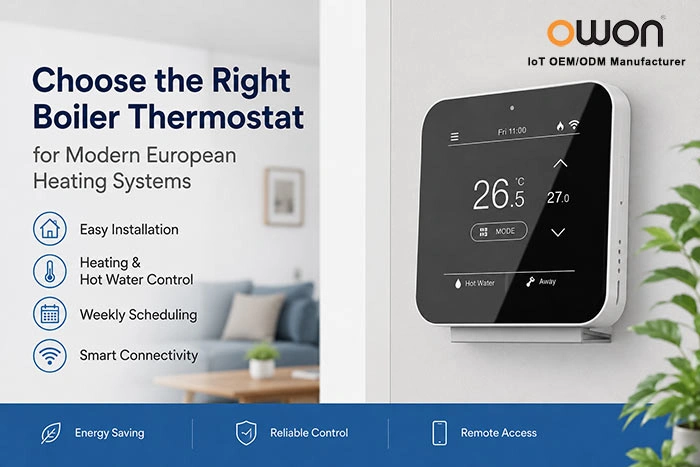
For example, the OWON PCT512 is designed for European boiler heating applications and supports combi boilers, system boilers, and heat-only boiler arrangements. It provides heating and domestic hot water control, weekly scheduling, boost mode, away mode, frost protection, and flexible wired or wireless installation.
As a smart boiler thermostat for European heating systems 🔗, it can also form part of a wider Zigbee solution involving gateways, radiator valves, and other connected devices.
The product should still be evaluated against the exact boiler wiring and project control requirements, but it illustrates how modern thermostats are moving beyond simple room-temperature adjustment toward more integrated heating management.
Conclusion
Choosing the right boiler thermostat requires a clear understanding of the heating system, installation environment, operating requirements, and future expansion plans.
Boiler compatibility should always come first. The next considerations are whether wired or wireless installation is more practical, whether domestic hot water requires independent control, and how the thermostat will connect with other devices or management platforms.
For individual homes, a simple programmable or Wi-Fi thermostat may be sufficient. For apartments, hotels, and connected heating projects, Zigbee can provide better scalability and integration.
The best thermostat is therefore not necessarily the model with the most visible features. It is the one that fits the boiler, simplifies installation, supports the intended control strategy, and remains suitable as the heating system develops.
Frequently Asked Questions
How do I know whether a boiler thermostat is compatible with my boiler?
Check the boiler type, control voltage, relay requirements, wiring terminals, and whether the system requires heating-only or heating-and-hot-water control. For professional installations, the boiler manual and thermostat wiring diagram should be reviewed before procurement.
Is a wireless boiler thermostat better than a wired thermostat?
It depends on the project. Wired thermostats are suitable for new construction where cabling can be planned. Wireless thermostats are often more practical for renovations, occupied properties, and projects where new wiring would increase labour or damage finished walls.
When should I choose a Zigbee boiler thermostat?
Zigbee is particularly suitable when the thermostat needs to integrate with gateways, smart radiator valves, room sensors, occupancy sensors, or a wider building-control platform. It is often more relevant for apartments, hotels, multi-room heating, and scalable smart-building projects.
Can one thermostat control both heating and domestic hot water?
Some models can, but not all. Heating and DHW control usually requires suitable thermostat functions, receiver outputs, and boiler-system compatibility. This should be confirmed before installation, especially in system-boiler applications with separate hot water cylinders.
boiler thermostat Zigbee thermostat smart boiler control wireless thermostat boiler heating control
