Adults and the Art of Being Young, Broke and Slightly Lost


Adults and the Art of Being Young, Broke and Slightly Lost
FX’s Adults follows five twenty-somethings navigating work, sex, friendship and money in New York, turning the pressure to grow up into a clever comedy about modern adulthood.
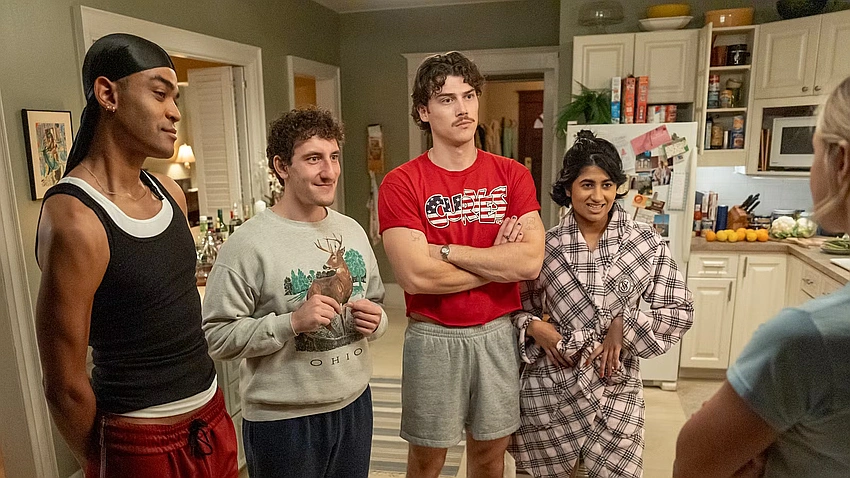
There is something almost comical about the title Adults. FX's 2025 comedy, created by Ben Kronengold and Rebecca Shaw, follows five twenty-somethings living together in New York as they attempt to negotiate work, sex, friendship, money and the vague expectation that they should eventually become functioning adults. The joke is obvious, but the show keeps returning to it from different angles: adulthood is less a destination than an increasingly elaborate performance.
Samir, Billie, Issa, Anton and Paul Baker inhabit the sort of communal domestic space that has become familiar in television, from Friends to Girls. Yet Adults places this familiar arrangement inside a more precarious economic and cultural landscape. Samir lives in his childhood home while his parents are away, Billie works at an unpleasant media company, and the group collectively drifts through the uncertainties of employment, relationships and money. It follows a group of twenty-somethings "trying to be good people", while the second shifts the emphasis towards navigating love, work, friendship and family.
The difference is subtle but important. These characters are not simply trying to have fun before adulthood arrives. They are already technically adults, and that is precisely the problem.

The New York Comedy of Precocity
Much of Adults' humour comes from the contradiction between how self-aware these characters believe themselves to be and how spectacularly incapable they can be of behaving sensibly.
This gives the series a distinctly contemporary comic vocabulary. Its characters are fluent in therapy-speak, political language, internet culture and the rituals of modern friendship, but that fluency does not necessarily make them wiser. Sometimes it makes them more ridiculous. The show understands that a person can know every correct word for a particular social problem and still have absolutely no idea what to do when confronted with one.
That tension places Adults within a longer tradition of coming-of-age fiction. The Bildungsroman traditionally follows a young person moving towards self-knowledge and social maturity. Adults seems almost suspicious of that trajectory. Its characters acquire information without necessarily acquiring wisdom. Their education is emotional, social and painfully repetitive.
This is also where the series becomes more interesting than its more outrageous jokes initially suggest. The vulgarity is often deliberately excessive, but underneath it lies an anxiety that is considerably quieter: what happens when the cultural scripts for adulthood no longer seem particularly convincing?
Friendship as a Survival Mechanism
The strongest idea in Adults is not its satire of Gen Z, but its treatment of friendship.
The five central characters are messy, invasive and occasionally unbearable, but their intimacy is also their principal source of stability. Their house becomes a kind of secular family home, where boundaries are constantly violated but loneliness is rarely allowed to become permanent.
The creators have acknowledged the influence of earlier ensemble comedies including Friends, Girls, Broad City and Living Single. Yet Adults inherits something more complicated from these shows than simply the format of five friends behaving badly together. It inherits the idea that friendship can function as an alternative family structure.
The difference is that this generation seems less certain that such structures will last. Their friendships are simultaneously comforting and claustrophobic. Everyone knows far too much about everyone else. Privacy becomes almost impossible, but so does isolation.
When the Show Tries Too Hard
Adults is not always successful. Its opening episode, in particular, has been criticised for mistaking extremity for wit, with reviewers pointing towards an excess of profanity and deliberately shocking behaviour.

That criticism is fair. There are moments when Adults feels as though it is desperately trying to prove that it understands its own generation. The irony is that the quieter scenes are often more revealing than the loud ones.
The cast eventually gives the series its emotional centre. Malik Elassal, Lucy Freyer, Amita Rao, Owen Thiele and Jack Innanen each give their characters distinct comic identities without breaking the ensemble dynamic.
A Comedy About the Failure to Arrive
What makes Adults worth watching is its refusal to present growing up as a clean narrative.
There is no decisive moment in which these characters suddenly become wiser versions of themselves. Instead, adulthood emerges through small humiliations, bad decisions, unpaid bills, awkward relationships and the gradual discovery that nobody else really knows what they are doing either.
That is perhaps the show's most literary quality. Like much contemporary coming-of-age fiction, Adults is interested less in transformation than in suspension. Its characters exist in the strange interval between dependence and independence, adolescence and maturity, certainty and confusion.
They are adults because the world requires them to be. They are still growing because the world has given them no convincing alternative.
And perhaps that is the joke at the heart of Adults: growing up was never supposed to feel this unfinished.
#AdultsFX #FXOnHulu #TVComedy #TwentySomethingLife #ComedySeries

Login to comment.
No thots yet. Be the first to share your thoughts!